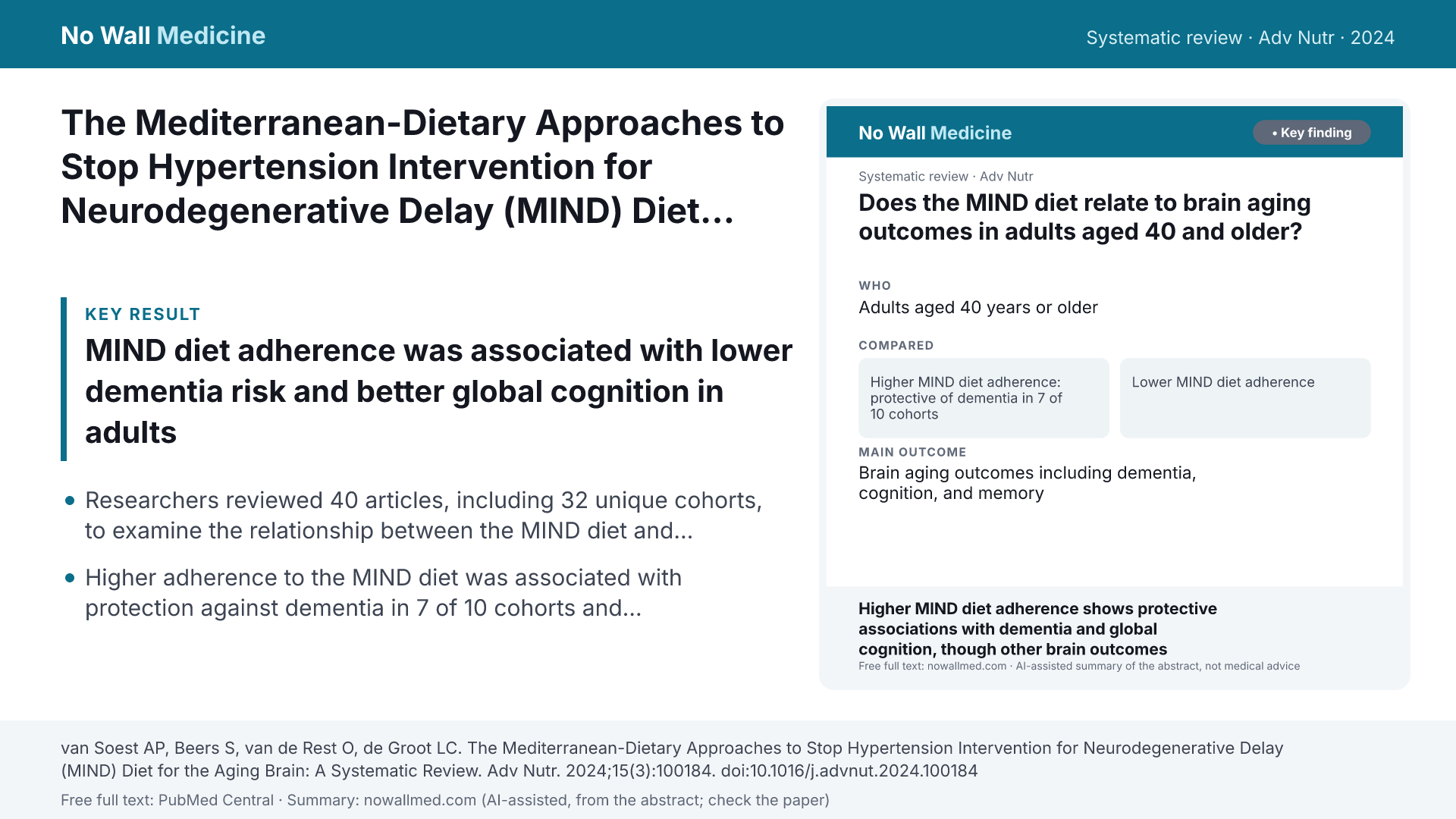
MIND diet adherence was associated with lower dementia risk and better global cognition in adults
The Mediterranean-Dietary Approaches to Stop Hypertension Intervention for Neurodegenerative Delay (MIND) Diet for the Aging Brain: A Systematic Review
Systematic reviewBenefit found
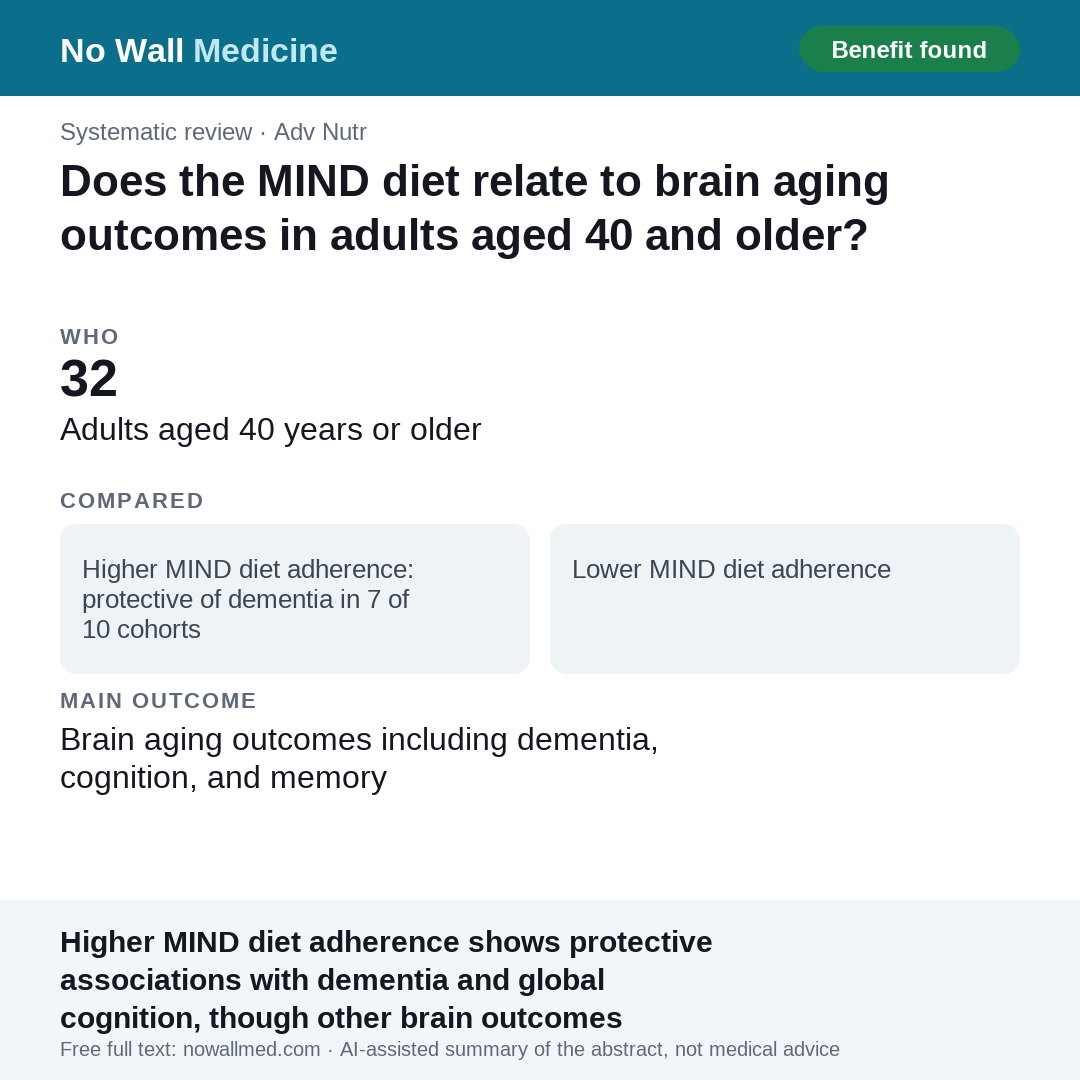
Does the MIND diet relate to brain aging outcomes in adults aged 40 and older?
Who
32
Adults aged 40 years or older
Compared
Higher MIND diet adherence: protective of dementia in 7 of 10 cohorts
Lower MIND diet adherence
Main outcome
Brain aging outcomes including dementia, cognition, and memory
Bottom line: Higher MIND diet adherence shows protective associations with dementia and global cognition, though other brain outcomes remain mixed.
Limitation: Many cohorts were of North American origin, suggesting results may be population-dependent.
Adv Nutr · 2024-02-03Download image
Clinical question: Does the MIND diet relate to brain aging outcomes in adults aged 40 and older?
Why it matters: It was unknown if the MIND diet, a dietary pattern designed to preserve brain function, is associated with various brain aging outcomes beyond dementia and cognition.
Key points
- Researchers reviewed 40 articles, including 32 unique cohorts, to examine the relationship between the MIND diet and brain aging in adults aged 40 years or older.
- Higher adherence to the MIND diet was associated with protection against dementia in 7 of 10 cohorts and positive associations for global cognition in 3 of 4 cohorts.
- The diet was associated with positive results for episodic memory in 4 of 6 cohorts, but associations with cognitive decline were less apparent.
Limitation the authors note: Many cohorts demonstrating protective associations were of North American origin, making it unclear if results apply to other populations.
Headline and key points written with AI from the paper’s abstract, with every number checked against it. Read the paper before relying on them.
Was this summary helpful?
Subject terms
Cite this article
van Soest AP, Beers S, van de Rest O, de Groot LC. The Mediterranean-Dietary Approaches to Stop Hypertension Intervention for Neurodegenerative Delay (MIND) Diet for the Aging Brain: A Systematic Review. Adv Nutr. 2024. doi:10.1016/j.advnut.2024.100184
Spotted a mistake? Suggest a correction