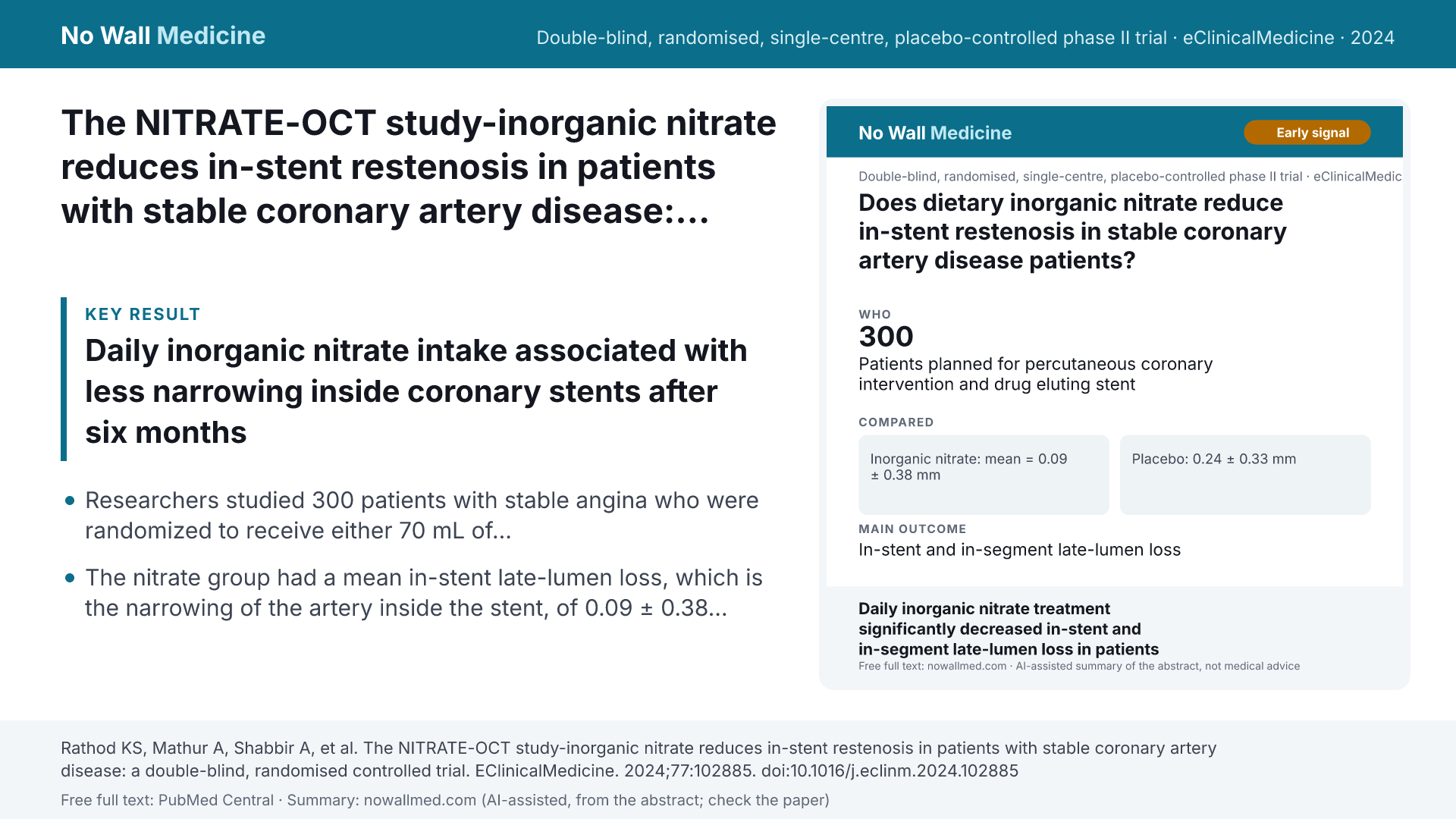
Daily inorganic nitrate intake associated with less narrowing inside coronary stents after six months
The NITRATE-OCT study-inorganic nitrate reduces in-stent restenosis in patients with stable coronary artery disease: a double-blind, randomised controlled trial
Double-blind, randomised, single-centre, placebo-controlled phase II trialBenefit found
Does dietary inorganic nitrate reduce in-stent restenosis in stable coronary artery disease patients?
Who
300
Patients planned for percutaneous coronary intervention and drug eluting stent implantation · Single-centre
Compared
Inorganic nitrate: mean = 0.09 ± 0.38 mm
Placebo: 0.24 ± 0.33 mm
Main outcome
In-stent and in-segment late-lumen loss
Result: in-stent LLL decreased by 0.16 mm (95% CI:0.06-0.25)
Bottom line: Daily inorganic nitrate treatment significantly decreased in-stent and in-segment late-lumen loss in patients undergoing percutaneous coronary intervention.
Funded by: National Institute for Health and Care Research and British Heart Foundation
eClinicalMedicine · 2024-10-18Download image
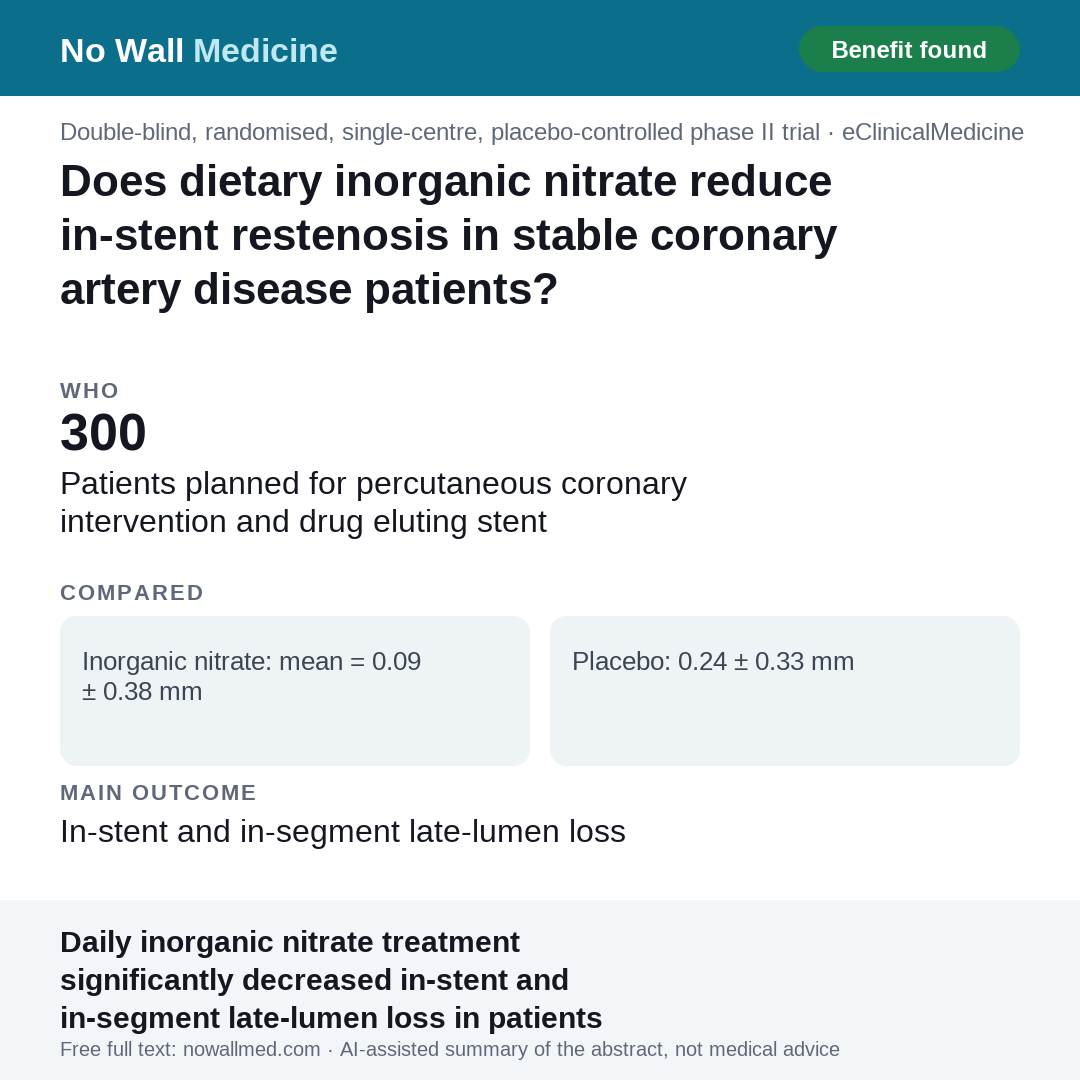
Clinical question: Does dietary inorganic nitrate reduce in-stent restenosis in stable coronary artery disease patients?
Why it matters: There are currently no effective treatments available to prevent in-stent restenosis, which is the re-narrowing of an artery after a stent has been placed.
Key points
- Researchers studied 300 patients with stable angina who were randomized to receive either 70 mL of nitrate-containing beetroot juice or a placebo for 6 months.
- The nitrate group had a mean in-stent late-lumen loss, which is the narrowing of the artery inside the stent, of 0.09 ± 0.38 mm compared to 0.24 ± 0.33 mm in the placebo group.
- In-segment late-lumen loss was 0.02 ± 0.52 mm in the nitrate group versus 0.26 ± 0.37 mm in the placebo group, and systolic blood pressure decreased by -12.06 ± 15.88 mmHg in the nitrate group.
Headline and key points written with AI from the paper’s abstract, with every number checked against it. Read the paper before relying on them.
Was this summary helpful?
Cite this article
Rathod KS, Mathur A, Shabbir A, Khambata RS, Lau C, Beirne AM. The NITRATE-OCT study-inorganic nitrate reduces in-stent restenosis in patients with stable coronary artery disease: a double-blind, randomised controlled trial. eClinicalMedicine. 2024. doi:10.1016/j.eclinm.2024.102885
Spotted a mistake? Suggest a correction
Top studies every Monday
The week’s key trials and guidelines in your specialties, plus any topics you follow. By email, free.
Get the weekly digest