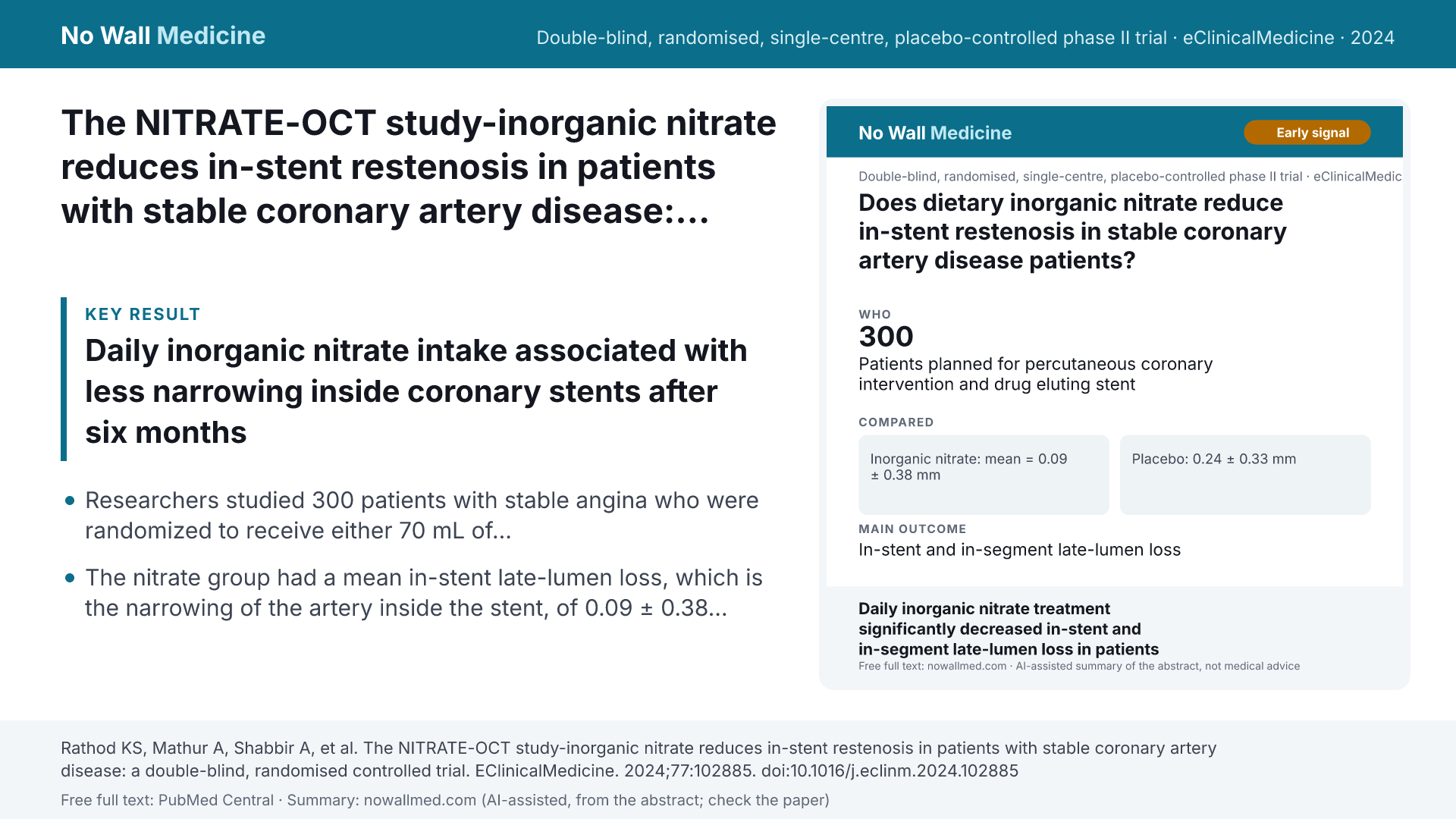
The NITRATE-OCT study-inorganic nitrate reduces in-stent restenosis in patients with stable coronary artery disease: a double-blind, randomised controlled trial
Key result: Daily inorganic nitrate intake associated with less narrowing inside coronary stents after six months
Key points
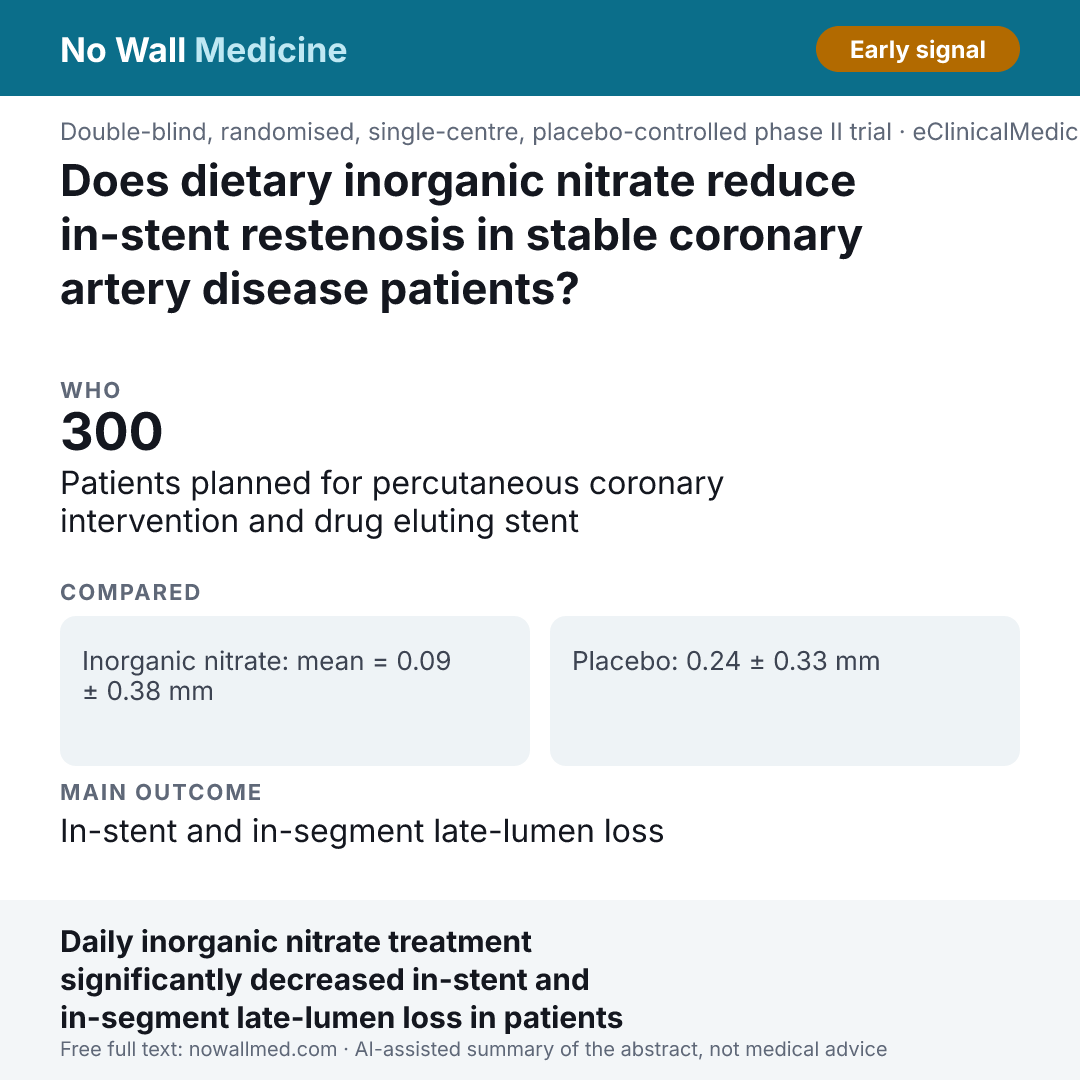
- Researchers studied 300 patients with stable angina who were randomized to receive either 70 mL of nitrate-containing beetroot juice or a placebo for 6 months.
- The nitrate group had a mean in-stent late-lumen loss, which is the narrowing of the artery inside the stent, of 0.09 ± 0.38 mm compared to 0.24 ± 0.33 mm in the placebo group.
- In-segment late-lumen loss was 0.02 ± 0.52 mm in the nitrate group versus 0.26 ± 0.37 mm in the placebo group, and systolic blood pressure decreased by -12.06 ± 15.88 mmHg in the nitrate group.
Why it matters: There are currently no effective treatments available to prevent in-stent restenosis, which is the re-narrowing of an artery after a stent has been placed.
Discussion prompts
- Would these patients look like yours? Who was left out?
- Is the main outcome one that matters to patients?
- Is the difference large enough to change what you do?
Cite: Rathod KS, Mathur A, Shabbir A, et al. The NITRATE-OCT study-inorganic nitrate reduces in-stent restenosis in patients with stable coronary artery disease: a double-blind, randomised controlled trial. EClinicalMedicine. 2024;77:102885. doi:10.1016/j.eclinm.2024.102885
Free full text: PubMed Central · Summary and visual abstract: nowallmed.com/a/the-nitrate-oct-study-inorganic-nitrate-reduces-in-stent-restenosis-9yj48b/ (AI-assisted from the abstract; check the paper before relying on it).