Trial protocol outlines study comparing partial prostate ablation to radical treatment for intermediate-risk prostate cancer
The PART randomised trial protocol: Partial Ablation versus Radical Treatment for prostate cancer
Multicentre, pragmatic, randomised controlled trial protocolUnclear result
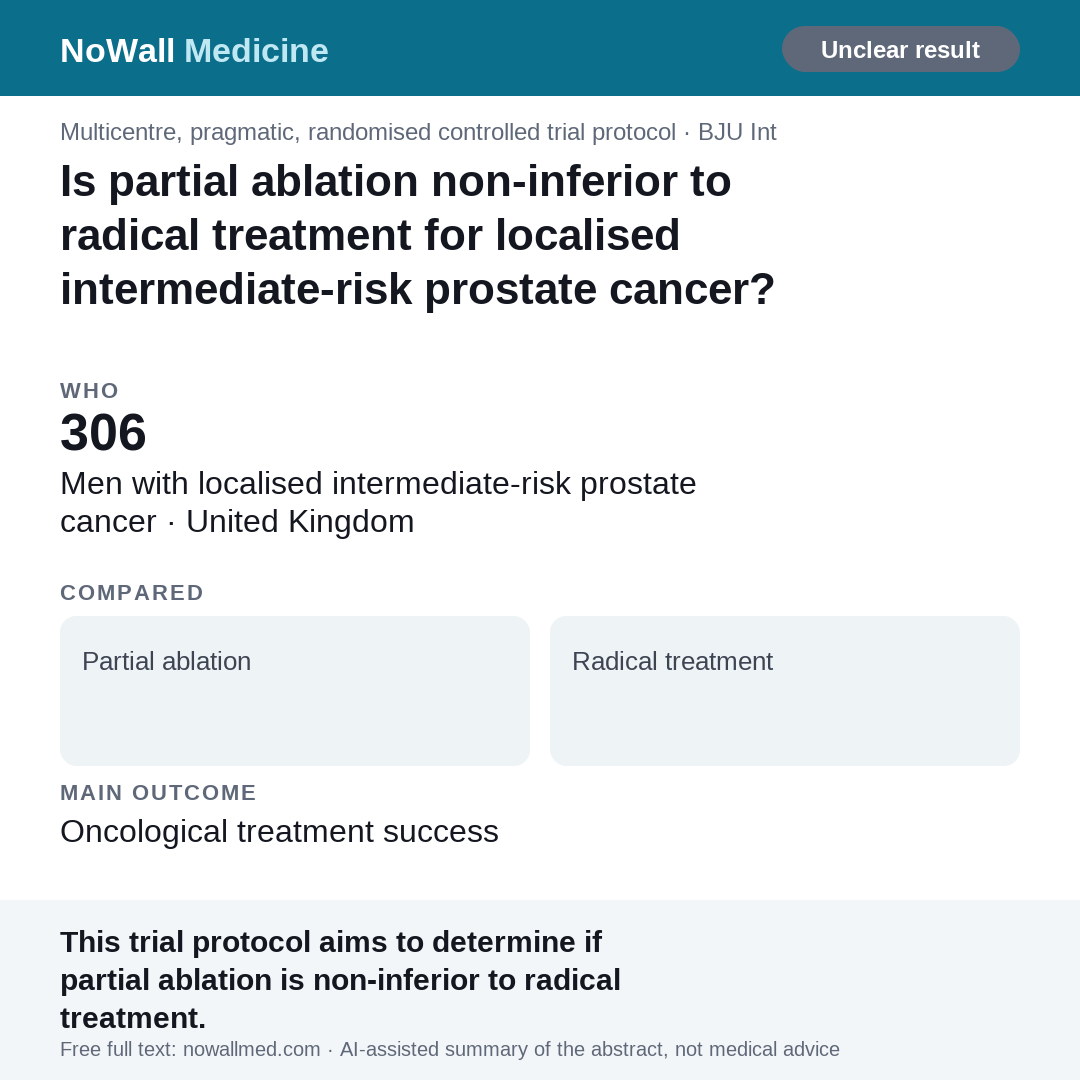
Is partial ablation non-inferior to radical treatment for localised intermediate-risk prostate cancer?
Who
306
Men with localised intermediate-risk prostate cancer · United Kingdom
Compared
Partial ablation
Radical treatment
Main outcome
Oncological treatment success
Bottom line: This trial protocol aims to determine if partial ablation is non-inferior to radical treatment.
BJU Int · 2026-09-18Download image
Clinical question: Is partial ablation non-inferior to radical treatment for localised intermediate-risk prostate cancer?
Why it matters: Doctors need high-level randomized evidence to determine if partial prostate ablation is as effective as radical treatment for localized intermediate-risk prostate cancer.
Key points
- The PART trial will compare partial prostate ablation, using high-intensity focused ultrasound or irreversible electroporation, against radical treatment in 306 men with intermediate-risk prostate cancer.
- Researchers aim to determine if partial ablation is non-inferior to radical prostatectomy, radical radiotherapy, or low-dose-rate brachytherapy regarding oncological treatment success at 3 years.
- The study will also measure side effects like urinary and sexual dysfunction, health-related quality of life, and cost-effectiveness.
Headline and key points written with AI from the paper’s abstract, with every number checked against it. Read the paper before relying on them.
Topics
Spotted a mistake? Suggest a correction
More in Urology
Checkpoint inhibitor regimens benefit renal cell carcinoma patients with poor prognosis most
Which Patients with Advanced Clear Cell Renal Cell Carcinoma Benefit Most from First-line Checkpoint Inhibitor Combination Regimens: A Meta-analysis of Individual Patient Data and Aggregate Data from Randomised Trials
Male factor infertility is influenced by genetics, environment, and lifestyle choices
Key Determinants and Clinical Impact of Male Factor Infertility: From Etiology to Treatment
Nectin-4-targeted PET/CT compared to FDG PET/CT for urothelial carcinoma staging
Diagnostic Performance of Nectin-4-targeted [68Ga]Ga-DOTA-N188 PET/CT versus [18F]-FDG PET/CT for Staging of Locally Advanced and Metastatic Urothelial Carcinoma: A Prospective, Single-center, Phase 2 Feasibility Trial
Robotic surgery worked as well as open surgery for Wilms tumor in selected cases
Exploring the Limits of Robotic Surgery for Wilms Tumor: A Descriptive Analysis