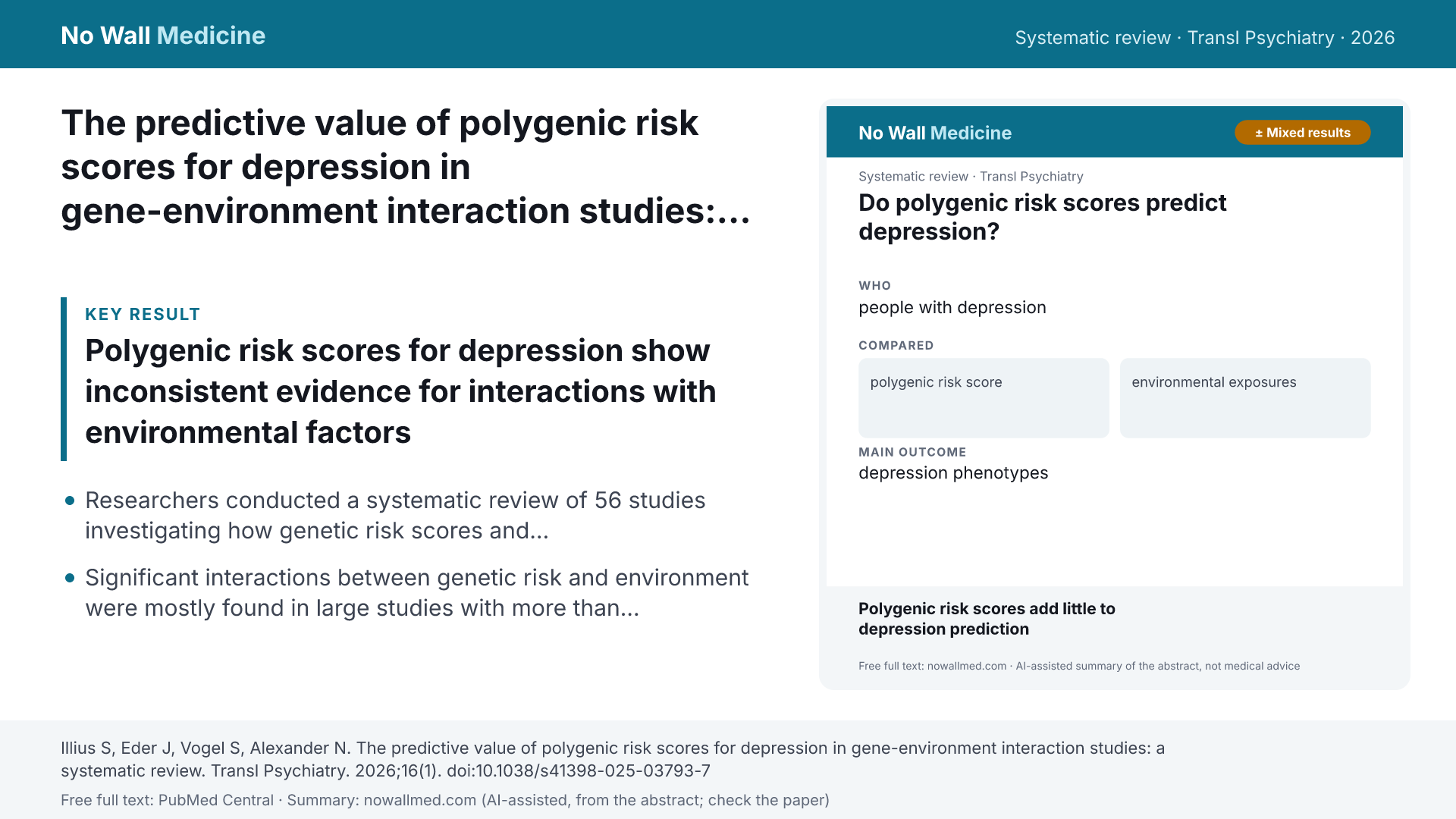
The predictive value of polygenic risk scores for depression in gene-environment interaction studies: a systematic review
Key result: Polygenic risk scores for depression show inconsistent evidence for interactions with environmental factors
Systematic reviewMixed results
Do polygenic risk scores predict depression?
Who
people with depression
Compared
polygenic risk score
environmental exposures
Main outcome
depression phenotypes
Bottom line: Polygenic risk scores add little to depression prediction
Limitation: require large samples
Transl Psychiatry · 2026-02-25
Key points
- Researchers conducted a systematic review of 56 studies investigating how genetic risk scores and environmental exposures like trauma or lifestyle interact to affect depression.
- Significant interactions between genetic risk and environment were mostly found in large studies with more than 40000 participants, particularly regarding recent environmental exposures.
- Genetic risk scores appeared to add only a small amount of explained variance to depression models and often correlated with how individuals experience environmental exposures.
Discussion prompts
- Would these patients look like yours? Who was left out?
- Is the main outcome one that matters to patients?
- Is the difference large enough to change what you do?
Cite: Illius S, Eder J, Vogel S, Alexander N. The predictive value of polygenic risk scores for depression in gene-environment interaction studies: a systematic review. Transl Psychiatry. 2026;16(1). doi:10.1038/s41398-025-03793-7
Free full text: PubMed Central · Summary and visual abstract: nowallmed.com/a/the-predictive-value-of-polygenic-risk-scores-for-depression-in-gene-7dge48/ (AI-assisted from the abstract; check the paper before relying on it).