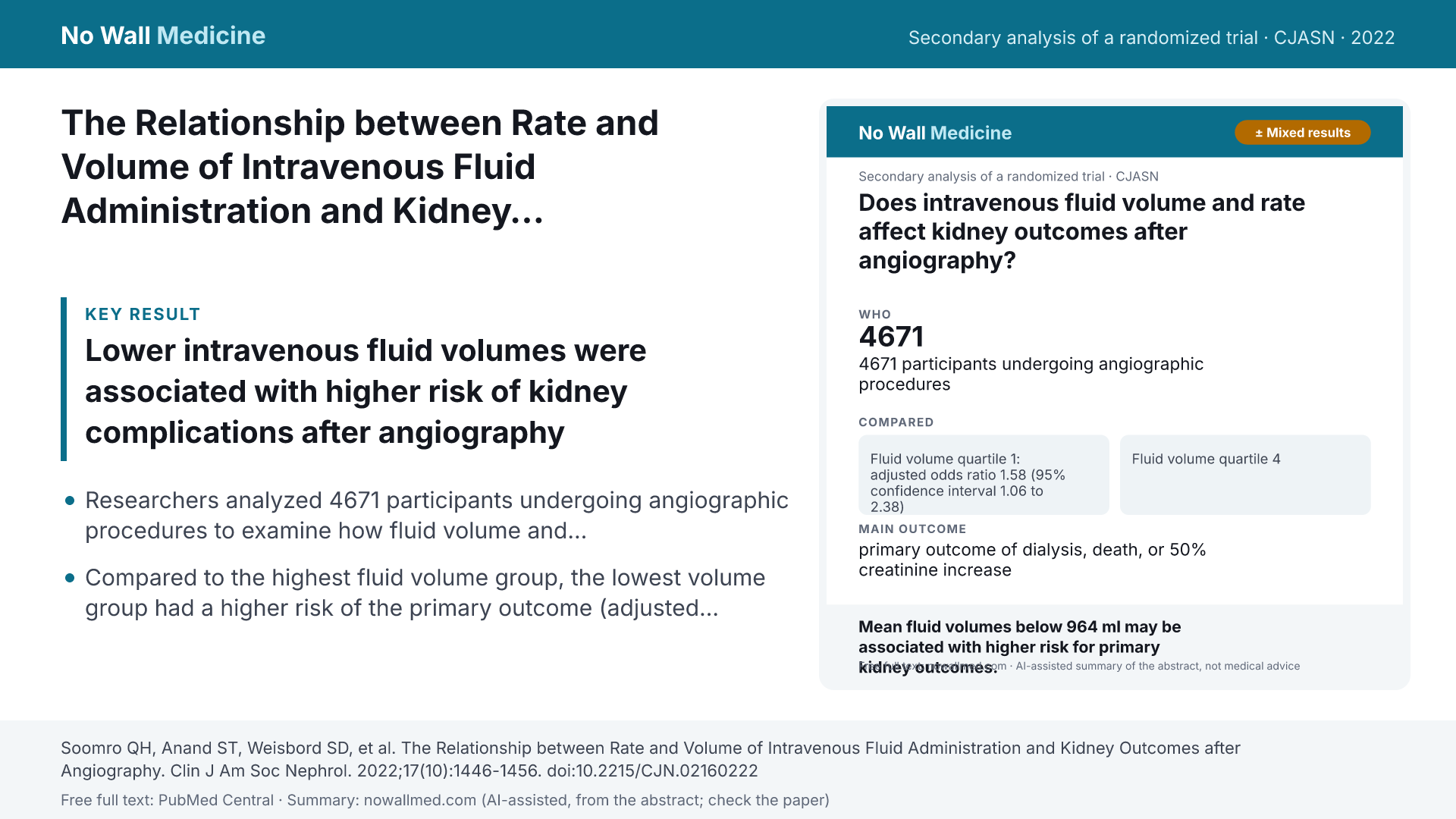
Lower intravenous fluid volumes were associated with higher risk of kidney complications after angiography
The Relationship between Rate and Volume of Intravenous Fluid Administration and Kidney Outcomes after Angiography
Secondary analysis of a randomized trialMixed results
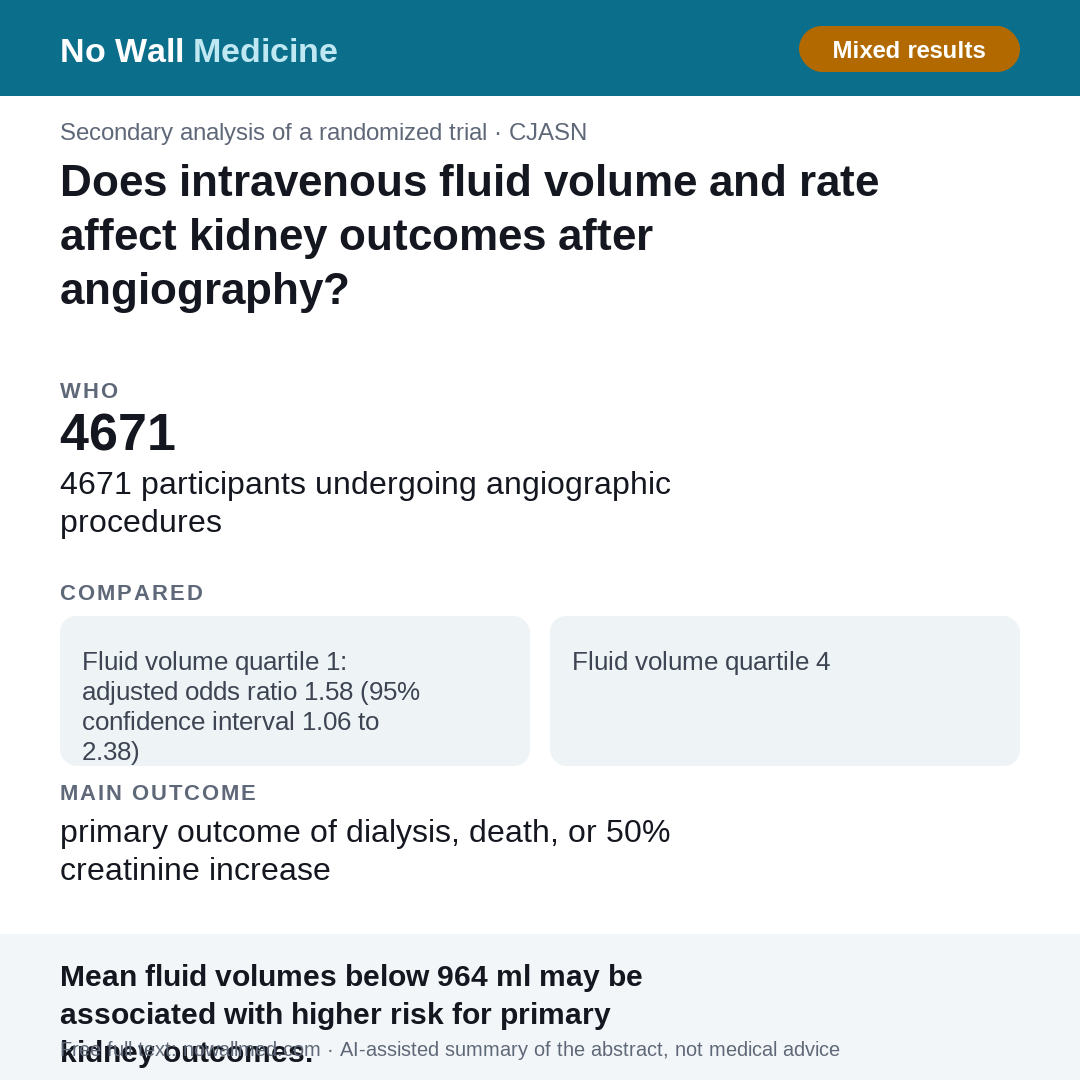
Does intravenous fluid volume and rate affect kidney outcomes after angiography?
Who
4671
4671 participants undergoing angiographic procedures
Compared
Fluid volume quartile 1: adjusted odds ratio 1.58 (95% confidence interval 1.06 to 2.38)
Fluid volume quartile 4
Main outcome
primary outcome of dialysis, death, or 50% creatinine increase
Result: adjusted odds ratio 1.58 (95% confidence interval 1.06 to 2.38)
Bottom line: Mean fluid volumes below 964 ml may be associated with higher risk for primary kidney outcomes.
Limitation: residual confounding cannot be excluded
CJASN · 2022-08-25Download image
Clinical question: Does intravenous fluid volume and rate affect kidney outcomes after angiography?
Key points
- Researchers analyzed 4671 participants undergoing angiographic procedures to examine how fluid volume and administration duration related to kidney injury.
- Compared to the highest fluid volume group, the lowest volume group had a higher risk of the primary outcome (adjusted odds ratio, 1.58; 95% confidence interval, 1.06 to 2.38).
- There was no difference in the incidence of contrast-associated acute kidney injury, which is defined as a 25% or 0.5 mg/dl increase in serum creatinine, across the fluid volume quartiles.
Limitation the authors note: Residual confounding cannot be excluded.
Headline and key points written with AI from the paper’s abstract, with every number checked against it. Read the paper before relying on them.
Was this summary helpful?
Subject terms
Headline, design, result, key points, caveat and citation as plain text.
Cite this article
Soomro QH, Anand ST, Weisbord SD, et al. The Relationship between Rate and Volume of Intravenous Fluid Administration and Kidney Outcomes after Angiography. CJASN. 2022. doi:10.2215/CJN.02160222
Spotted a mistake? Suggest a correction