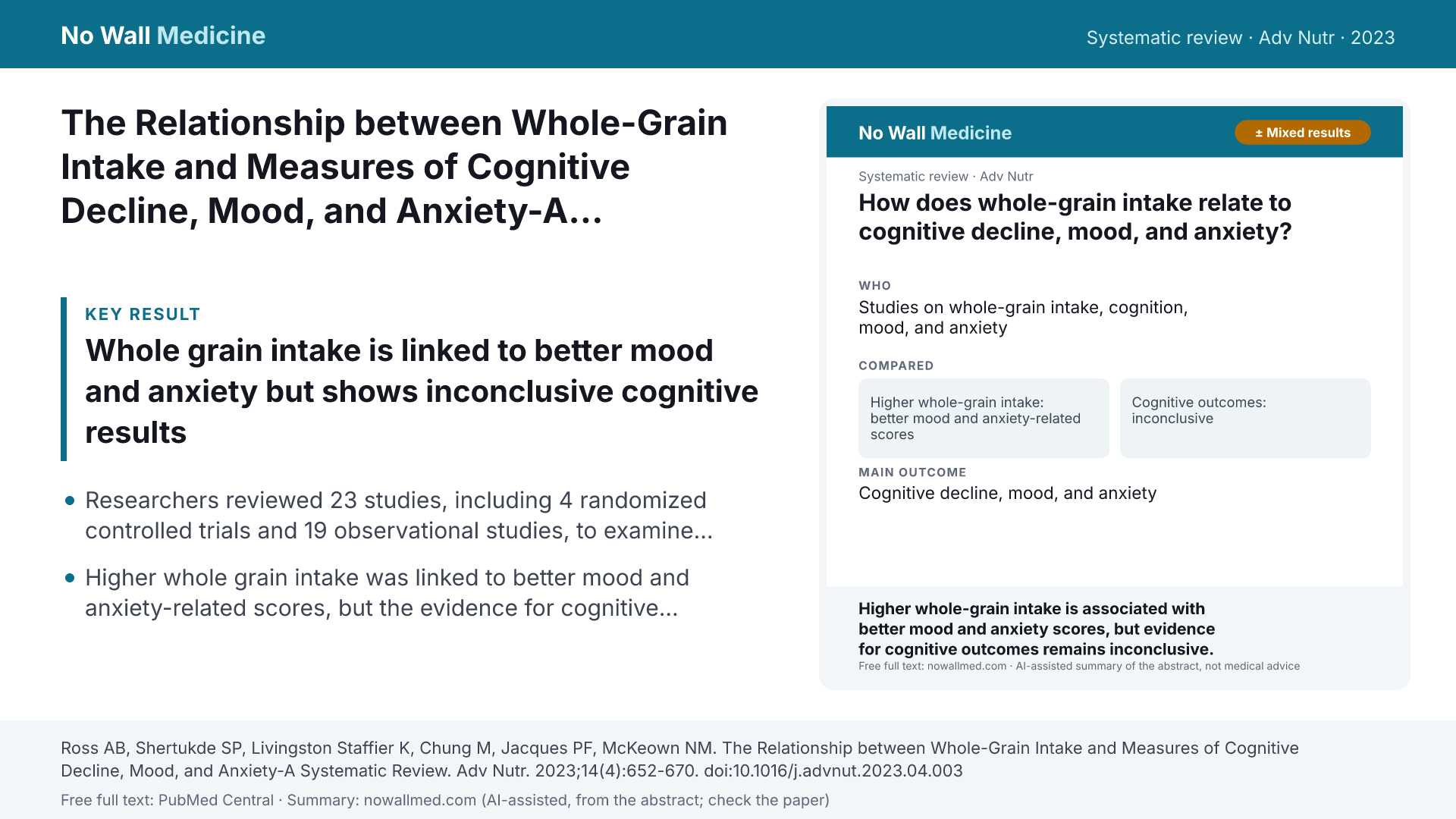
Whole grain intake is linked to better mood and anxiety but shows inconclusive cognitive results
The Relationship between Whole-Grain Intake and Measures of Cognitive Decline, Mood, and Anxiety-A Systematic Review
Systematic reviewMixed results
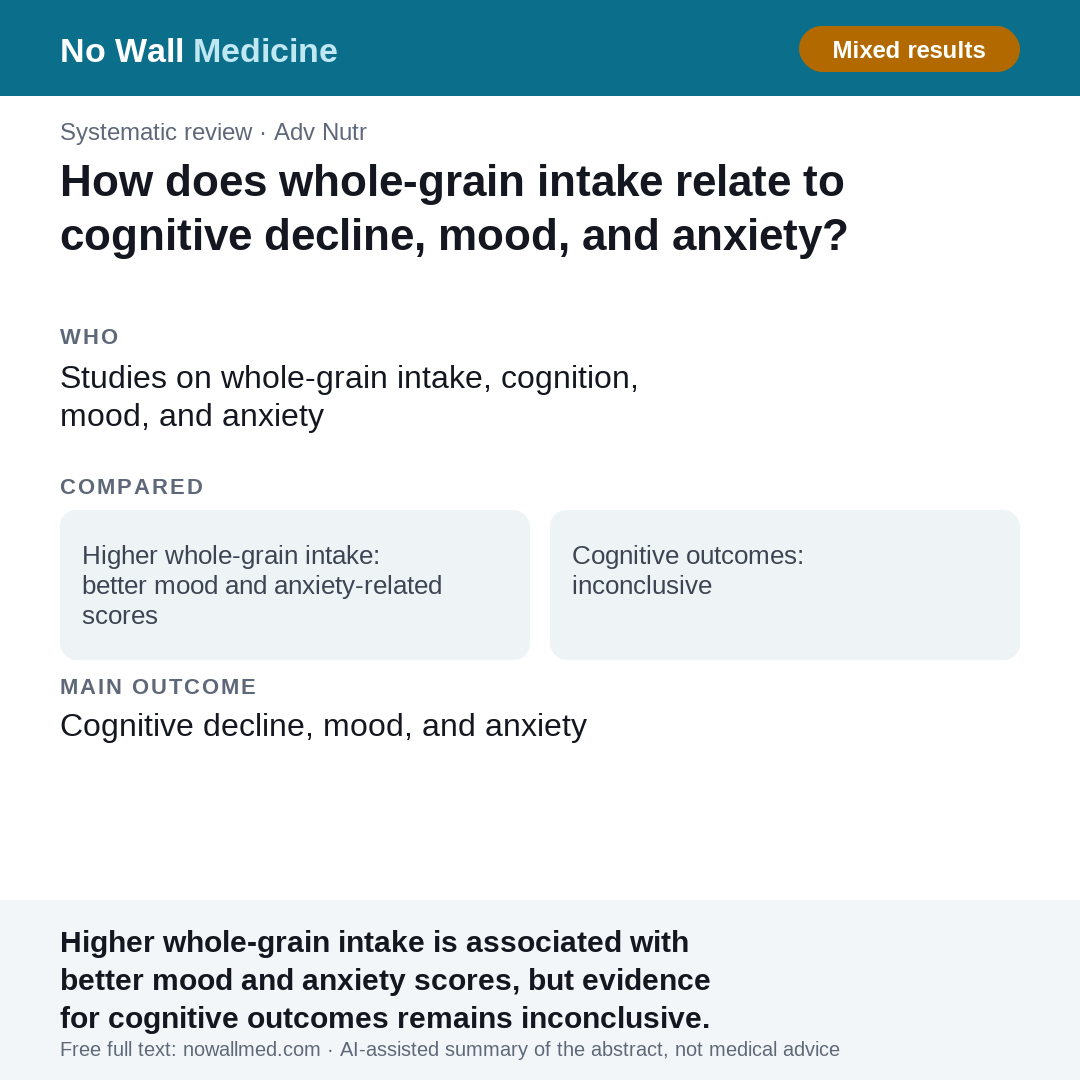
How does whole-grain intake relate to cognitive decline, mood, and anxiety?
Who
Studies on whole-grain intake, cognition, mood, and anxiety
Compared
Higher whole-grain intake: better mood and anxiety-related scores
Cognitive outcomes: inconclusive
Main outcome
Cognitive decline, mood, and anxiety
Bottom line: Higher whole-grain intake is associated with better mood and anxiety scores, but evidence for cognitive outcomes remains inconclusive.
Limitation: Low or very low strength of evidence and high risk of bias in reporting.
Adv Nutr · 2023-04-19Download image
Clinical question: How does whole-grain intake relate to cognitive decline, mood, and anxiety?
Key points
- Researchers reviewed 23 studies, including 4 randomized controlled trials and 19 observational studies, to examine the link between whole grains and mental health.
- Higher whole grain intake was linked to better mood and anxiety-related scores, but the evidence for cognitive decline was inconclusive.
- The strength of available evidence was low or very low for all outcomes studied in this review.
Limitation the authors note: The authors noted a high risk of bias toward studies reporting results and a lack of well-designed randomized controlled trials.
Headline and key points written with AI from the paper’s abstract, with every number checked against it. Read the paper before relying on them.
Was this summary helpful?
Subject terms
Headline, design, result, key points, caveat and citation as plain text.
Cite this article
Ross AB, Shertukde SP, Livingston Staffier K, Chung M, Jacques PF, McKeown NM. The Relationship between Whole-Grain Intake and Measures of Cognitive Decline, Mood, and Anxiety-A Systematic Review. Adv Nutr. 2023. doi:10.1016/j.advnut.2023.04.003
Spotted a mistake? Suggest a correction