The Relationship between Whole-Grain Intake and Measures of Cognitive Decline, Mood, and Anxiety-A Systematic Review
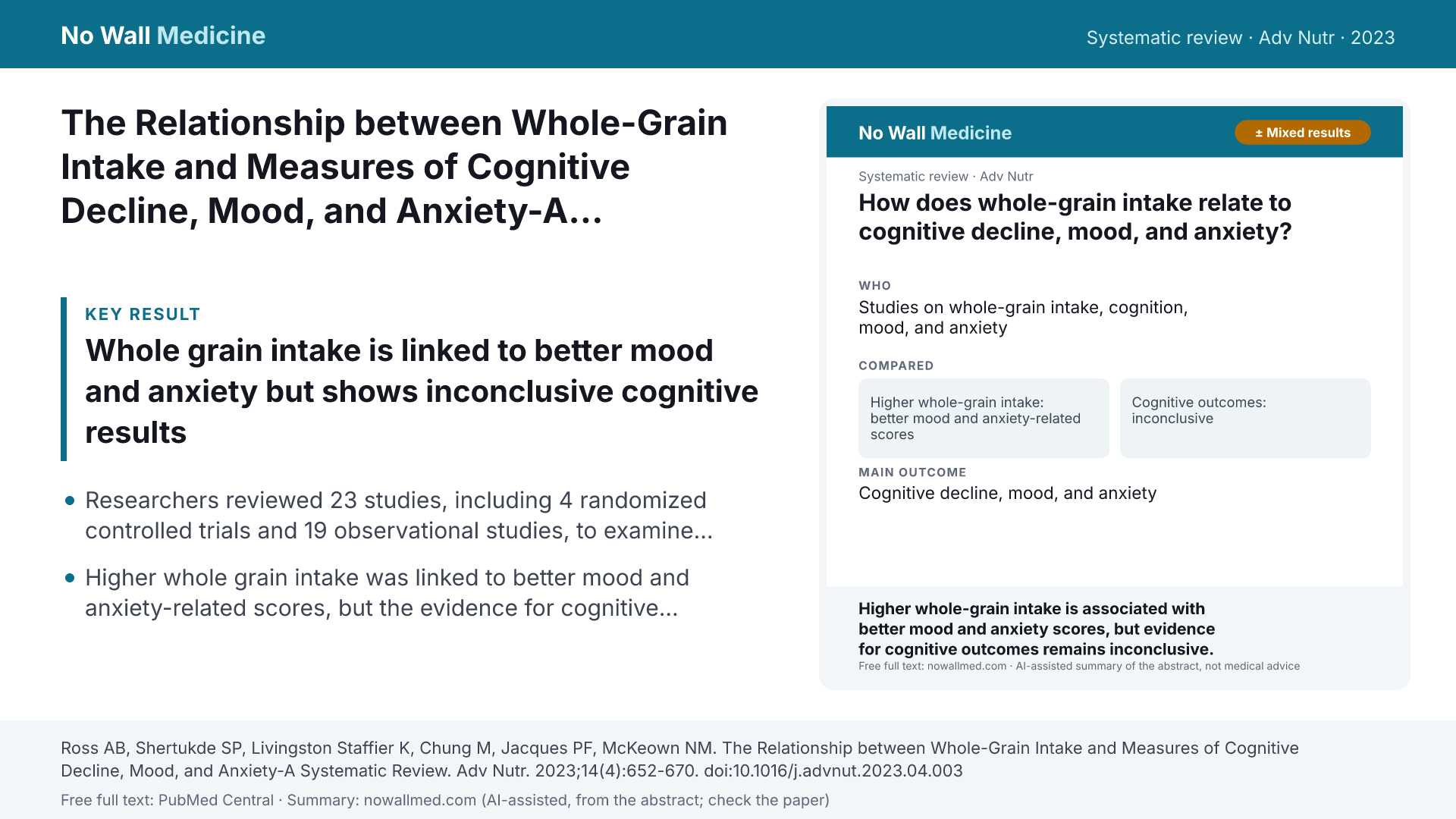
Key result: Whole grain intake is linked to better mood and anxiety but shows inconclusive cognitive results
Key points
- Researchers reviewed 23 studies, including 4 randomized controlled trials and 19 observational studies, to examine the link between whole grains and mental health.
- Higher whole grain intake was linked to better mood and anxiety-related scores, but the evidence for cognitive decline was inconclusive.
- The strength of available evidence was low or very low for all outcomes studied in this review.
Limitation the authors note: The authors noted a high risk of bias toward studies reporting results and a lack of well-designed randomized controlled trials.
Discussion prompts
- Would these patients look like yours? Who was left out?
- Is the main outcome one that matters to patients?
- Is the difference large enough to change what you do?
Cite: Ross AB, Shertukde SP, Livingston Staffier K, Chung M, Jacques PF, McKeown NM. The Relationship between Whole-Grain Intake and Measures of Cognitive Decline, Mood, and Anxiety-A Systematic Review. Adv Nutr. 2023;14(4):652-670. doi:10.1016/j.advnut.2023.04.003
Free full text: PubMed Central · Summary and visual abstract: nowallmed.com/a/the-relationship-between-whole-grain-intake-and-measures-of-cognitive-1b7kuih/ (AI-assisted from the abstract; check the paper before relying on it).