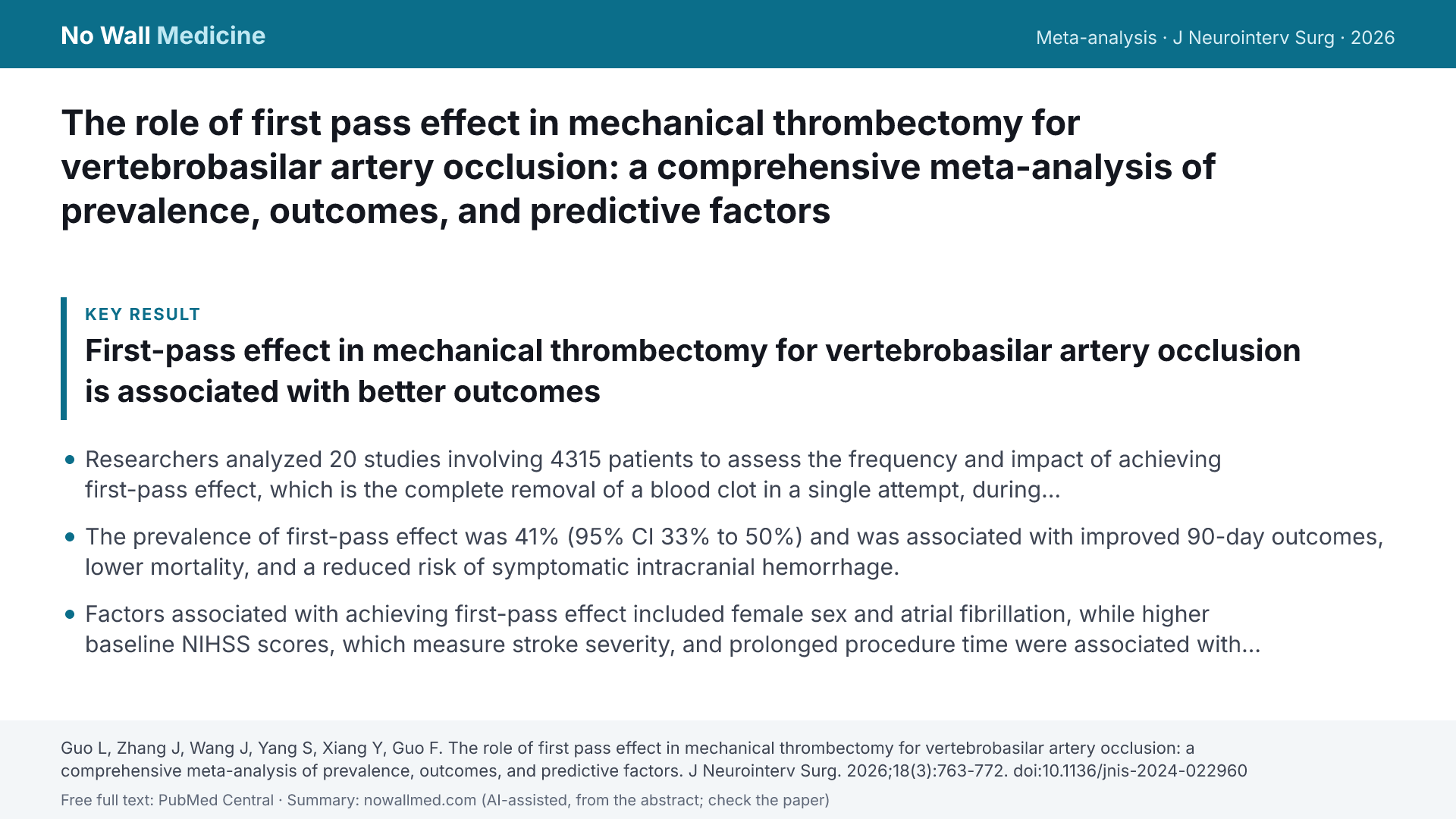
First-pass effect in mechanical thrombectomy for vertebrobasilar artery occlusion is associated with better outcomes
The role of first pass effect in mechanical thrombectomy for vertebrobasilar artery occlusion: a comprehensive meta-analysis of prevalence, outcomes, and predictive factors
Why it matters: The frequency and predictors of achieving first-pass effect during mechanical thrombectomy for vertebrobasilar artery occlusion remain unclear.
Key points
- Researchers analyzed 20 studies involving 4315 patients to assess the frequency and impact of achieving first-pass effect, which is the complete removal of a blood clot in a single attempt, during mechanical thrombectomy.
- The prevalence of first-pass effect was 41% (95% CI 33% to 50%) and was associated with improved 90-day outcomes, lower mortality, and a reduced risk of symptomatic intracranial hemorrhage.
- Factors associated with achieving first-pass effect included female sex and atrial fibrillation, while higher baseline NIHSS scores, which measure stroke severity, and prolonged procedure time were associated with lower likelihoods.
Headline and key points written with AI from the paper’s abstract, with every number checked against it. Read the paper before relying on them.
Was this summary helpful?
Abstract
Background
First-pass effect (FPE) is crucial for better outcomes in mechanical thrombectomy (MT) for acute large vessel occlusions. However, its frequency and predictors in vertebrobasilar artery occlusion (VBAO) remain unclear. Objective
To conduct a comprehensive systematic review and meta-analysis to assess the incidence of FPE in MT for VBAO and its impact on key clinical outcomes. Additionally, to explore potential predictors of achieving FPE, addressing critical knowledge gaps and providing evidence to optimize treatment strategies for patients with VBAO. Methods
A systematic literature search was performed in PubMed, EMBASE, Web of Science, and the Cochrane Library up to November 1, 2024. Studies evaluating FPE in patients with acute VBAO undergoing MT were included. The prevalence of FPE was estimated using a meta-analysis of proportions, and associations with clinical outcomes and predictive factors were assessed using pooled ORs with random-effects models. Results
Twenty studies involving 4315 patients met inclusion criteria. The overall prevalence of FPE in patients with VBAO was 41% (95% CI 33% to 50%). FPE was significantly associated with improved 90-day outcomes (modified Rankin Scale (mRS) score 0-2: OR=2.00, 95% CI 1.45 to 2.75; mRS score 0-3: OR=2.33, 95% CI 1.78 to 3.04), reduced risk of symptomatic intracranial hemorrhage (OR=0.49, 95% CI 0.27 to 0.87), and lower mortality (OR=0.43, 95% CI 0.32 to 0.57). The results showed that significant positive predictors of FPE included female sex, atrial fibrillation, cardioembolic or unknown stroke etiology, mid- or distal basilar artery occlusion, contact aspiration techniques, and the use of larger catheters. Conversely, negative predictors were identified as a history of hypertension, hyperlipidemia, prior stroke or transient ischemic attack, higher baseline NIHSS scores, prolonged procedure time, and the use of general anesthesia. Conclusion
Achieving FPE in acute VBAO is strongly associated with improved clinical outcomes. Important clinical, procedural, and anatomical factors related to FPE were identified, aiding clinical decisions and thrombectomy techniques.
Abstract reproduced under the article’s CC BY NC licence.
Subject terms
Cite this article
Guo L, Zhang J, Wang J, Yang S, Xiang Y, Guo F. The role of first pass effect in mechanical thrombectomy for vertebrobasilar artery occlusion: a comprehensive meta-analysis of prevalence, outcomes, and predictive factors. J Neurointerv Surg. 2026. doi:10.1136/jnis-2024-022960
Spotted a mistake? Suggest a correction
Top studies every Monday
The week’s key trials and guidelines in your specialties, plus any topics you follow. By email, free.
Get the weekly digest