The role of first pass effect in mechanical thrombectomy for vertebrobasilar artery occlusion: a comprehensive meta-analysis of prevalence, outcomes, and predictive factors
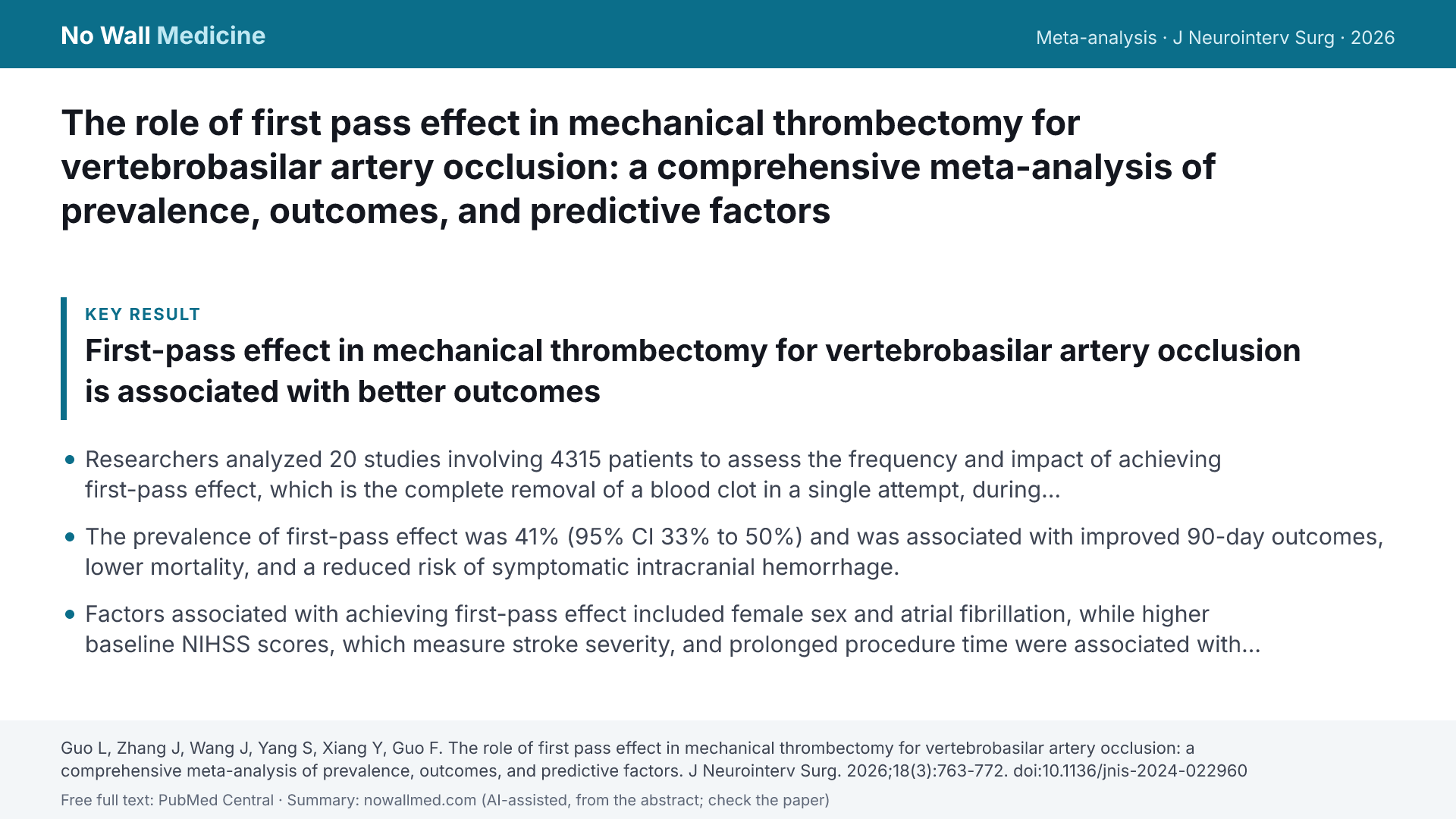
Key result: First-pass effect in mechanical thrombectomy for vertebrobasilar artery occlusion is associated with better outcomes
Key points
- Researchers analyzed 20 studies involving 4315 patients to assess the frequency and impact of achieving first-pass effect, which is the complete removal of a blood clot in a single attempt, during mechanical thrombectomy.
- The prevalence of first-pass effect was 41% (95% CI 33% to 50%) and was associated with improved 90-day outcomes, lower mortality, and a reduced risk of symptomatic intracranial hemorrhage.
- Factors associated with achieving first-pass effect included female sex and atrial fibrillation, while higher baseline NIHSS scores, which measure stroke severity, and prolonged procedure time were associated with lower likelihoods.
Discussion prompts
- Would these patients look like yours? Who was left out?
- Is the main outcome one that matters to patients?
- Is the difference large enough to change what you do?
Cite: Guo L, Zhang J, Wang J, Yang S, Xiang Y, Guo F. The role of first pass effect in mechanical thrombectomy for vertebrobasilar artery occlusion: a comprehensive meta-analysis of prevalence, outcomes, and predictive factors. J Neurointerv Surg. 2026;18(3):763-772. doi:10.1136/jnis-2024-022960
Free full text: PubMed Central · Summary and visual abstract: nowallmed.com/a/the-role-of-first-pass-effect-in-mechanical-thrombectomy-for-17h6dsh/ (AI-assisted from the abstract; check the paper before relying on it).