Robotic surgery for testicular cancer linked to shorter hospital stays and fewer complications
The role of robotic retroperitoneal lymph node dissection in testicular cancer: a systematic review and meta-analysis
Systematic review and cumulative meta-analysisBenefit found
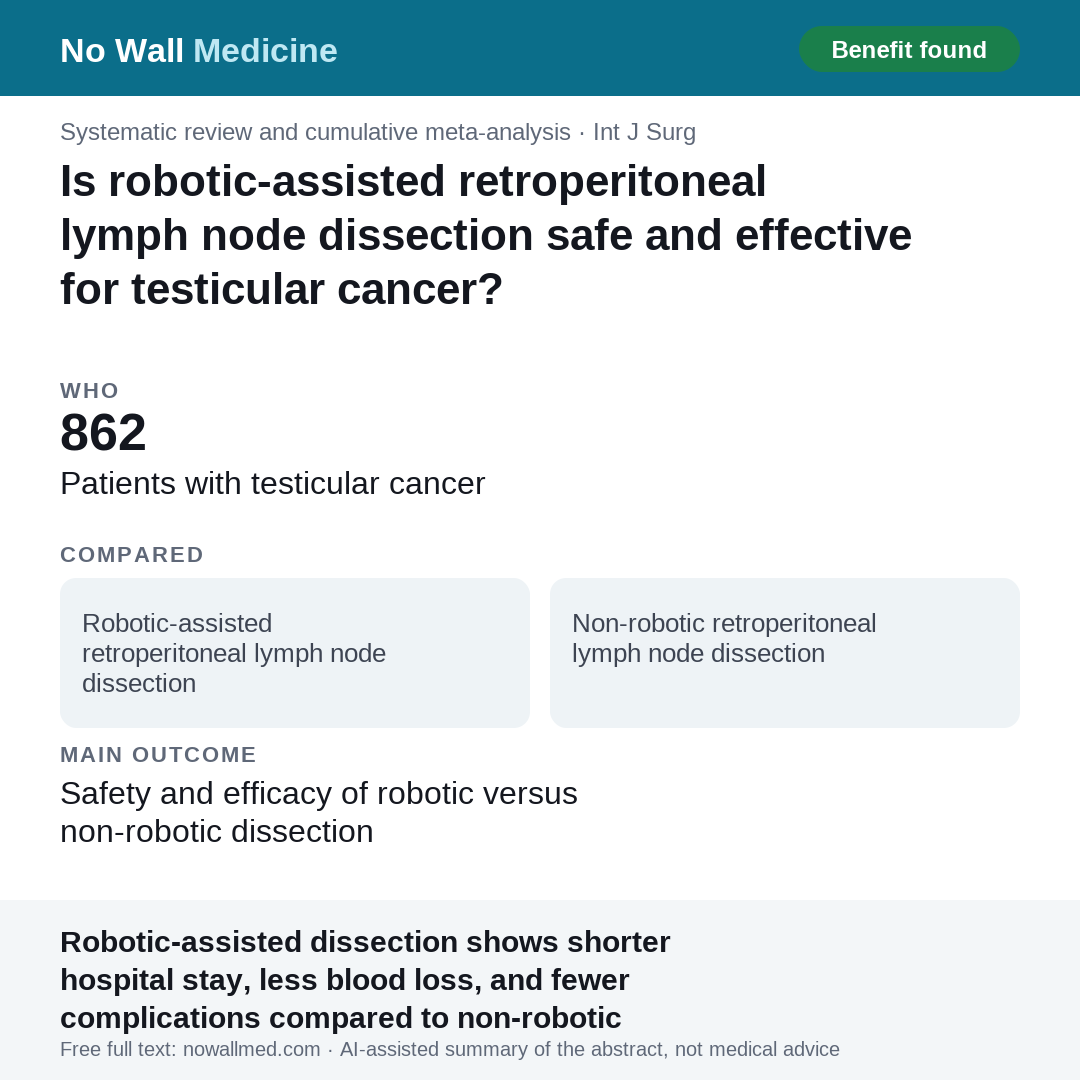
Is robotic-assisted retroperitoneal lymph node dissection safe and effective for testicular cancer?
Who
862
Patients with testicular cancer
Compared
Robotic-assisted retroperitoneal lymph node dissection
Non-robotic retroperitoneal lymph node dissection
Main outcome
Safety and efficacy of robotic versus non-robotic dissection
Result: odds ratio=0.45 (95% CI 0.28, 0.73) for overall complications
Bottom line: Robotic-assisted dissection shows shorter hospital stay, less blood loss, and fewer complications compared to non-robotic methods.
Limitation: Longer follow-up and more studies are needed to confirm findings.
Int J Surg · 2023-09-01Download image
Clinical question: Is robotic-assisted retroperitoneal lymph node dissection safe and effective for testicular cancer?
Why it matters: It is unknown whether robotic-assisted surgery is as safe and effective as traditional open or laparoscopic methods for removing lymph nodes in testicular cancer.
Key points
- Researchers analyzed seven studies involving 862 patients to compare robotic-assisted retroperitoneal lymph node dissection with non-robotic methods.
- Robotic surgery was associated with a shorter hospital stay by -1.21 days, less blood loss by -0.69, and lower overall complications with an odds ratio of 0.45.
- Robotic methods showed a higher lymph node yield by 5.73 compared to laparoscopic surgery, but operation time and cancer recurrence rates were similar.
Headline and key points written with AI from the paper’s abstract, with every number checked against it. Read the paper before relying on them.
Was this summary helpful?
Subject terms
Cite this article
Ge S, Zeng Z, Li Y, Gan L, Meng C, Li K. The role of robotic retroperitoneal lymph node dissection in testicular cancer: a systematic review and meta-analysis. Int J Surg. 2023. doi:10.1097/JS9.0000000000000520
Spotted a mistake? Suggest a correction
Top studies every Monday
The week’s key trials and guidelines in your specialties, plus any topics you follow. By email, free.
Get the weekly digest