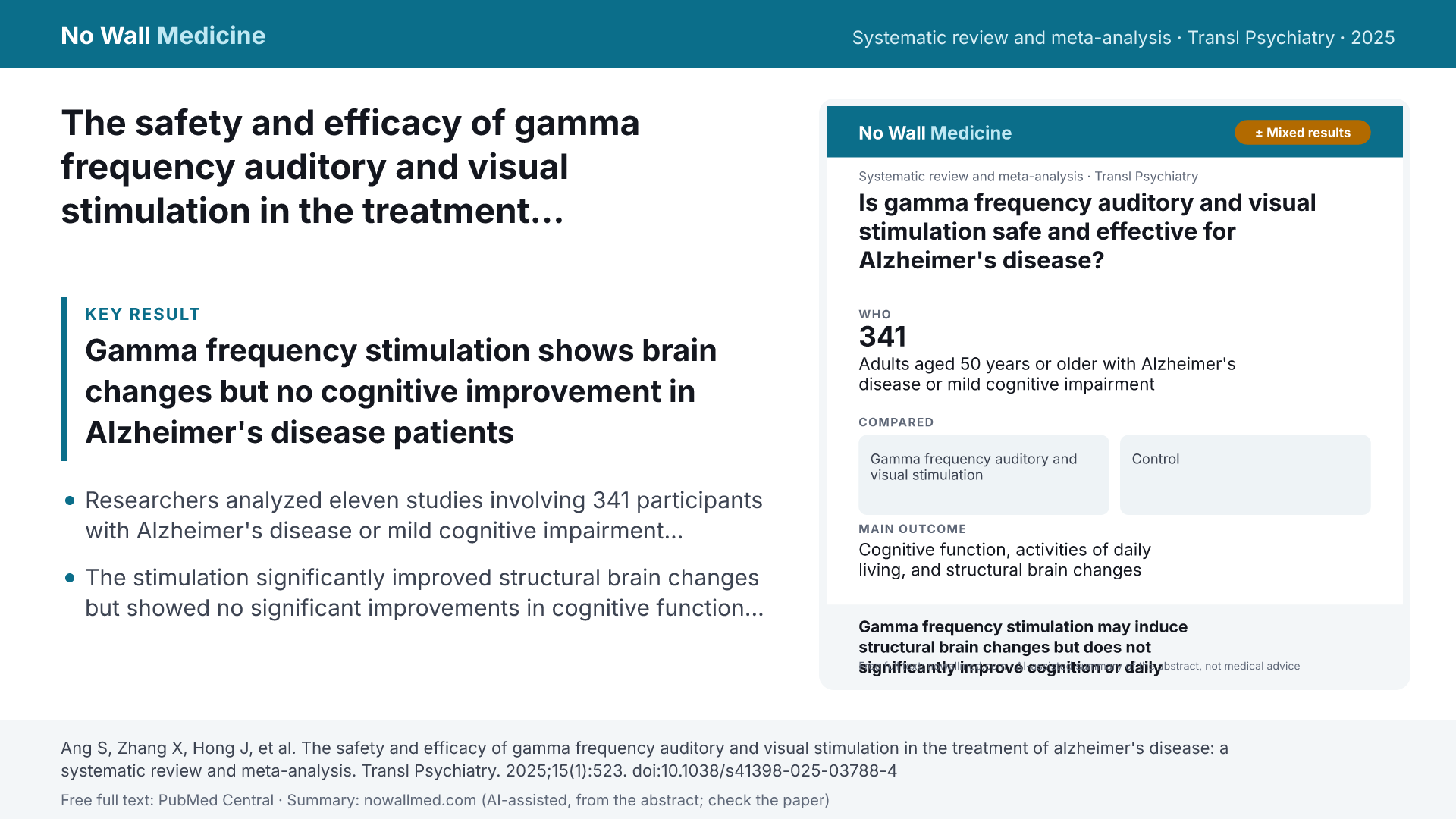
Gamma frequency stimulation shows brain changes but no cognitive improvement in Alzheimer's disease patients
The safety and efficacy of gamma frequency auditory and visual stimulation in the treatment of alzheimer's disease: a systematic review and meta-analysis
Systematic review and meta-analysisMixed results
Is gamma frequency auditory and visual stimulation safe and effective for Alzheimer's disease?
Who
341
Adults aged 50 years or older with Alzheimer's disease or mild cognitive impairment
Compared
Gamma frequency auditory and visual stimulation
Control
Main outcome
Cognitive function, activities of daily living, and structural brain changes
Result: SMD 0.16 (95% CI -0.36 to 0.68) for cognitive function
Bottom line: Gamma frequency stimulation may induce structural brain changes but does not significantly improve cognition or daily functioning.
Limitation: High heterogeneity was observed.
Transl Psychiatry · 2025-12-11Download image
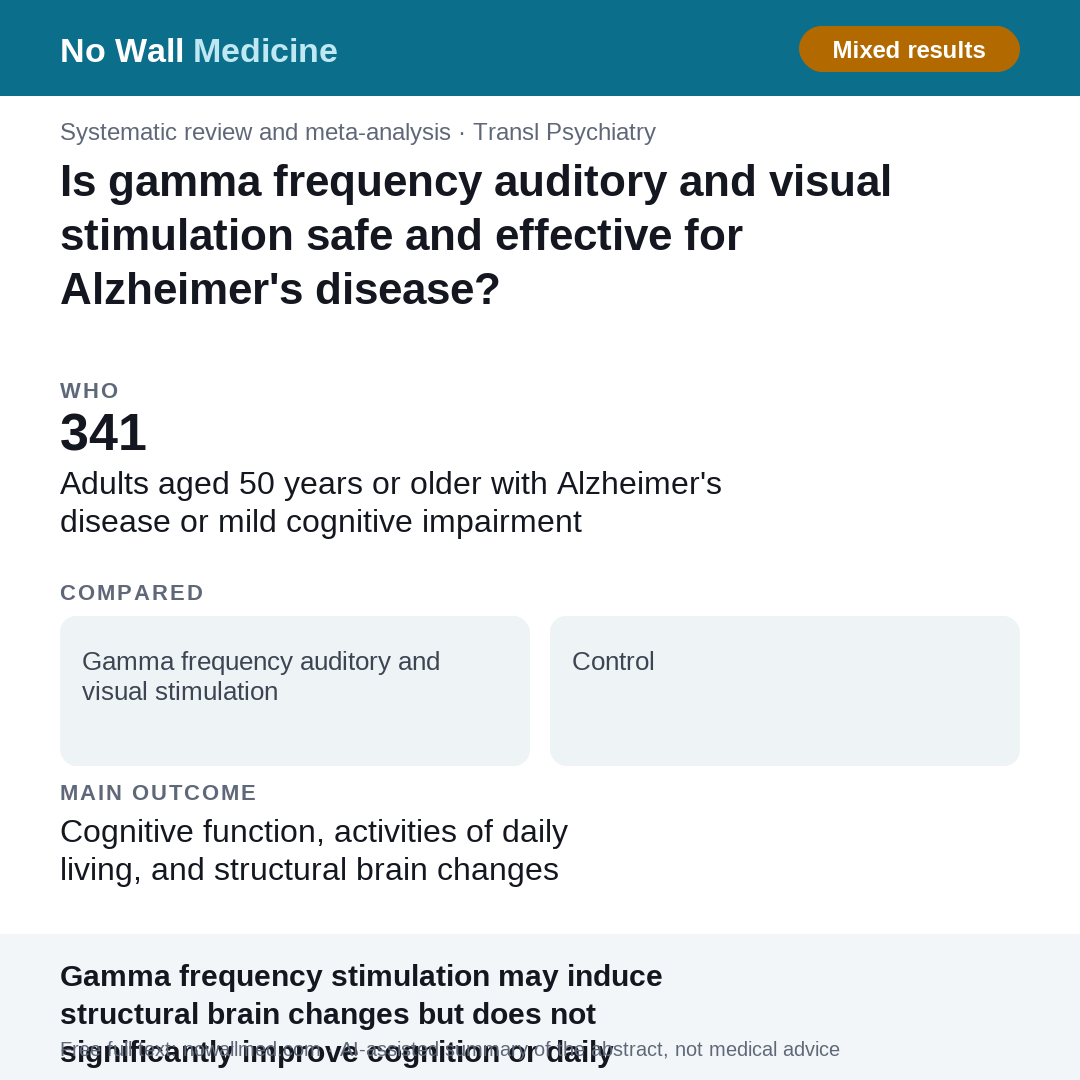
Clinical question: Is gamma frequency auditory and visual stimulation safe and effective for Alzheimer's disease?
Why it matters: Current treatments for Alzheimer's disease offer limited benefits, creating a need for novel therapies like gamma frequency auditory and visual stimulation.
Key points
- Researchers analyzed eleven studies involving 341 participants with Alzheimer's disease or mild cognitive impairment to evaluate gamma frequency auditory and visual stimulation.
- The stimulation significantly improved structural brain changes but showed no significant improvements in cognitive function or activities of daily living.
- While overall adverse events did not increase significantly, the stimulation was associated with a significantly increased risk of tinnitus.
Limitation the authors note: High heterogeneity was observed among the included studies.
Headline and key points written with AI from the paper’s abstract, with every number checked against it. Read the paper before relying on them.
Was this summary helpful?
Subject terms
Cite this article
Ang S, Zhang X, Hong J, et al. The safety and efficacy of gamma frequency auditory and visual stimulation in the treatment of alzheimer's disease: a systematic review and meta-analysis. Transl Psychiatry. 2025. doi:10.1038/s41398-025-03788-4
Spotted a mistake? Suggest a correction