The safety and efficacy of gamma frequency auditory and visual stimulation in the treatment of alzheimer's disease: a systematic review and meta-analysis
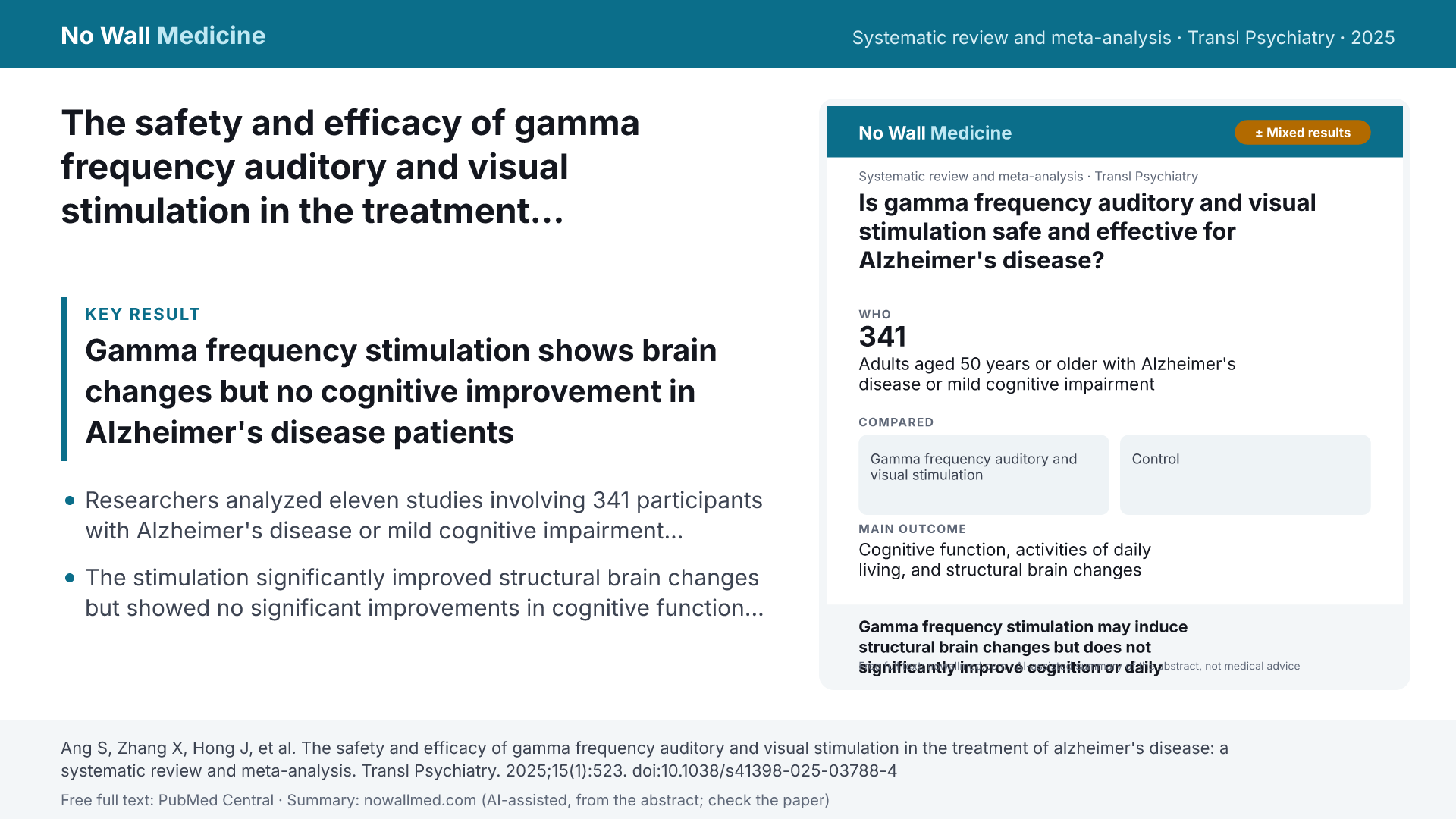
Key result: Gamma frequency stimulation shows brain changes but no cognitive improvement in Alzheimer's disease patients
Key points
- Researchers analyzed eleven studies involving 341 participants with Alzheimer's disease or mild cognitive impairment to evaluate gamma frequency auditory and visual stimulation.
- The stimulation significantly improved structural brain changes but showed no significant improvements in cognitive function or activities of daily living.
- While overall adverse events did not increase significantly, the stimulation was associated with a significantly increased risk of tinnitus.
Why it matters: Current treatments for Alzheimer's disease offer limited benefits, creating a need for novel therapies like gamma frequency auditory and visual stimulation.
Limitation the authors note: High heterogeneity was observed among the included studies.
Discussion prompts
- Would these patients look like yours? Who was left out?
- Is the main outcome one that matters to patients?
- Is the difference large enough to change what you do?
Cite: Ang S, Zhang X, Hong J, et al. The safety and efficacy of gamma frequency auditory and visual stimulation in the treatment of alzheimer's disease: a systematic review and meta-analysis. Transl Psychiatry. 2025;15(1):523. doi:10.1038/s41398-025-03788-4
Free full text: PubMed Central · Summary and visual abstract: nowallmed.com/a/the-safety-and-efficacy-of-gamma-frequency-auditory-and-visual-1pd3bkp/ (AI-assisted from the abstract; check the paper before relying on it).