The short-term and long-term adverse effects of melatonin treatment in children and adolescents: a systematic review and GRADE assessment
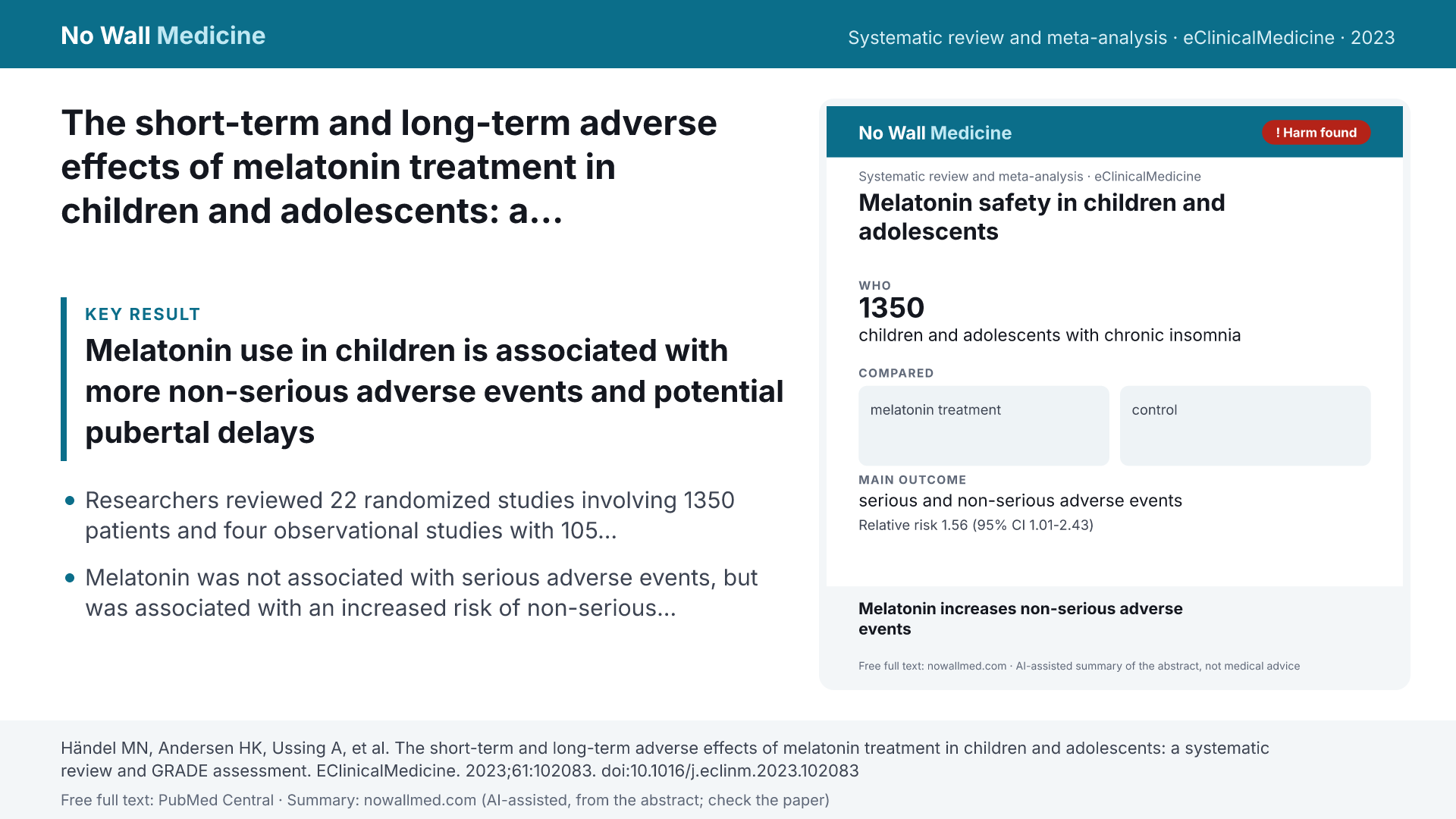
Key result: Melatonin use in children is associated with more non-serious adverse events and potential pubertal delays
Systematic review and meta-analysisHarm found
Melatonin safety in children and adolescents
Who
1350
children and adolescents with chronic insomnia
Compared
melatonin treatment
control
Main outcome
serious and non-serious adverse events
Result: Relative risk 1.56 (95% CI 1.01-2.43)
Bottom line: Melatonin increases non-serious adverse events
Limitation: methodological limitations
eClinicalMedicine · 2023-07-06 · Funded by Danish Health Authority and Oak Foundation
Key points
- Researchers reviewed 22 randomized studies involving 1350 patients and four observational studies with 105 patients regarding melatonin use in children and adolescents aged 5-20 years.
- Melatonin was not associated with serious adverse events, but was associated with an increased risk of non-serious adverse events with a relative risk of 1.56.
- Three studies showed little or no influence on pubertal development after 2-4 years of treatment, while one study noted a potential delay after more than 7 years.
Limitation the authors note: The authors state that the findings need further evaluation due to several methodological limitations.
Discussion prompts
- Would these patients look like yours? Who was left out?
- Is the main outcome one that matters to patients?
- Is the difference large enough to change what you do?
Cite: Händel MN, Andersen HK, Ussing A, et al. The short-term and long-term adverse effects of melatonin treatment in children and adolescents: a systematic review and GRADE assessment. EClinicalMedicine. 2023;61:102083. doi:10.1016/j.eclinm.2023.102083
Free full text: PubMed Central · Summary and visual abstract: nowallmed.com/a/the-short-term-and-long-term-adverse-effects-of-melatonin-treatment-e2ukje/ (AI-assisted from the abstract; check the paper before relying on it).