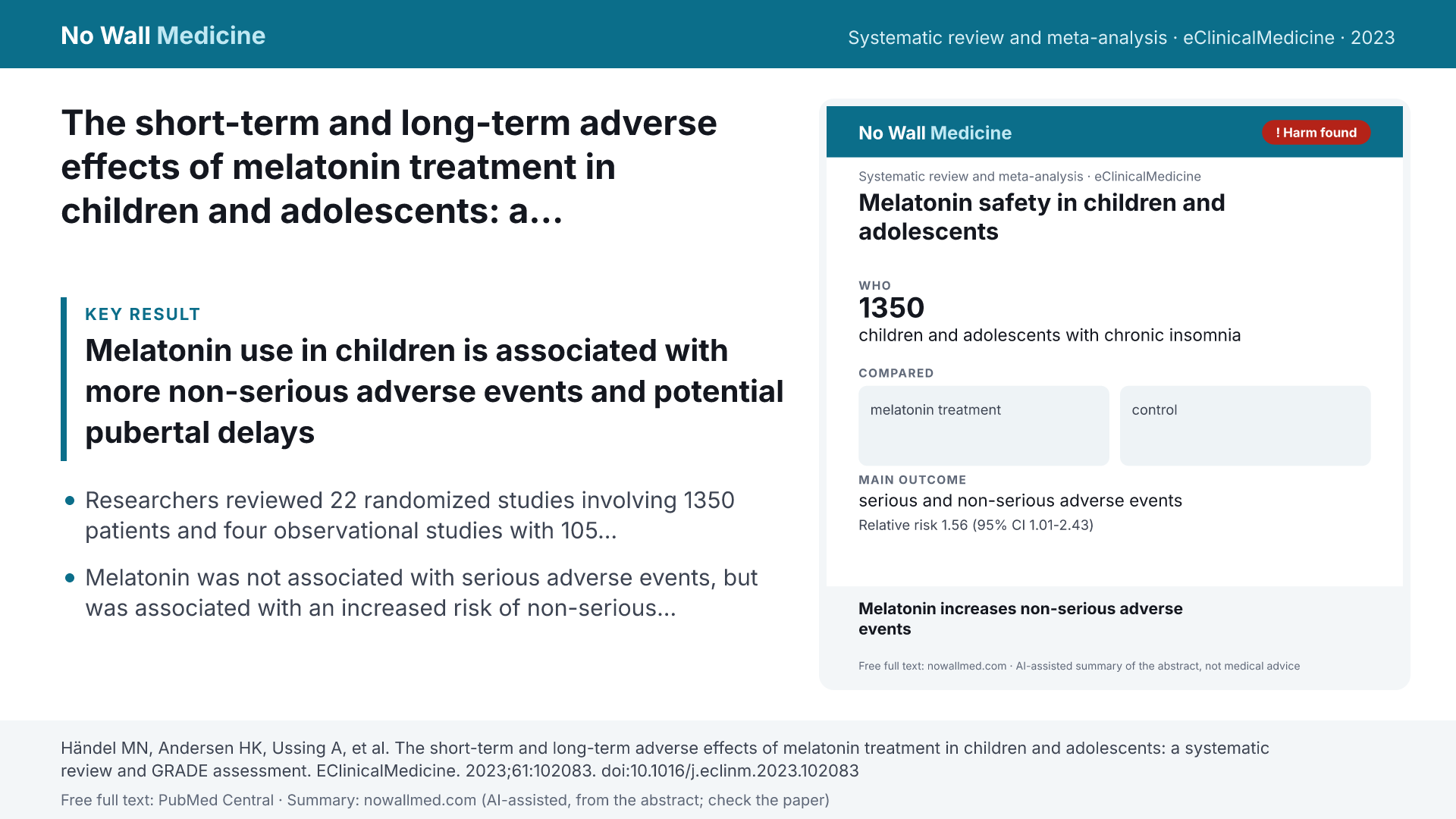
Melatonin use in children is associated with more non-serious adverse events and potential pubertal delays
The short-term and long-term adverse effects of melatonin treatment in children and adolescents: a systematic review and GRADE assessment
Systematic review and meta-analysisHarm found
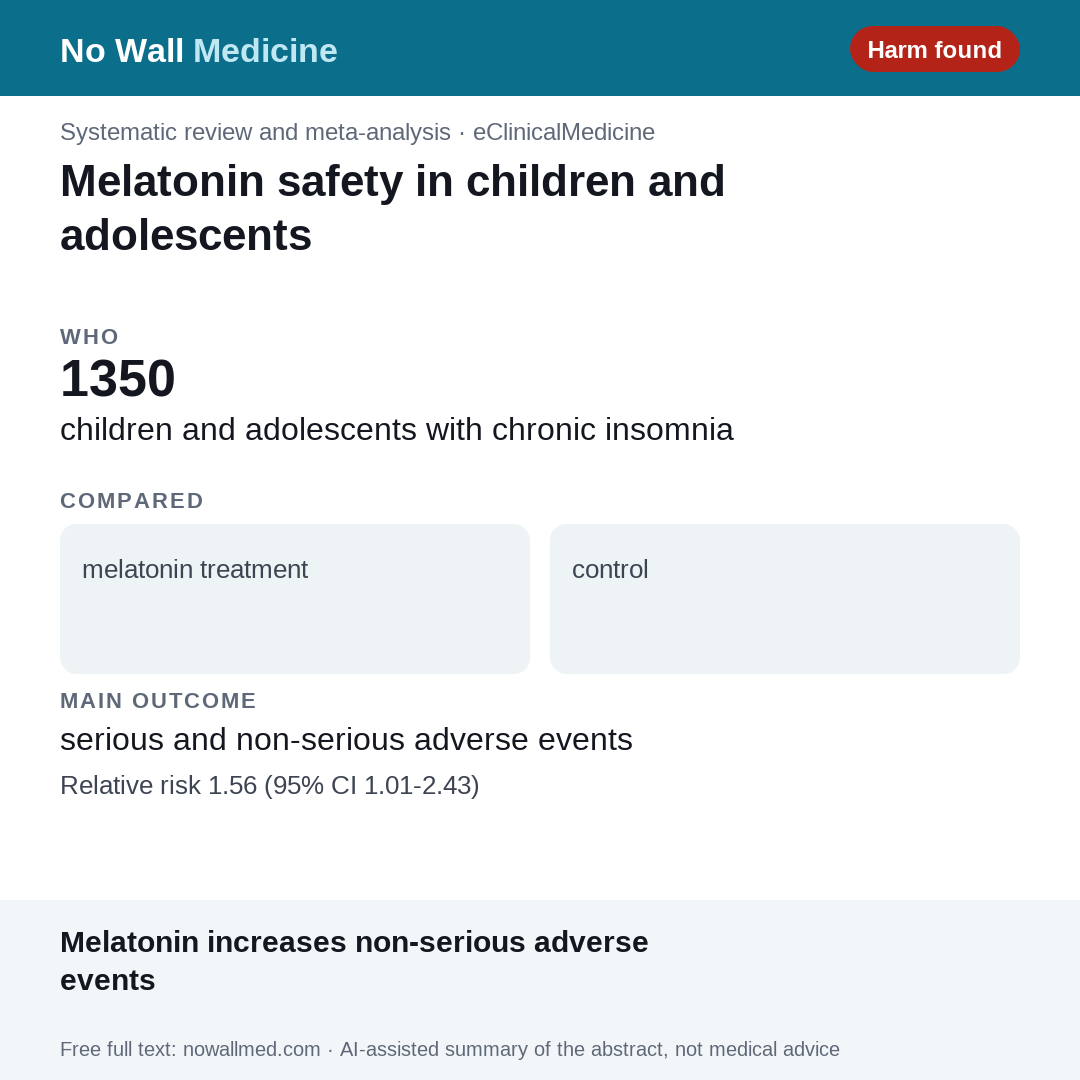
Melatonin safety in children and adolescents
Who
1350
children and adolescents with chronic insomnia
Compared
melatonin treatment
control
Main outcome
serious and non-serious adverse events
Result: Relative risk 1.56 (95% CI 1.01-2.43)
Bottom line: Melatonin increases non-serious adverse events
Limitation: methodological limitations
Funded by: Danish Health Authority and Oak Foundation
eClinicalMedicine · 2023-07-06Download image
Key points
- Researchers reviewed 22 randomized studies involving 1350 patients and four observational studies with 105 patients regarding melatonin use in children and adolescents aged 5-20 years.
- Melatonin was not associated with serious adverse events, but was associated with an increased risk of non-serious adverse events with a relative risk of 1.56.
- Three studies showed little or no influence on pubertal development after 2-4 years of treatment, while one study noted a potential delay after more than 7 years.
Limitation the authors note: The authors state that the findings need further evaluation due to several methodological limitations.
Headline and key points written with AI from the paper’s abstract, with every number checked against it. Read the paper before relying on them.
Was this summary helpful?
Cite this article
Händel MN, Andersen HK, Ussing A, et al. The short-term and long-term adverse effects of melatonin treatment in children and adolescents: a systematic review and GRADE assessment. EClinicalMedicine. 2023;61:102083. doi:10.1016/j.eclinm.2023.102083
Spotted a mistake? Suggest a correction