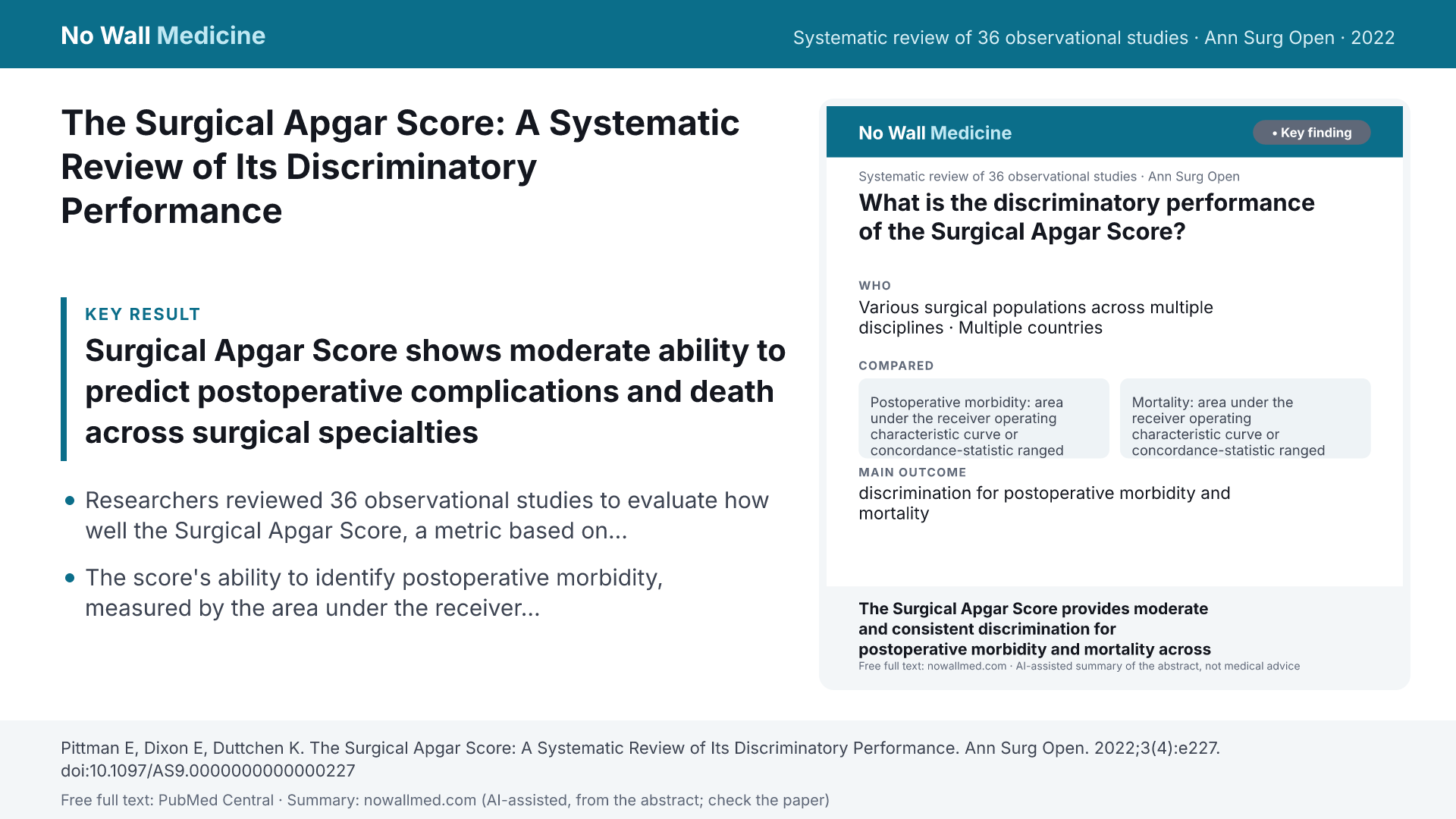
Surgical Apgar Score shows moderate ability to predict postoperative complications and death across surgical specialties
The Surgical Apgar Score: A Systematic Review of Its Discriminatory Performance
Systematic review of 36 observational studiesKey finding
What is the discriminatory performance of the Surgical Apgar Score?
Who
Various surgical populations across multiple disciplines · Multiple countries
Compared
Postoperative morbidity: area under the receiver operating characteristic curve or concordance-statistic ranged from 0.59 to 0.872
Mortality: area under the receiver operating characteristic curve or concordance-statistic ranged from 0.63 to 0.92
Main outcome
discrimination for postoperative morbidity and mortality
Bottom line: The Surgical Apgar Score provides moderate and consistent discrimination for postoperative morbidity and mortality across surgical disciplines.
Ann Surg Open · 2022-12-07 · Save PNG

Clinical question: What is the discriminatory performance of the Surgical Apgar Score?
Key points
- Researchers reviewed 36 observational studies to evaluate how well the Surgical Apgar Score, a metric based on intraoperative data, predicts patient outcomes.
- The score's ability to identify postoperative morbidity, measured by the area under the receiver operating characteristic curve, ranged from 0.59 to 0.872.
- For predicting mortality, the area under the receiver operating characteristic curve ranged from 0.63 in a combined surgical population to 0.92 in a general and vascular surgery population.
Limitation the authors note: The review included only observational studies.
Headline and key points written with AI from the paper’s abstract, with every number checked against it. Read the paper before relying on them.
Was this summary helpful?
Headline, design, result, key points, caveat and citation as plain text.
Cite this article
Pittman E, Dixon E, Duttchen K. The Surgical Apgar Score: A Systematic Review of Its Discriminatory Performance. Ann Surg Open. 2022;3(4):e227. doi:10.1097/AS9.0000000000000227
Spotted a mistake? Suggest a correction