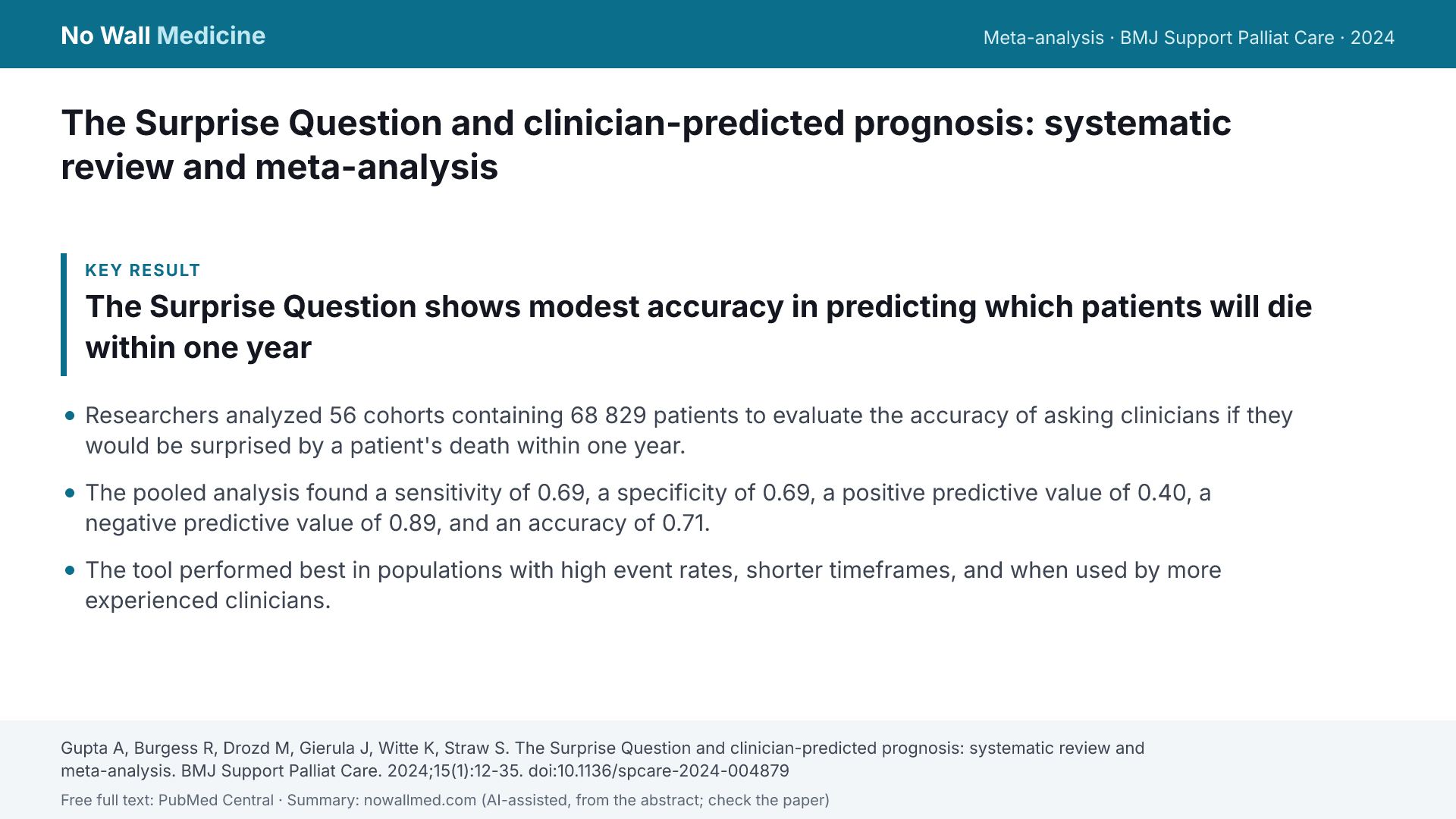
The Surprise Question shows modest accuracy in predicting which patients will die within one year
The Surprise Question and clinician-predicted prognosis: systematic review and meta-analysis
Why it matters: It is unknown how accurate the Surprise Question is across different healthcare settings, specialties, follow-up periods, and different types of respondents.
Key points
- Researchers analyzed 56 cohorts containing 68 829 patients to evaluate the accuracy of asking clinicians if they would be surprised by a patient's death within one year.
- The pooled analysis found a sensitivity of 0.69, a specificity of 0.69, a positive predictive value of 0.40, a negative predictive value of 0.89, and an accuracy of 0.71.
- The tool performed best in populations with high event rates, shorter timeframes, and when used by more experienced clinicians.
Headline and key points written with AI from the paper’s abstract, with every number checked against it. Read the paper before relying on them.
Was this summary helpful?
Abstract
Background
The Surprise Question, 'Would you be surprised if this person died within the next year?' is a simple tool that can be used by clinicians to identify people within the last year of life. This review aimed to determine the accuracy of this assessment, across different healthcare settings, specialties, follow-up periods and respondents. Methods
Searches were conducted of Medline, Embase, AMED, PubMed and the Cochrane Central Register of Controlled Trials, from inception until 01 January 2024. Studies were included if they reported original data on the ability of the Surprise Question to predict survival. For each study (including subgroups), sensitivity, specificity, positive and negative predictive values and accuracy were determined. Results
Our dataset comprised 56 distinct cohorts, including 68 829 patients. In a pooled analysis, the sensitivity of the Surprise Question was 0.69 ((0.64 to 0.74) I2=97.2%), specificity 0.69 ((0.63 to 0.74) I2=99.7%), positive predictive value 0.40 ((0.35 to 0.45) I2=99.4%), negative predictive value 0.89 ((0.87 to 0.91) I2=99.7%) and accuracy 0.71 ((0.68 to 0.75) I2=99.3%). The prompt performed best in populations with high event rates, shorter timeframes and when posed to more experienced respondents. Conclusions
The Surprise Question demonstrated modest accuracy with considerable heterogeneity across the population to which it was applied and to whom it was posed. Prospective studies should test whether the prompt can facilitate timely access to palliative care services, as originally envisioned. Prospero registration number
CRD32022298236.
Abstract reproduced under the article’s CC BY licence.
Subject terms
Cite this article
Gupta A, Burgess R, Drozd M, Gierula J, Witte K, Straw S. The Surprise Question and clinician-predicted prognosis: systematic review and meta-analysis. BMJ Support Palliat Care. 2024. doi:10.1136/spcare-2024-004879
Spotted a mistake? Suggest a correction