The Surprise Question and clinician-predicted prognosis: systematic review and meta-analysis
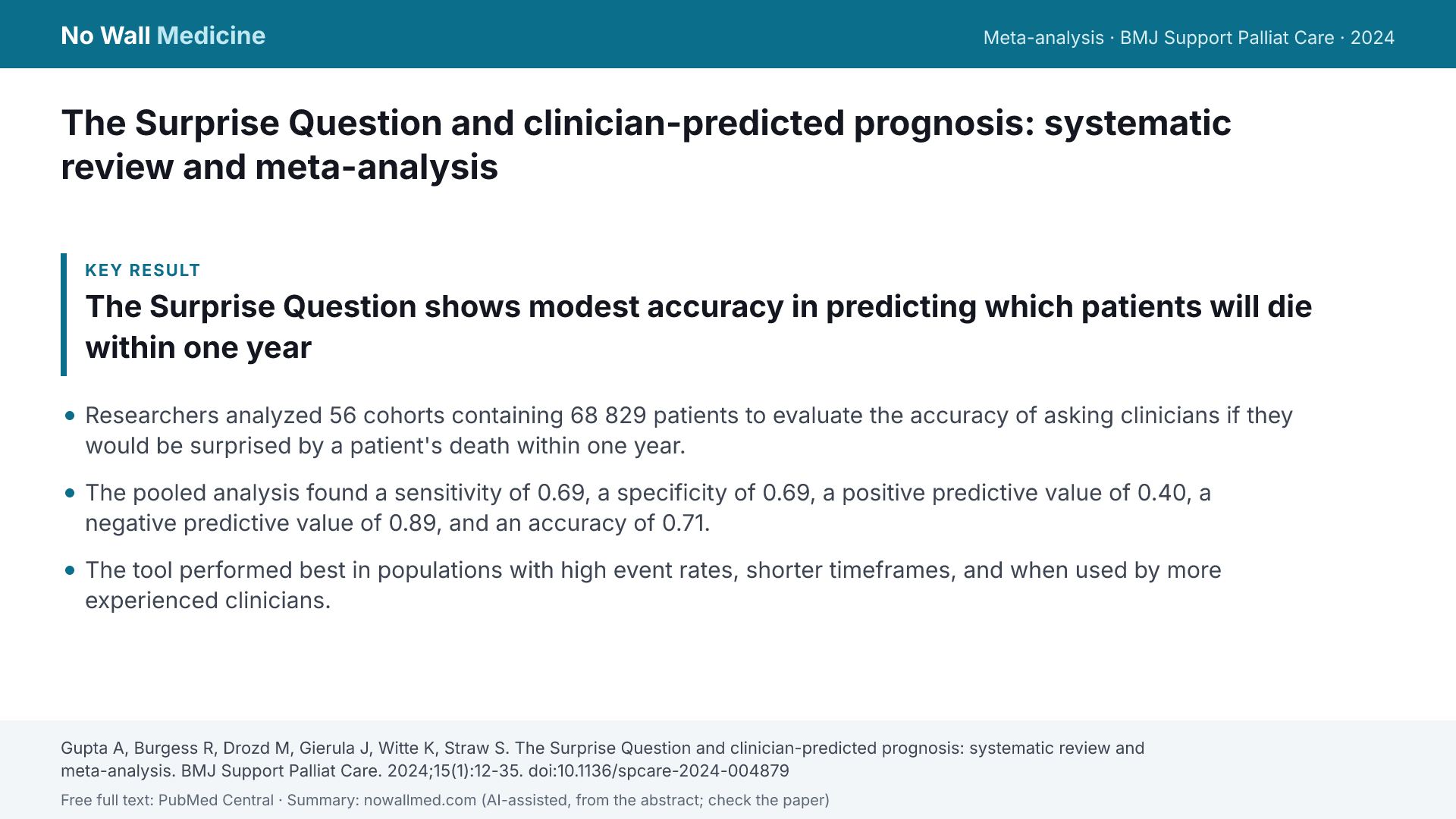
Key result: The Surprise Question shows modest accuracy in predicting which patients will die within one year
Key points
- Researchers analyzed 56 cohorts containing 68 829 patients to evaluate the accuracy of asking clinicians if they would be surprised by a patient's death within one year.
- The pooled analysis found a sensitivity of 0.69, a specificity of 0.69, a positive predictive value of 0.40, a negative predictive value of 0.89, and an accuracy of 0.71.
- The tool performed best in populations with high event rates, shorter timeframes, and when used by more experienced clinicians.
Discussion prompts
- Would these patients look like yours? Who was left out?
- Is the main outcome one that matters to patients?
- Is the difference large enough to change what you do?
Cite: Gupta A, Burgess R, Drozd M, Gierula J, Witte K, Straw S. The Surprise Question and clinician-predicted prognosis: systematic review and meta-analysis. BMJ Support Palliat Care. 2024;15(1):12-35. doi:10.1136/spcare-2024-004879
Free full text: PubMed Central · Summary and visual abstract: nowallmed.com/a/the-surprise-question-and-clinician-predicted-prognosis-systematic-1jsrzdq/ (AI-assisted from the abstract; check the paper before relying on it).