Most new drugs lacked appropriate comparator in efficacy trials
The use of appropriate, inappropriate and no comparators in efficacy trials for European Medicines Agency-approved drugs 2011-2024: a retrospective cohort study
Why it matters: Guidelines require new drugs to have added therapeutic benefit compared to existing treatments
Key points
- Researchers studied 321 drug indications with 649 populations from 2011 to 2024.
- 58% of drug indications had at least one population tested with an appropriate comparator.
- Drug indications in 2023-2024 had 7.5 times higher odds of being tested with a single-arm trial.
Limitation the authors note: Other institutions may define the appropriate comparator differently
Study type: Observational study: it can show a link, but not prove that one thing causes another.
Headline and key points written with AI from the paper’s abstract, with every number checked against it. Read the paper before relying on them.
Was this summary helpful?
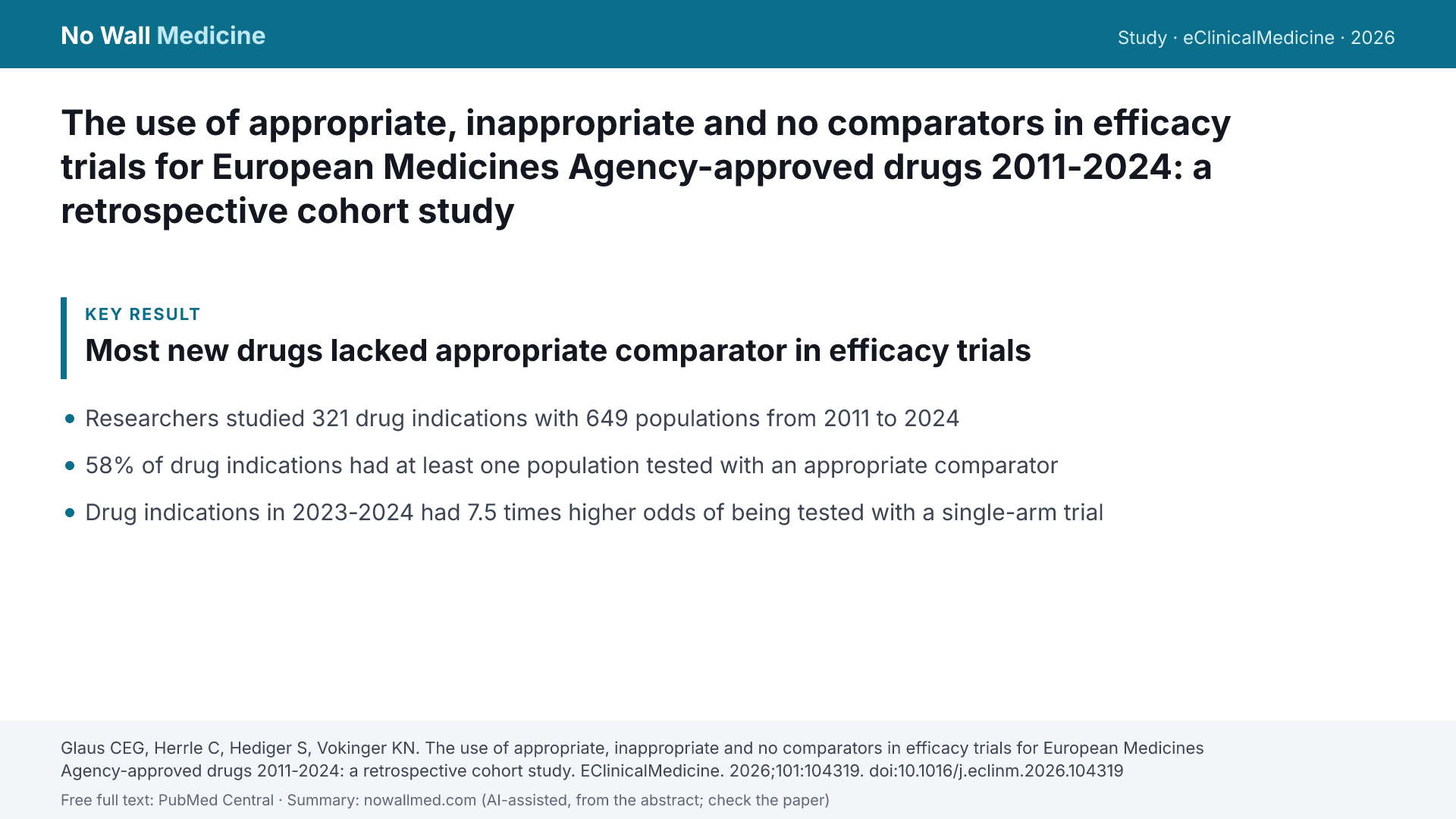
Headline, design, result, key points, caveat and citation as plain text.
Cite this article
Glaus CEG, Herrle C, Hediger S, Vokinger KN. The use of appropriate, inappropriate and no comparators in efficacy trials for European Medicines Agency-approved drugs 2011-2024: a retrospective cohort study. EClinicalMedicine. 2026;101:104319. doi:10.1016/j.eclinm.2026.104319
Spotted a mistake? Suggest a correction