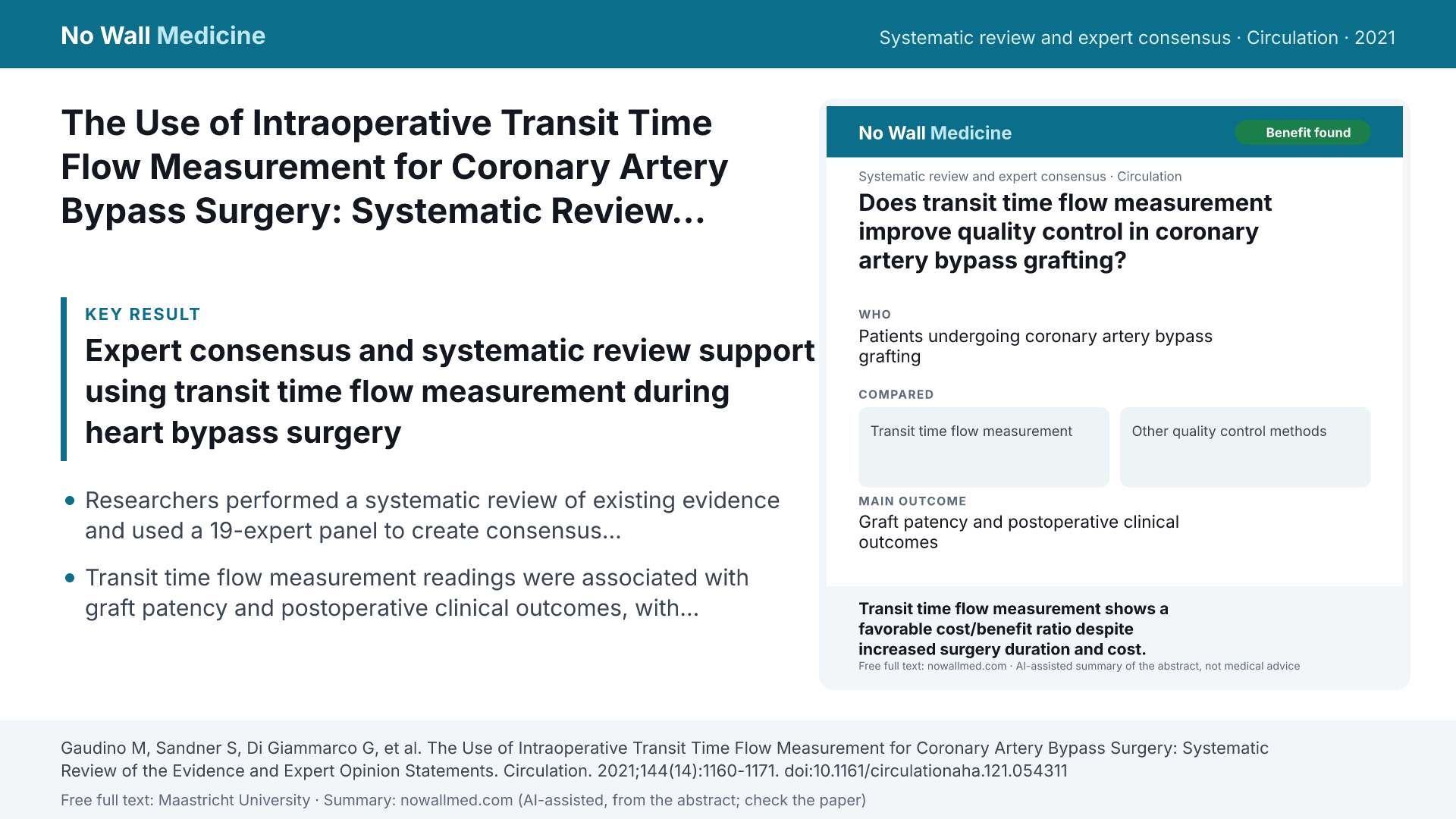
Expert consensus and systematic review support using transit time flow measurement during heart bypass surgery
The Use of Intraoperative Transit Time Flow Measurement for Coronary Artery Bypass Surgery: Systematic Review of the Evidence and Expert Opinion Statements
Systematic review and expert consensusBenefit found
Does transit time flow measurement improve quality control in coronary artery bypass grafting?
Who
Patients undergoing coronary artery bypass grafting
Compared
Transit time flow measurement
Other quality control methods
Main outcome
Graft patency and postoperative clinical outcomes
Bottom line: Transit time flow measurement shows a favorable cost/benefit ratio despite increased surgery duration and cost.
Limitation: High methodological heterogeneity among the published series.
Circulation · 2021-10-04 · Save PNG
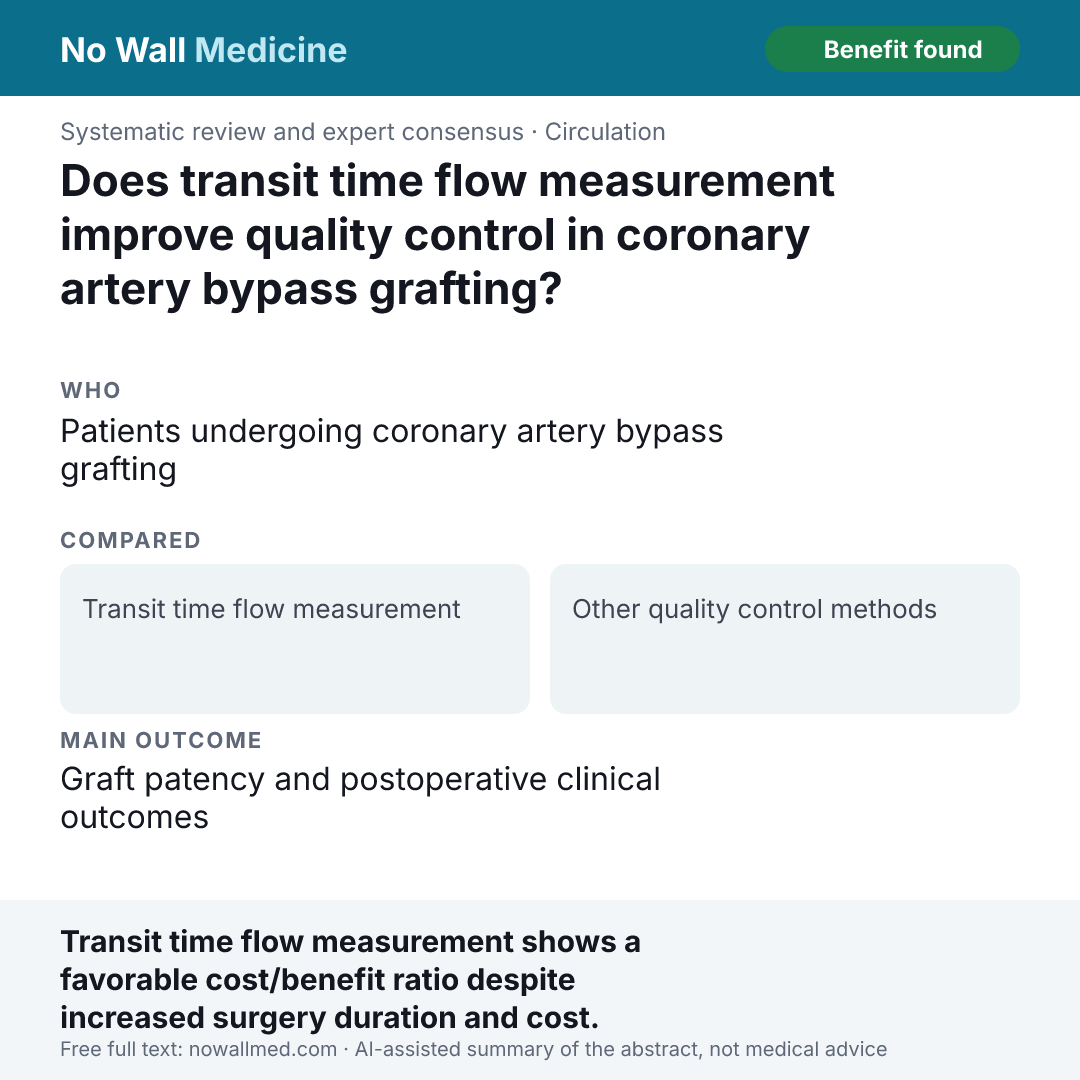
Clinical question: Does transit time flow measurement improve quality control in coronary artery bypass grafting?
Why it matters: The use of transit time flow measurement for quality control in heart bypass surgery remains underused due to limited information and a lack of standardization.
Key points
- Researchers performed a systematic review of existing evidence and used a 19-expert panel to create consensus recommendations for transit time flow measurement during heart bypass surgery.
- Transit time flow measurement readings were associated with graft patency and postoperative clinical outcomes, with more robust evidence for arterial grafts and grafts to the left anterior descending artery.
- The use of this measurement technique was associated with increased surgery duration and cost, though no data were available to quantify these effects.
Limitation the authors note: The existing evidence shows high methodological heterogeneity among the published series.
Headline and key points written with AI from the paper’s abstract, with every number checked against it. Read the paper before relying on them.
Was this summary helpful?
Subject terms
Headline, design, result, key points, caveat and citation as plain text.
Cite this article
Gaudino M, Sandner S, Di Giammarco G, et al. The Use of Intraoperative Transit Time Flow Measurement for Coronary Artery Bypass Surgery: Systematic Review of the Evidence and Expert Opinion Statements. Circulation. 2021;144(14):1160-1171. doi:10.1161/circulationaha.121.054311
Spotted a mistake? Suggest a correction