Review of 131 studies shows Janus kinase inhibitors provide benefits for difficult-to-treat rheumatoid arthritis
Therapeutic approaches for difficult-to-treat rheumatoid arthritis: a systematic literature review of current evidence
Systematic literature review and meta-analysisMixed results
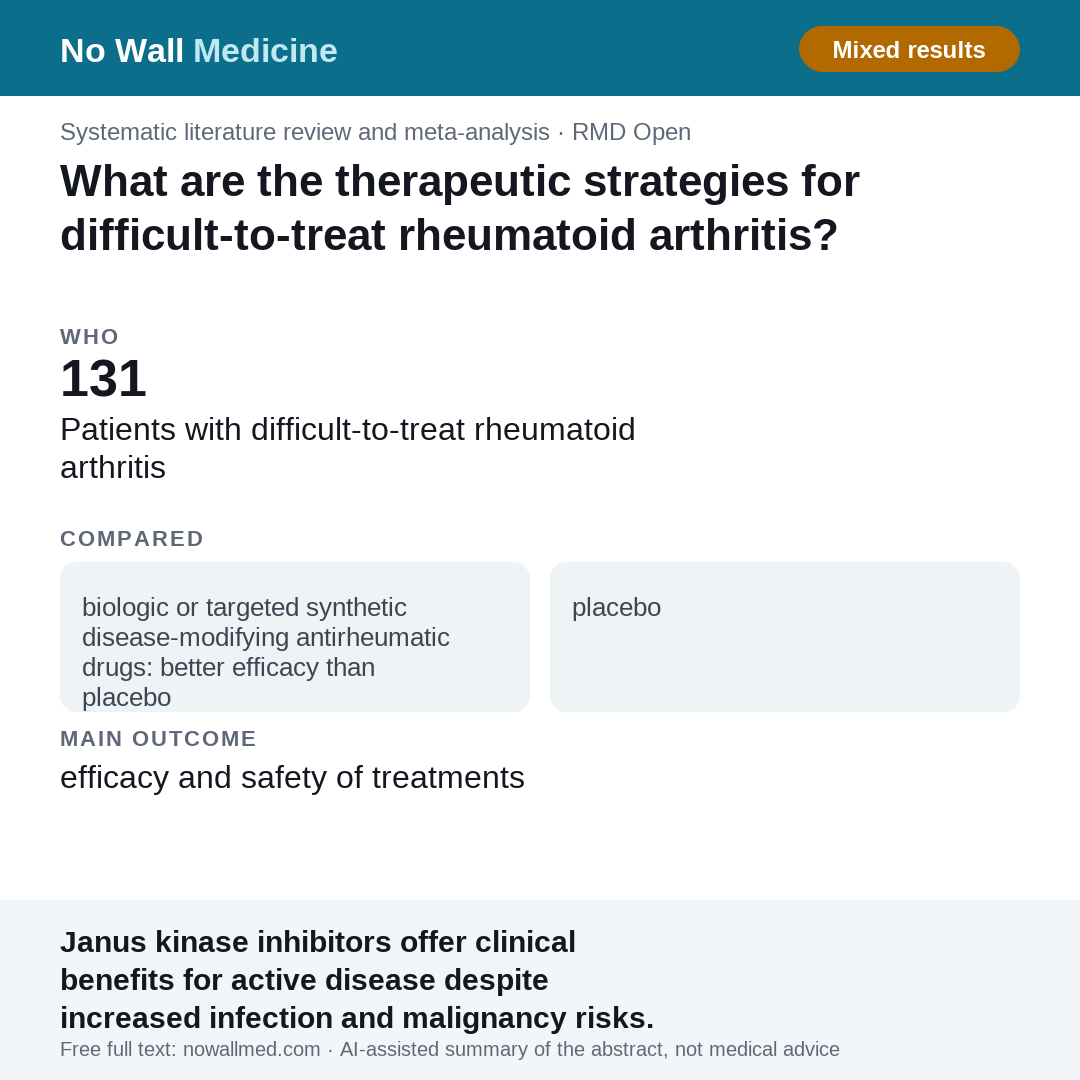
What are the therapeutic strategies for difficult-to-treat rheumatoid arthritis?
Who
131
Patients with difficult-to-treat rheumatoid arthritis
Compared
biologic or targeted synthetic disease-modifying antirheumatic drugs: better efficacy than placebo
placebo
Main outcome
efficacy and safety of treatments
Bottom line: Janus kinase inhibitors offer clinical benefits for active disease despite increased infection and malignancy risks.
Limitation: Most studies for prior biologic failures had a high risk of bias.
RMD Open · 2026-08-04Download image
Clinical question: What are the therapeutic strategies for difficult-to-treat rheumatoid arthritis?
Why it matters: Clinicians need updated evidence regarding therapeutic strategies for patients with rheumatoid arthritis who have active disease and limited remaining treatment options.
Key points
- Researchers reviewed 131 studies to evaluate treatments for patients with active rheumatoid arthritis and limited options or prior medication failures.
- In patients with at least 2 prior biologic or targeted synthetic disease-modifying antirheumatic drugs, all such drugs except otilimab were more effective than placebo.
- Janus kinase inhibitors maintained efficacy despite increasing prior drug failures but were associated with an increased occurrence of infection and malignancy.
Limitation the authors note: The authors state that there is a need for standardized reporting and dedicated studies on non-pharmacological interventions.
Headline and key points written with AI from the paper’s abstract, with every number checked against it. Read the paper before relying on them.
Was this summary helpful?
Abstract
Objective
This systematic literature review (SLR) aims to update the evidence regarding therapeutic strategies in difficult-to-treat rheumatoid arthritis (D2T RA), building on the previous SLR informing the European Alliance of Associations for Rheumatology (EULAR) points to consider for the management of D2T RA. Methods
Three research questions addressed efficacy or safety of treatments in patients with RA with (1) active disease and limited treatment options; (2) active disease with ≥2 prior biologic/targeted synthetic disease-modifying antirheumatic drugs (b/tsDMARDs) and (3) poor health-related quality of life and low objective disease activity (non-pharmacological interventions). MEDLINE, Embase and Cochrane Library were searched until July 2025. Meta-analysis and meta-regression were conducted. Results
We screened 8589 records and included 131 studies. For research question (RQ)1, evidence on DMARD efficacy and safety was synthesised across a wide spectrum of comorbidities including obesity, cardiovascular disease, history of malignancy and respiratory comorbidities. For RQ2, all b/tsDMARDs except otilimab demonstrated better efficacy than placebo (mostly high risk of bias). Meta-regression showed efficacy was maintained for Janus kinase inhibitors (JAKi) despite increasing number of prior bDMARD failures (1 to ≥3). Safety results confirmed the increased occurrence of infection and malignancy with JAKi. For RQ3, limited evidence suggested orthopaedic surgical intervention as a potential non-pharmacological option in patients with D2T RA. Conclusions
This SLR summarised evidence supporting DMARD efficacy/safety across multiple comorbidities. In patients with active RA with ≥2 prior bDMARDs, JAKi offer substantial clinical benefits but require careful risk stratification given cardiovascular and malignancy risks. Furthermore, standardised reporting and dedicated studies on non-pharmacological interventions are urgently needed. Prospero registration number
CRD42024593584.
Abstract reproduced under the article’s CC BY licence.
Subject terms
Cite this article
Shams G, Dorgó AM, Ripepi C, et al. Therapeutic approaches for difficult-to-treat rheumatoid arthritis: a systematic literature review of current evidence. RMD Open. 2026. doi:10.1136/rmdopen-2026-006860
Spotted a mistake? Suggest a correction