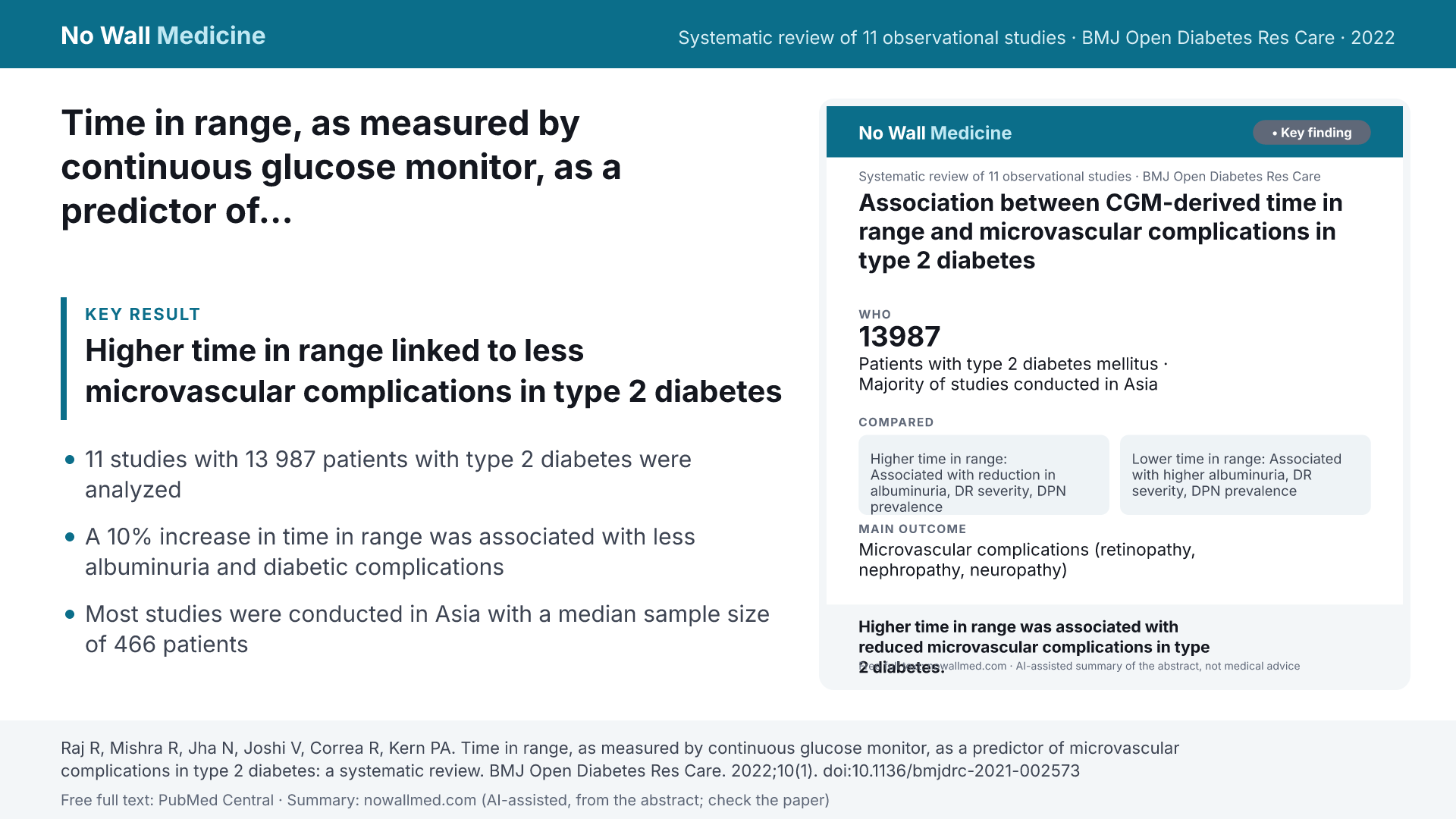
Higher time in range linked to less microvascular complications in type 2 diabetes
Time in range, as measured by continuous glucose monitor, as a predictor of microvascular complications in type 2 diabetes: a systematic review
Systematic review of 11 observational studiesKey finding
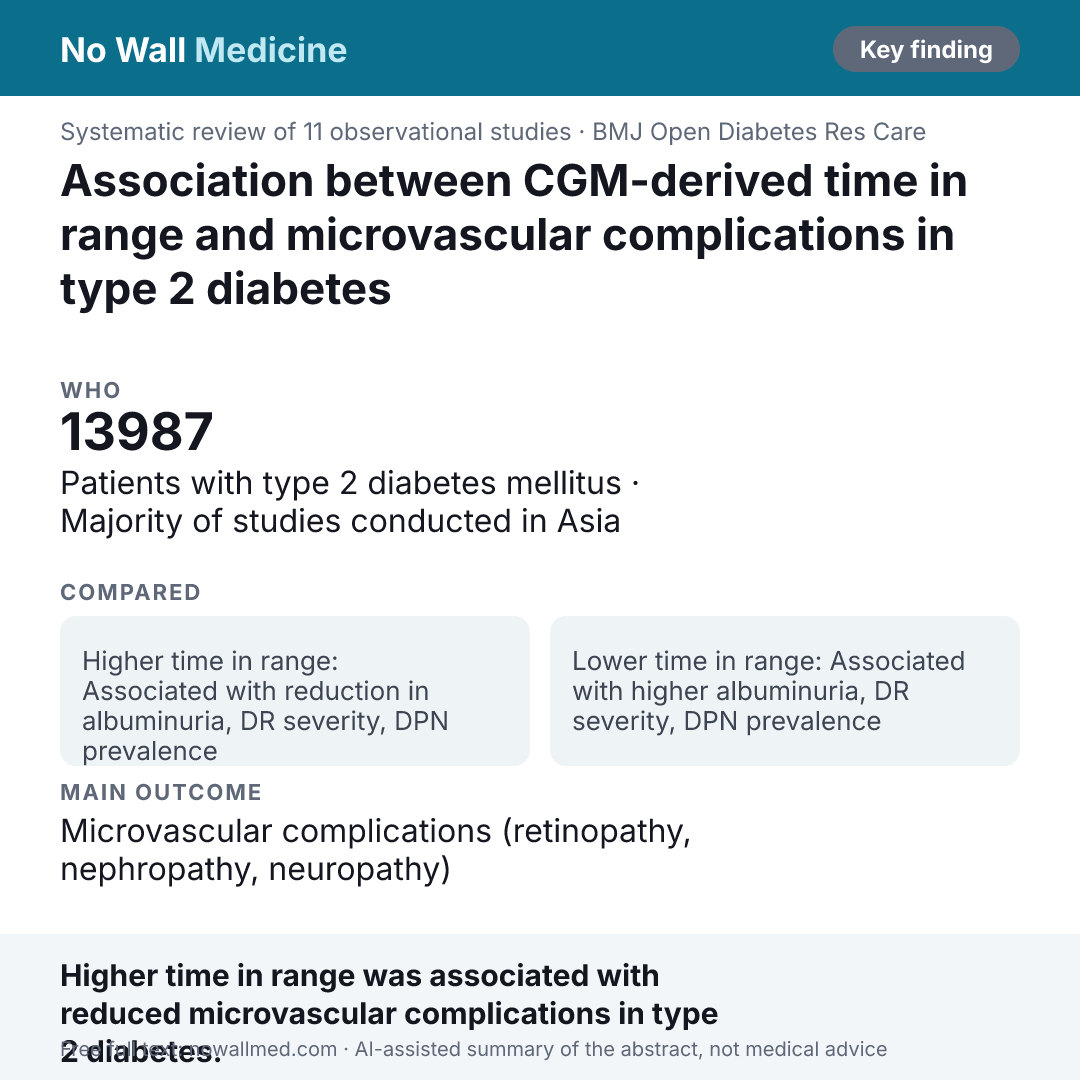
Association between CGM-derived time in range and microvascular complications in type 2 diabetes
Who
13987
Patients with type 2 diabetes mellitus · Majority of studies conducted in Asia
Compared
Higher time in range: Associated with reduction in albuminuria, DR severity, DPN prevalence
Lower time in range: Associated with higher albuminuria, DR severity, DPN prevalence
Main outcome
Microvascular complications (retinopathy, nephropathy, neuropathy)
Result: 10% increase in TIR associated with reduction in albuminuria, DR severity, DPN prevalence
Bottom line: Higher time in range was associated with reduced microvascular complications in type 2 diabetes.
Limitation: Larger-scale multicenter investigation with more diverse participants is warranted to validate utility.
BMJ Open Diabetes Res Care · 2022-01-04 · Save PNG
Key points
- 11 studies with 13 987 patients with type 2 diabetes were analyzed.
- A 10% increase in time in range was associated with less albuminuria and diabetic complications.
- Most studies were conducted in Asia with a median sample size of 466 patients.
Limitation the authors note: The review notes that a larger-scale multicenter investigation with more diverse participants is warranted
Headline and key points written with AI from the paper’s abstract, with every number checked against it. Read the paper before relying on them.
Was this summary helpful?
Abstract
Continuous glucose monitoring (CGM)-derived time in range (TIR) correlates with hemoglobin A1c (A1c) among patients with type 2 diabetes mellitus (T2DM); however, there is a paucity of data evaluating its association with microvascular complications. We conducted this systematic review to examine the association between TIR and microvascular complications of diabetic retinopathy (DR), diabetic nephropathy (DN), and diabetic peripheral neuropathy (DPN). We conducted a comprehensive literature search on PubMed, Scopus, and Web of Science online databases following the Preferred Reporting Items for Systematic Reviews and Meta-Analyses guidelines. Full-text original articles that evaluated the association between CGM-derived TIR and risk of microvascular complications and were published between 2010 and June 2021 were included in our systematic review. The quality of the included studies was evaluated using the National Heart, Lung, and Blood Institute Quality Assessment Tool for Observational Cohort and Cross-Sectional Studies. Data were analyzed using qualitative synthesis. Eleven studies on a total of 13 987 patients were included in the systematic review. The median sample size, baseline A1c, and diabetes duration were 466 patients (range: 105-5901), 8.2% (SD 0.5%), and 11.3 years (1.0), respectively. Majority of the studies were conducted in Asia (10 out of 11). Four studies evaluated the relationship between CGM-derived TIR and DR and CGM-derived TIR and DN, while seven studies evaluated the relationship between CGM-derived TIR and DPN. A 10% increase in TIR was associated with a reduction in albuminuria, severity of DR, and prevalence of DPN and cardiac autonomic neuropathy. In addition, an association was observed between urinary albumin to creatinine ratio but not with estimated glomerular filtration rate. This review summarizes recent evidence supporting an association between CGM-derived TIR and microvascular complications among patients with T2DM. A larger-scale multicenter investigation that includes more diverse participants is warranted to further validate the utility of TIR as a predictor of diabetic microvascular complications.
Abstract reproduced under the article’s CC BY NC licence.
Subject terms
Headline, design, result, key points, caveat and citation as plain text.
Cite this article
Raj R, Mishra R, Jha N, Joshi V, Correa R, Kern PA. Time in range, as measured by continuous glucose monitor, as a predictor of microvascular complications in type 2 diabetes: a systematic review. BMJ Open Diabetes Res Care. 2022;10(1). doi:10.1136/bmjdrc-2021-002573
Spotted a mistake? Suggest a correction