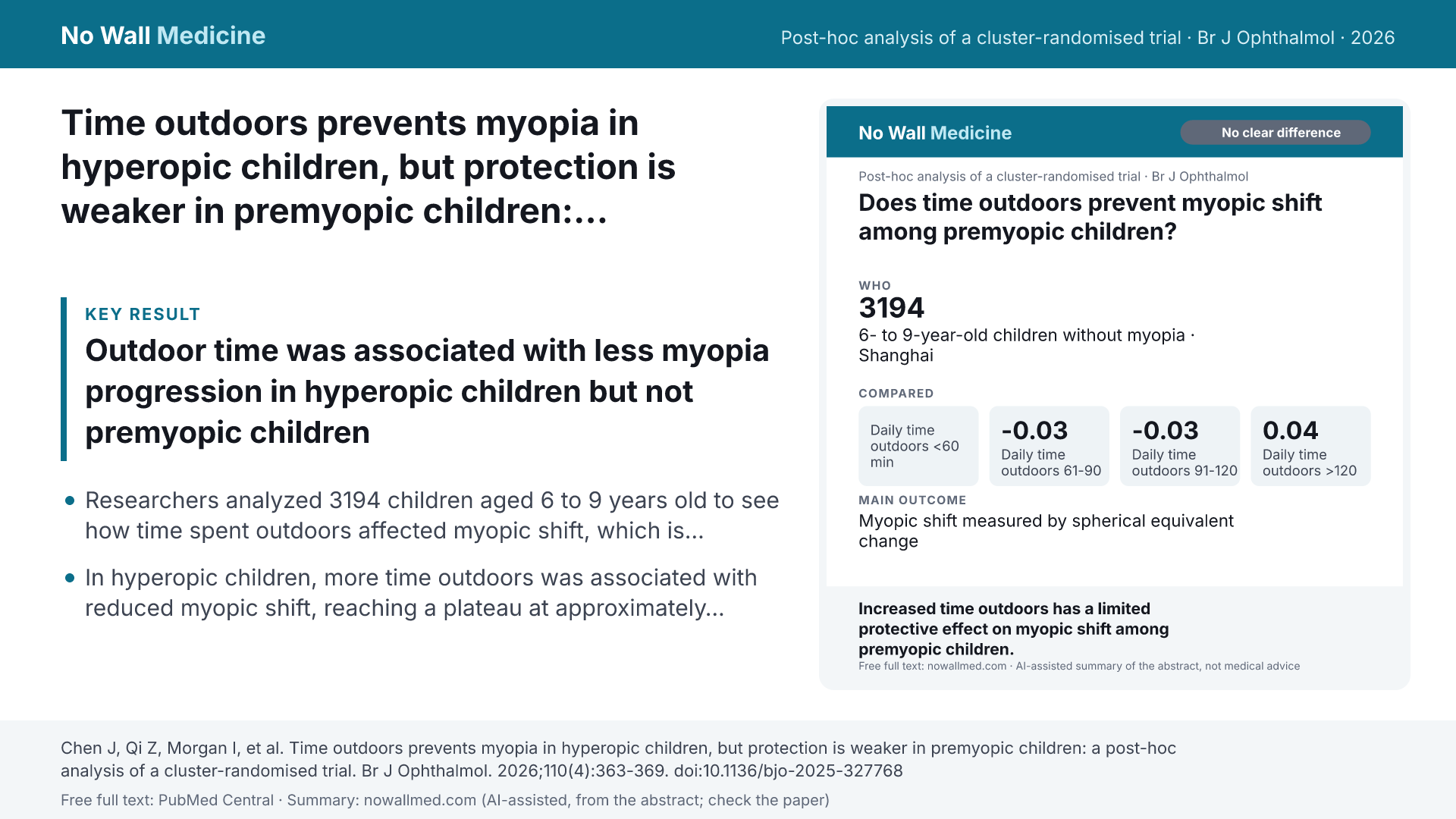
Time outdoors prevents myopia in hyperopic children, but protection is weaker in premyopic children: a post-hoc analysis of a cluster-randomised trial
Key result: Outdoor time was associated with less myopia progression in hyperopic children but not premyopic children
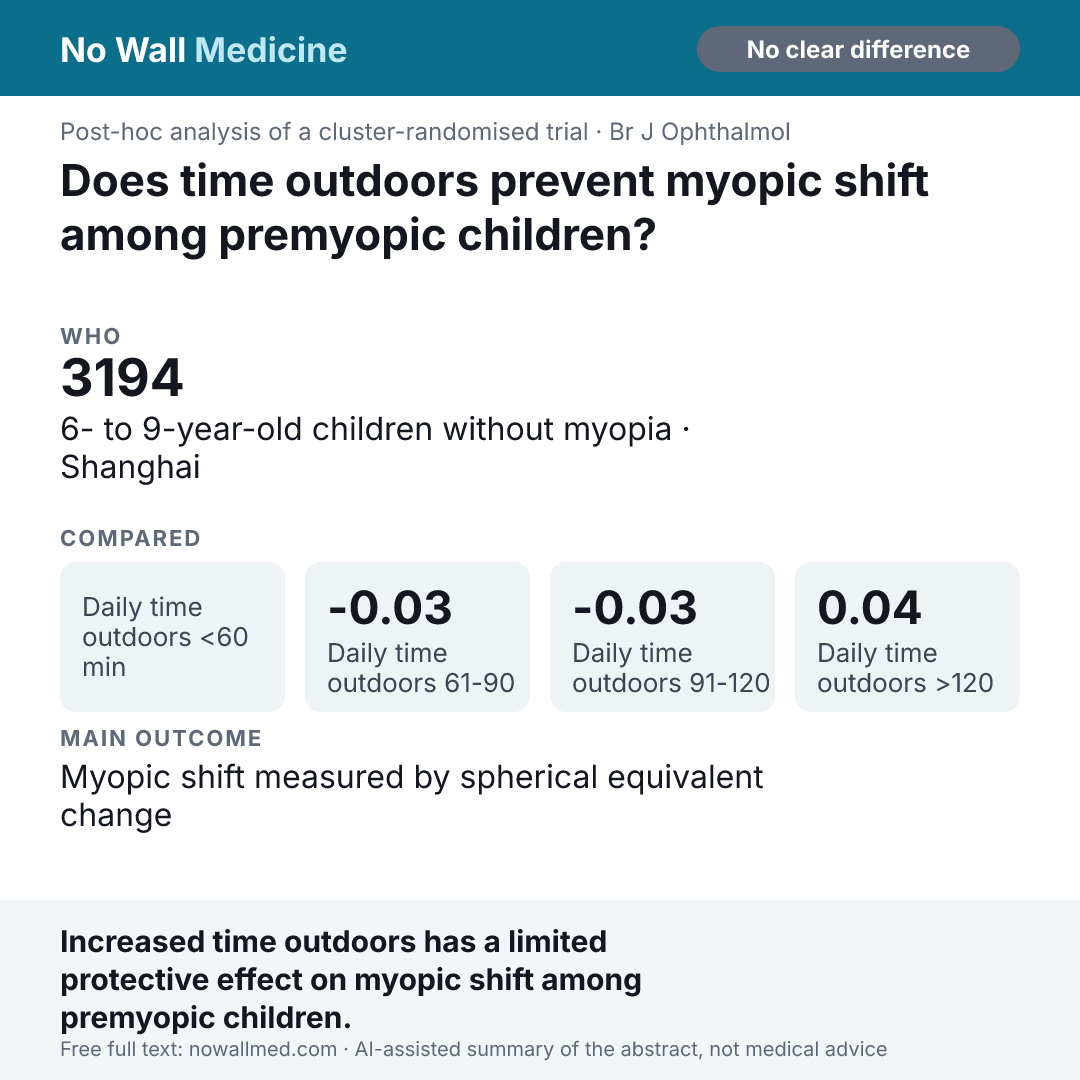
Post-hoc analysis of a cluster-randomised trialNo clear difference
Does time outdoors prevent myopic shift among premyopic children?
Who
3194
6- to 9-year-old children without myopia · Shanghai
Compared
Daily time outdoors <60 min
-0.03Daily time outdoors 61-90 min/d (95% CI -0.10 to 0.05)
-0.03Daily time outdoors 91-120 min/d (95% CI -0.11 to 0.05)
0.04Daily time outdoors >120 min/d (95% CI -0.05 to 0.14)
Main outcome
Myopic shift measured by spherical equivalent change
Bottom line: Increased time outdoors has a limited protective effect on myopic shift among premyopic children.
Br J Ophthalmol · 2026-03-20 · Save PNG
Key points
- Researchers analyzed 3194 children aged 6 to 9 years old to see how time spent outdoors affected myopic shift, which is the change in eye focus measurement.
- In hyperopic children, more time outdoors was associated with reduced myopic shift, reaching a plateau at approximately 120 min/day.
- For premyopic children, the relationship between outdoor time and myopic shift was J-shaped and did not reach statistical significance for any subgroup.
Discussion prompts
- Would these patients look like yours? Who was left out?
- Is the main outcome one that matters to patients?
- Is the difference large enough to change what you do?
Cite: Chen J, Qi Z, Morgan I, et al. Time outdoors prevents myopia in hyperopic children, but protection is weaker in premyopic children: a post-hoc analysis of a cluster-randomised trial. Br J Ophthalmol. 2026;110(4):363-369. doi:10.1136/bjo-2025-327768
Free full text: PubMed Central · Summary and visual abstract: nowallmed.com/a/time-outdoors-prevents-myopia-in-hyperopic-children-but-protection-is-67zf9h/ (AI-assisted from the abstract; check the paper before relying on it).