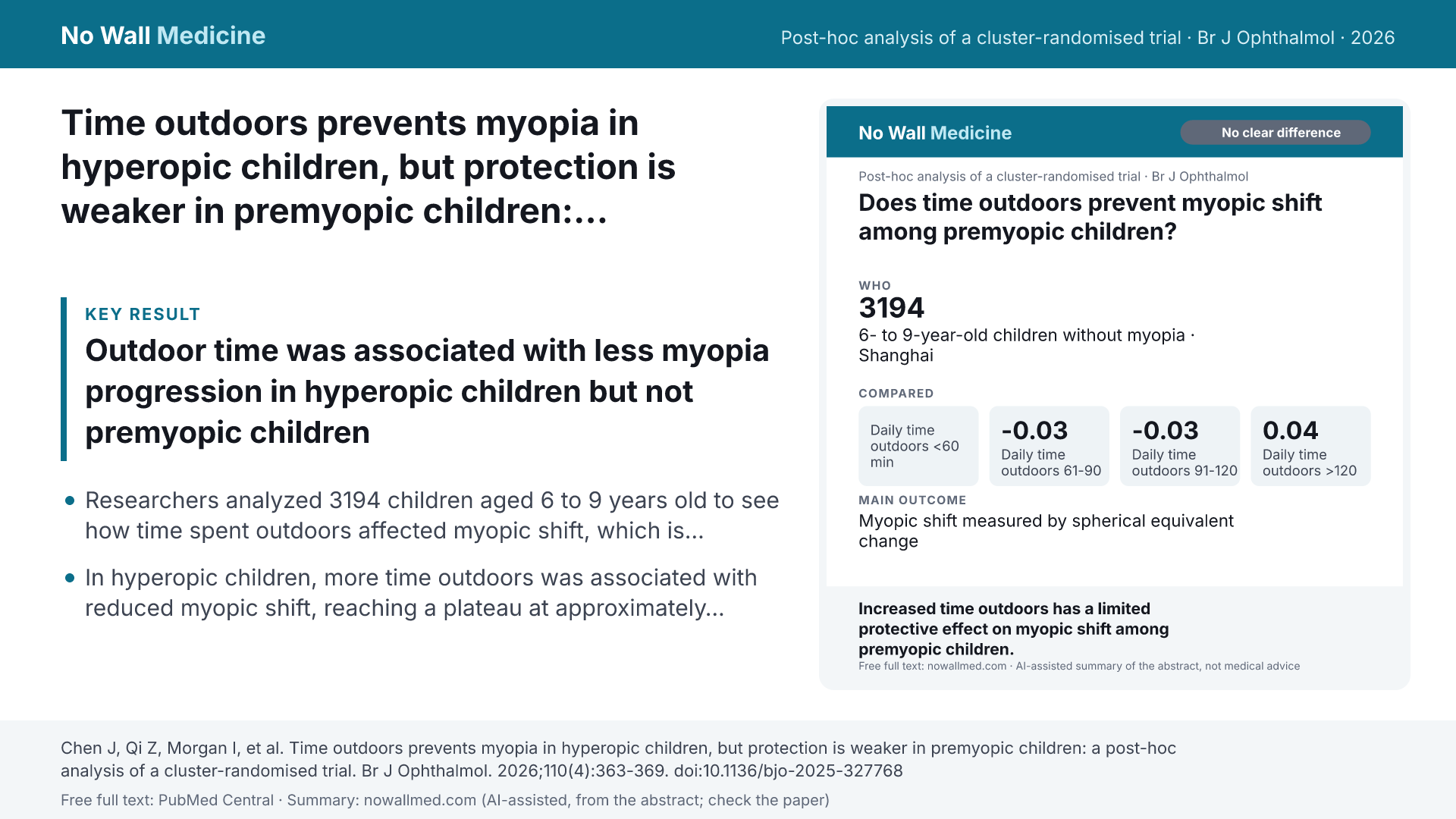
Outdoor time was associated with less myopia progression in hyperopic children but not premyopic children
Time outdoors prevents myopia in hyperopic children, but protection is weaker in premyopic children: a post-hoc analysis of a cluster-randomised trial
Post-hoc analysis of a cluster-randomised trialNo clear difference
Does time outdoors prevent myopic shift among premyopic children?
Who
3194
6- to 9-year-old children without myopia · Shanghai
Compared
Daily time outdoors <60 min
-0.03Daily time outdoors 61-90 min/d (95% CI -0.10 to 0.05)
-0.03Daily time outdoors 91-120 min/d (95% CI -0.11 to 0.05)
0.04Daily time outdoors >120 min/d (95% CI -0.05 to 0.14)
Main outcome
Myopic shift measured by spherical equivalent change
Bottom line: Increased time outdoors has a limited protective effect on myopic shift among premyopic children.
Br J Ophthalmol · 2026-03-20Download image
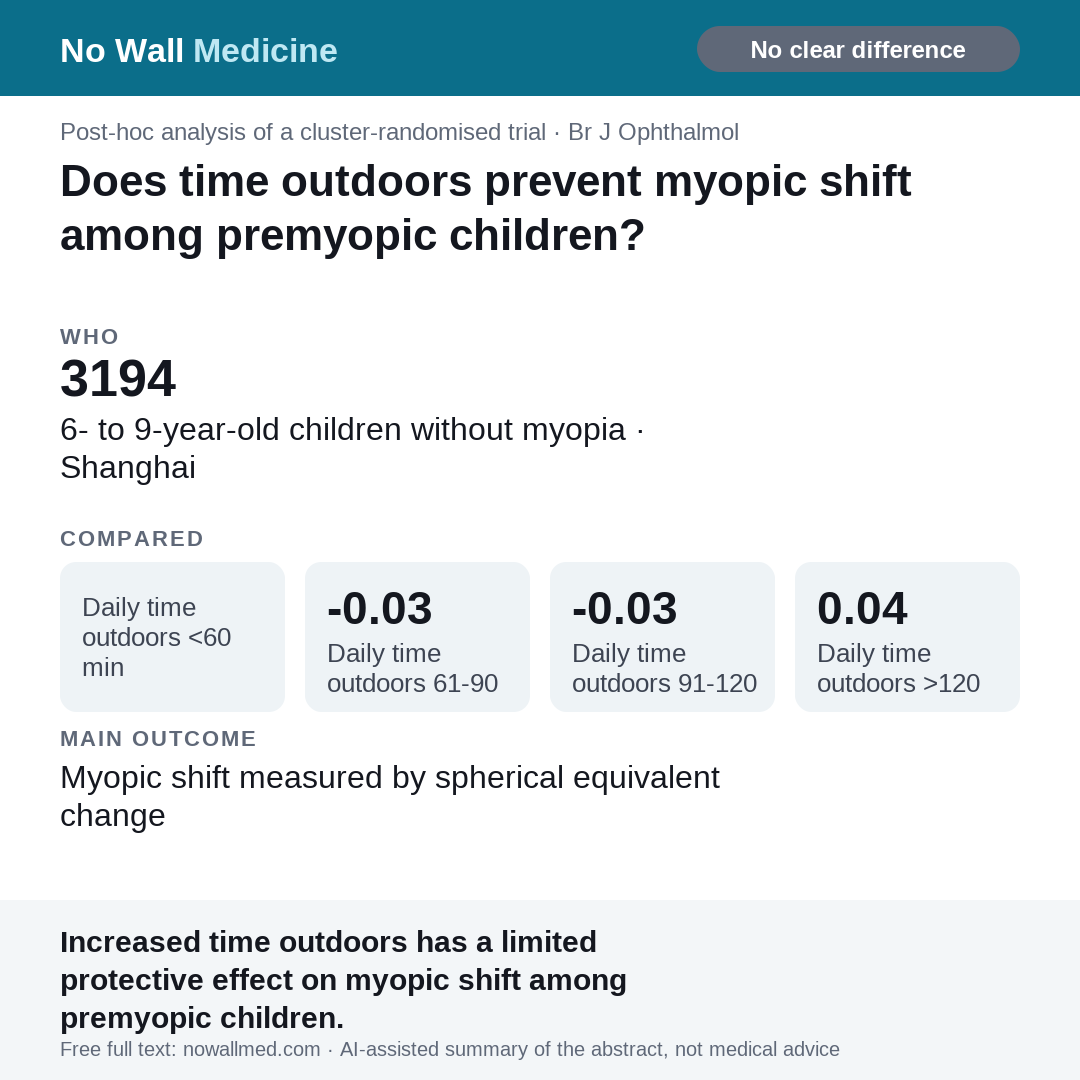
Clinical question: Does time outdoors prevent myopic shift among premyopic children?
Key points
- Researchers analyzed 3194 children aged 6 to 9 years old to see how time spent outdoors affected myopic shift, which is the change in eye focus measurement.
- In hyperopic children, more time outdoors was associated with reduced myopic shift, reaching a plateau at approximately 120 min/day.
- For premyopic children, the relationship between outdoor time and myopic shift was J-shaped and did not reach statistical significance for any subgroup.
Headline and key points written with AI from the paper’s abstract, with every number checked against it. Read the paper before relying on them.
Was this summary helpful?
Abstract
Aims
To investigate the effect of time outdoors on myopic shift among premyopic children. Methods
Post-hoc analysis was nested in a cluster-randomised trial of the Shanghai Time Outside to Reduce Myopia (STORM) study. 6- to 9-year-old participants without myopia from the STORM study, who wore wristwatches to monitor time outdoors from 2017 to 2018, were included. Participants were all examined with cycloplegic refraction. Daily time outdoors was objectively monitored with the wearable smartwatch. Premyopia was defined as a cycloplegic spherical equivalent (SE) from -0.50 to +0.75 (inclusive) dioptres (D). Myopic shift was SE change from baseline to 1 year follow-up. Results
Among 3194 participants (1369 premyopic; mean age 8.2±0.6 years; 49.5% boys), there were no statistical differences between premyopic and hyperopic children in time outdoors (p=0.303). Hyperopes showed reduced myopic shift with increasing outdoor time (plateau at about 120 min/day). However, premyopes exhibited a J-shaped relationship between time outdoors and myopic shift. In comparison to the subgroup with daily time outdoors <60 min, the difference in SE change in the other subgroups was not statistically significant (61-90 min/d: -0.03 (95% CI -0.10 to 0.05); 91-120 min/d: -0.03 (95% CI -0.11 to 0.05)). The reduced myopic shift was only observed with time outdoors >120 min/d, although it was still not statistically significant (>120 min/d: 0.04 (95% CI -0.05 to 0.14)). Conclusions
Among premyopic children, increased time outdoors has a limited protective effect on myopic shift, suggesting longer duration of time outdoors or additional interventions to prevent or delay myopia onset in this population.
Abstract reproduced under the article’s CC BY NC licence.
Subject terms
Cite this article
Chen J, Qi Z, Morgan I, et al. Time outdoors prevents myopia in hyperopic children, but protection is weaker in premyopic children: a post-hoc analysis of a cluster-randomised trial. Br J Ophthalmol. 2026;110(4):363-369. doi:10.1136/bjo-2025-327768
Spotted a mistake? Suggest a correction