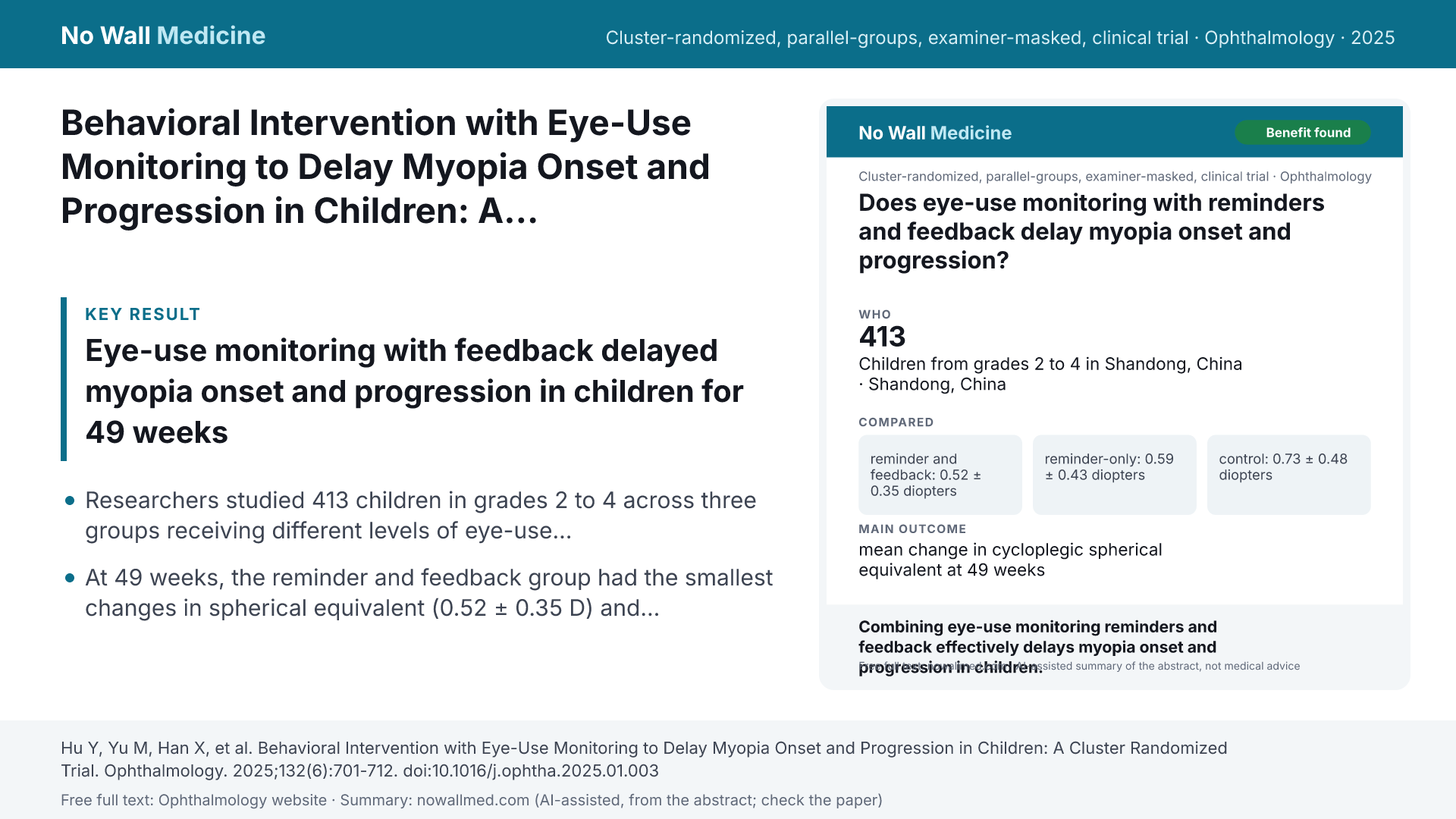
Eye-use monitoring with feedback delayed myopia onset and progression in children for 49 weeks
Behavioral Intervention with Eye-Use Monitoring to Delay Myopia Onset and Progression in Children: A Cluster Randomized Trial
Cluster-randomized, parallel-groups, examiner-masked, clinical trialBenefit found
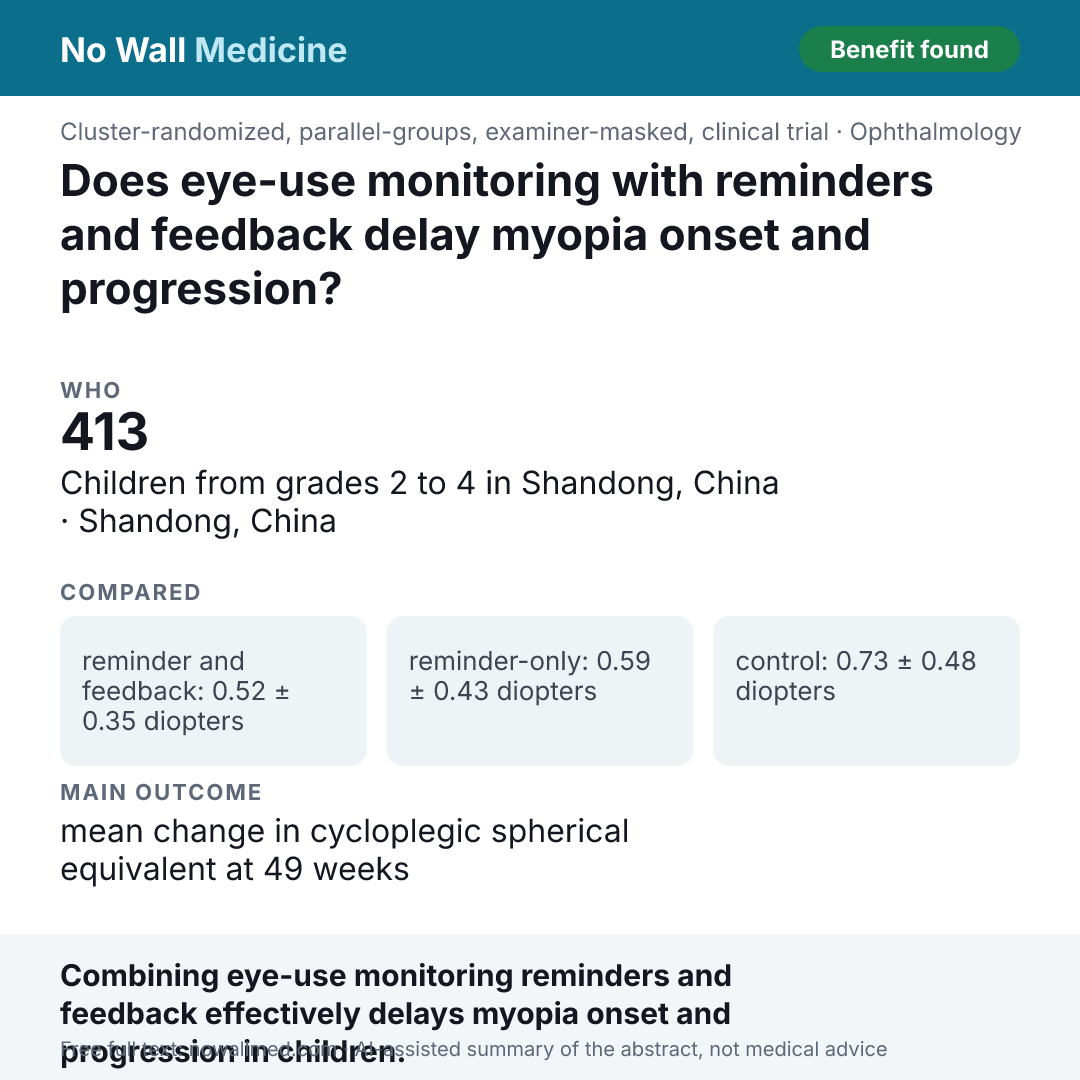
Does eye-use monitoring with reminders and feedback delay myopia onset and progression?
Who
413
Children from grades 2 to 4 in Shandong, China · Shandong, China
Compared
reminder and feedback: 0.52 ± 0.35 diopters
reminder-only: 0.59 ± 0.43 diopters
control: 0.73 ± 0.48 diopters
Main outcome
mean change in cycloplegic spherical equivalent at 49 weeks
Bottom line: Combining eye-use monitoring reminders and feedback effectively delays myopia onset and progression in children.
Limitation: differences diminished by the 98-week follow-up
Ophthalmology · 2025-01-09 · Save PNG
Clinical question: Does eye-use monitoring with reminders and feedback delay myopia onset and progression?
Key points
- Researchers studied 413 children in grades 2 to 4 across three groups receiving different levels of eye-use monitoring technology.
- At 49 weeks, the reminder and feedback group had the smallest changes in spherical equivalent (0.52 ± 0.35 D) and axial length (0.30 ± 0.14 mm).
- Myopia incidence was 13.3% in the reminder and feedback group compared to 21.6% in the reminder-only group and 27.8% in the control group.
Headline and key points written with AI from the paper’s abstract, with every number checked against it. Read the paper before relying on them.
Was this summary helpful?
Subject terms
Headline, design, result, key points, caveat and citation as plain text.
Cite this article
Hu Y, Yu M, Han X, et al. Behavioral Intervention with Eye-Use Monitoring to Delay Myopia Onset and Progression in Children: A Cluster Randomized Trial. Ophthalmology. 2025;132(6):701-712. doi:10.1016/j.ophtha.2025.01.003
Spotted a mistake? Suggest a correction