Repeated low-level red light treatment delayed myopia progression and reduced myopia incidence in children
Effectiveness of repeated low-level red light in myopia prevention and myopia control
Randomized trialBenefit found
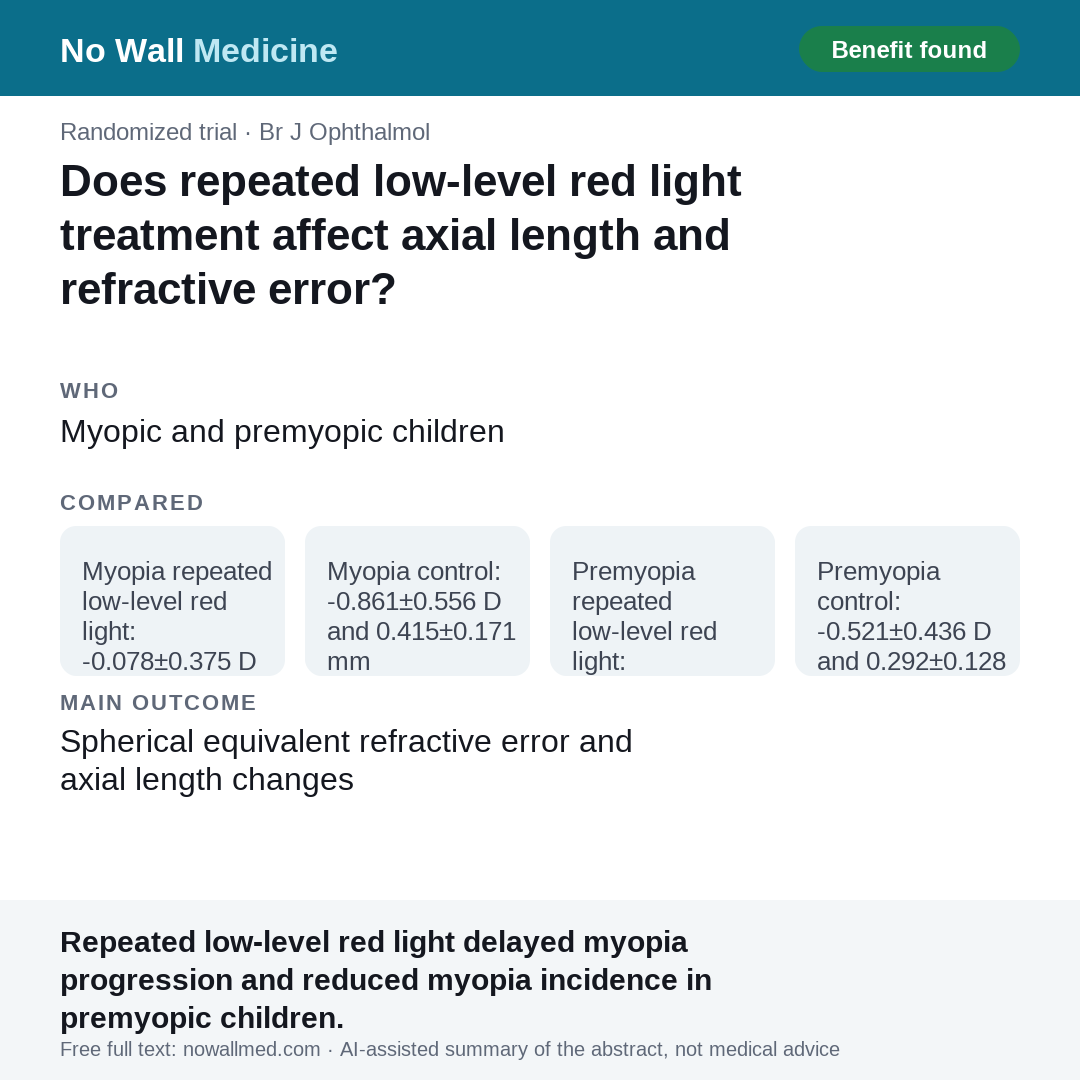
Does repeated low-level red light treatment affect axial length and refractive error?
Who
Myopic and premyopic children
Compared
Myopia repeated low-level red light: -0.078±0.375 D and 0.033±0.123 mm
Myopia control: -0.861±0.556 D and 0.415±0.171 mm
Premyopia repeated low-level red light: -0.181±0.417 D and 0.145±0.175 mm
Premyopia control: -0.521±0.436 D and 0.292±0.128 mm
Main outcome
Spherical equivalent refractive error and axial length changes
Bottom line: Repeated low-level red light delayed myopia progression and reduced myopia incidence in premyopic children.
Br J Ophthalmol · 2024-08-22Download image
Clinical question: Does repeated low-level red light treatment affect axial length and refractive error?
Why it matters: It was unknown if repeated low-level red light treatment could control axial length growth and refractive error changes in myopic and premyopic children.
Key points
- Children with myopia or premyopia were randomly assigned to receive 3 minute sessions of repeated low-level red light twice daily for 12 months.
- In the premyopia group, the incidence of myopia was 2.5% in the red light group compared to 19.4% in the control group.
- In the myopia group, spherical equivalent refractive error changed by -0.078±0.375 D for the red light group versus -0.861±0.556 D for the control group.
Headline and key points written with AI from the paper’s abstract, with every number checked against it. Read the paper before relying on them.
Was this summary helpful?
Abstract
Background/aims
To compare the effects of repeated low-level red light (RLRL) treatment on axial length growth and refractive error changes in myopic and premyopic children. Methods
Subjects were assigned randomly to four subgroups: myopia-RLRL group (M-RL), myopia-control group (M-C), premyopia-RLRL group (PM-RL) and premyopia-control group (PM-C). Subjects in the RLRL group completed a 12-month treatment composed of a 3 min RLRL treatment session twice daily, with an interval of at least 4 hours, for 7 days per week. Visits were scheduled before and at 1-month, 3-month, 6-month, 9-month and 12-month follow-up after the treatment. Repeated-measures analysis of variance was used to compare the spherical equivalent refractive errors (SE) and axial length (AL) changes between the groups across the treatment period. Results
After 12 months of treatment, in the myopia group, SE and AL changes were -0.078±0.375 D and 0.033±0.123 mm for M-RL and -0.861±0.556 D and 0.415±0.171 mm for M-C; in the premyopia group, the progression of SE and AL was -0.181±0.417 D and 0.145±0.175 mm for PM-RL and -0.521±0.436 D and 0.292±0.128 mm for PM-C. PM-RL indicated a lower myopia incidence than PM-C (2.5% vs 19.4%). Additionally, the percentage of AL shortening in the M-RL was higher than that in the PM-RL before the 9-month follow-up. Conclusion
RLRL effectively delayed myopia progression in children with myopia and reduced the incidence of myopia in premyopic children. Moreover, RLRL exhibited a stronger impact on myopic children compared with premyopic individuals.
Abstract reproduced under the article’s CC BY NC licence.
Subject terms
Cite this article
Liu G, Rong H, Liu Y, Wang B, Du B, Song D. Effectiveness of repeated low-level red light in myopia prevention and myopia control. Br J Ophthalmol. 2024. doi:10.1136/bjo-2023-324260
Spotted a mistake? Suggest a correction
Top studies every Monday
The week’s key trials and guidelines in your specialties, plus any topics you follow. By email, free.
Get the weekly digest