Five days of short exercise sessions showed similar hypoglycemia levels to two longer sessions
Time spent in hypoglycemia is comparable when the same amount of exercise is performed 5 or 2 days weekly: a randomized crossover study in people with type 1 diabetes
Randomized crossover studyNo clear difference
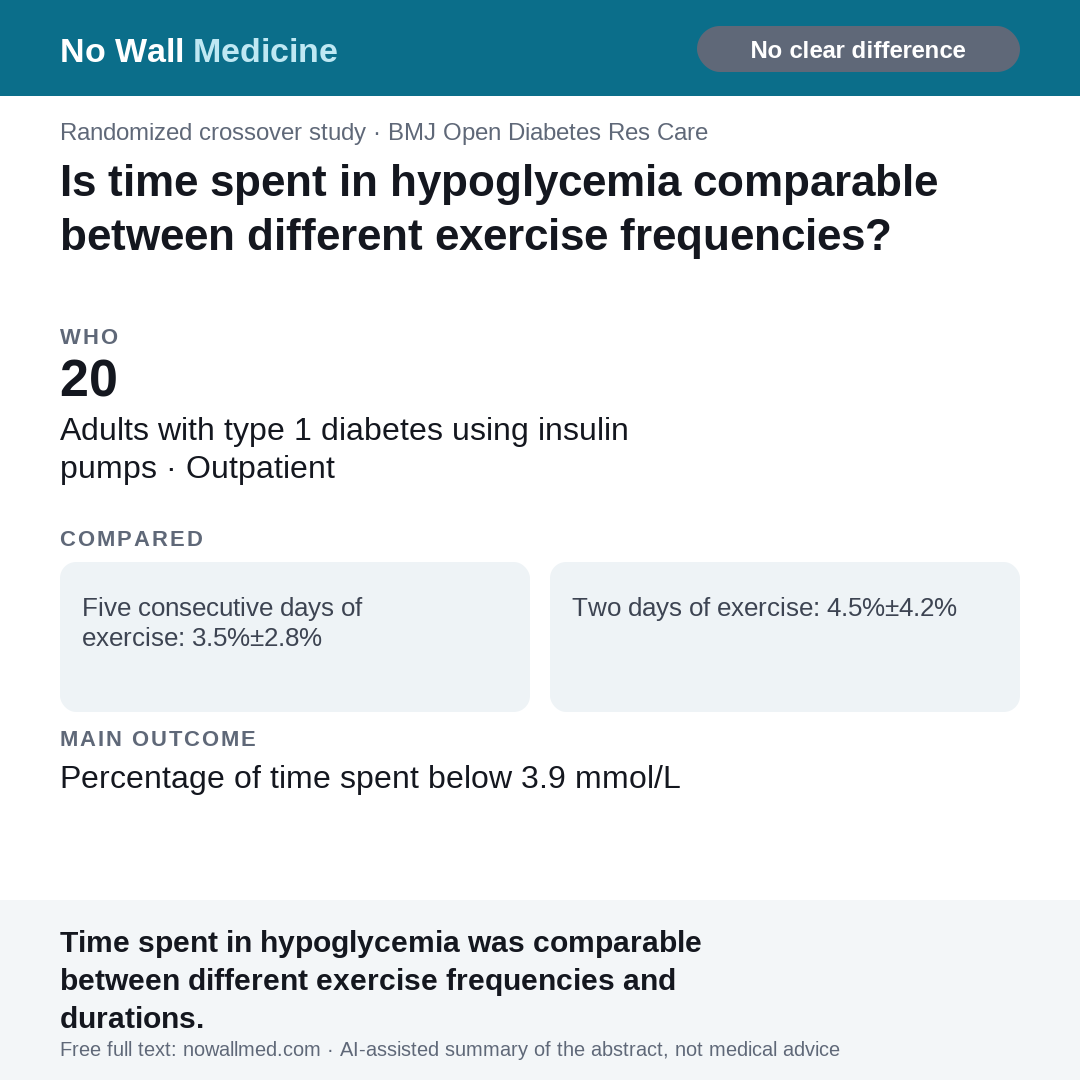
Is time spent in hypoglycemia comparable between different exercise frequencies?
Who
20
Adults with type 1 diabetes using insulin pumps · Outpatient
Compared
Five consecutive days of exercise: 3.5%±2.8%
Two days of exercise: 4.5%±4.2%
Main outcome
Percentage of time spent below 3.9 mmol/L
Bottom line: Time spent in hypoglycemia was comparable between different exercise frequencies and durations.
BMJ Open Diabetes Res Care · 2021-01-29Download image
Clinical question: Is time spent in hypoglycemia comparable between different exercise frequencies?
Why it matters: It is unknown how the frequency and duration of physical activity affect the risk of hypoglycemia in people with type 1 diabetes.
Key points
- Twenty adults with type 1 diabetes were studied using a randomized crossover design to compare five daily exercise sessions against two longer sessions per week.
- The percentage of time spent in hypoglycemia, defined as glucose below 3.9 mmol/L, was 3.5%±2.8% for the five-day group and 4.5%±4.2% for the two-day group.
- No significant differences were observed in mean glucose, glycemic variability, or time spent in target or high glucose ranges between the two exercise frequencies.
Headline and key points written with AI from the paper’s abstract, with every number checked against it. Read the paper before relying on them.
Was this summary helpful?
Abstract
Introduction
People with type 1 diabetes are recommended to exercise regularly. However, limited evidence exists on how frequency and duration of exercise affect the risk of hypoglycemia. The study aimed to compare the percentage of time spent in hypoglycemia between two 5-day periods with different frequency and duration of physical activity. Research design and methods
In this outpatient randomized crossover study, 26 participants aged 18-65 years with type 1 diabetes for ≥2 years and insulin pump use for ≥1 year were included. After a 7-day observation period, participants completed two 5-day intervention periods separated by a washout period of at least 14 days. One period included five exercise sessions on 5 consecutive days (5S), each consisting of 4 min of resistance training and 30 min of aerobic exercise. Another period included two exercise sessions on 2 days with at least 2 days in between (2S), each consisting of 10 min of resistance training and 75 min of aerobic exercise. During each period, participants performed in total 150 min of aerobic exercise and 20 min of resistance training and wore continuous glucose monitors (Dexcom G6) and accelerometers (ActiGraph wGT3X-BT). Results
Twenty insulin pump-treated adults (10 women) with type 1 diabetes completed the study. The baseline median (range) age was 48 (24-64) years, glycated hemoglobin 55 (44-66) mmol/mol, diabetes duration 24 (8-57) years, and body mass index 28.4 (22.3-35.8) kg/m2. No differences were observed between 5S and 2S in the percentage (mean±SD) of time spent below 3.9 mmol/L (3.5%±2.8% vs 4.5%±4.2%, p=0.28), time spent in 3.9-10.0 mmol/L (65.3%±15.0% vs 68.5%±13.6%, p=0.31), time spent above 10.0 mmol/L (31.2%±16.4% vs 27.3%±14.5%, p=0.15), mean glucose (8.7±1.3 mmol/L vs 8.5±1.2 mmol/L, p=0.33) and glycemic variability (35.8%±5.3% vs 35.8%±6.6%, p=0.97). Conclusions
Time spent in hypoglycemia was comparable between the two 5-day periods with different duration and frequency of physical activity. Trial registration number
NCT04089462.
Abstract reproduced under the article’s CC BY NC licence.
Subject terms
Cite this article
Steineck IIK, Ranjan AG, Schmidt S, Norgaard K. Time spent in hypoglycemia is comparable when the same amount of exercise is performed 5 or 2 days weekly: a randomized crossover study in people with type 1 diabetes. BMJ Open Diabetes Res Care. 2021. doi:10.1136/bmjdrc-2020-001919
Spotted a mistake? Suggest a correction
Top studies every Monday
The week’s key trials and guidelines in your specialties, plus any topics you follow. By email, free.
Get the weekly digest