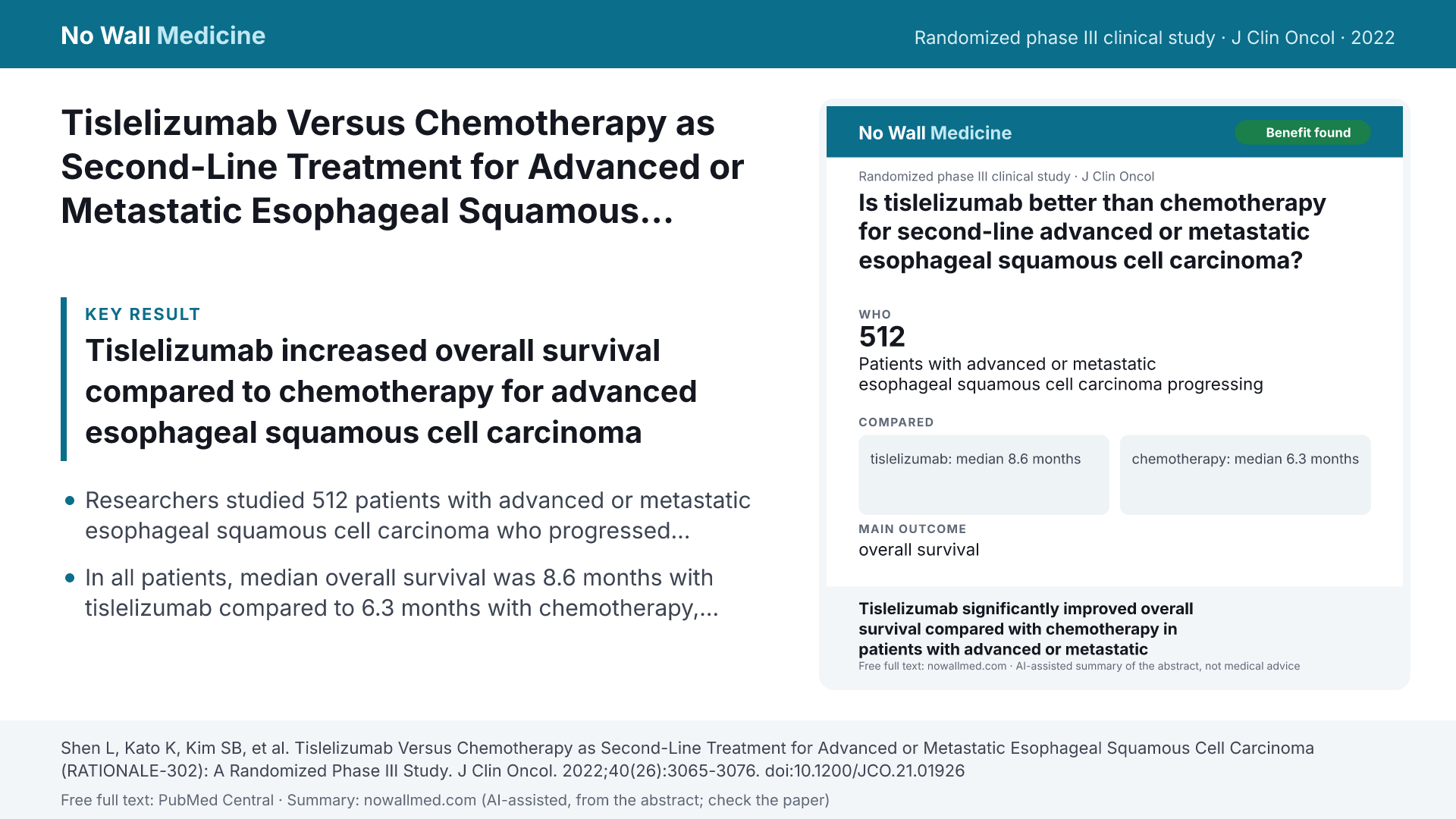
Tislelizumab Versus Chemotherapy as Second-Line Treatment for Advanced or Metastatic Esophageal Squamous Cell Carcinoma (RATIONALE-302): A Randomized Phase III Study
Key result: Tislelizumab increased overall survival compared to chemotherapy for advanced esophageal squamous cell carcinoma
Key points
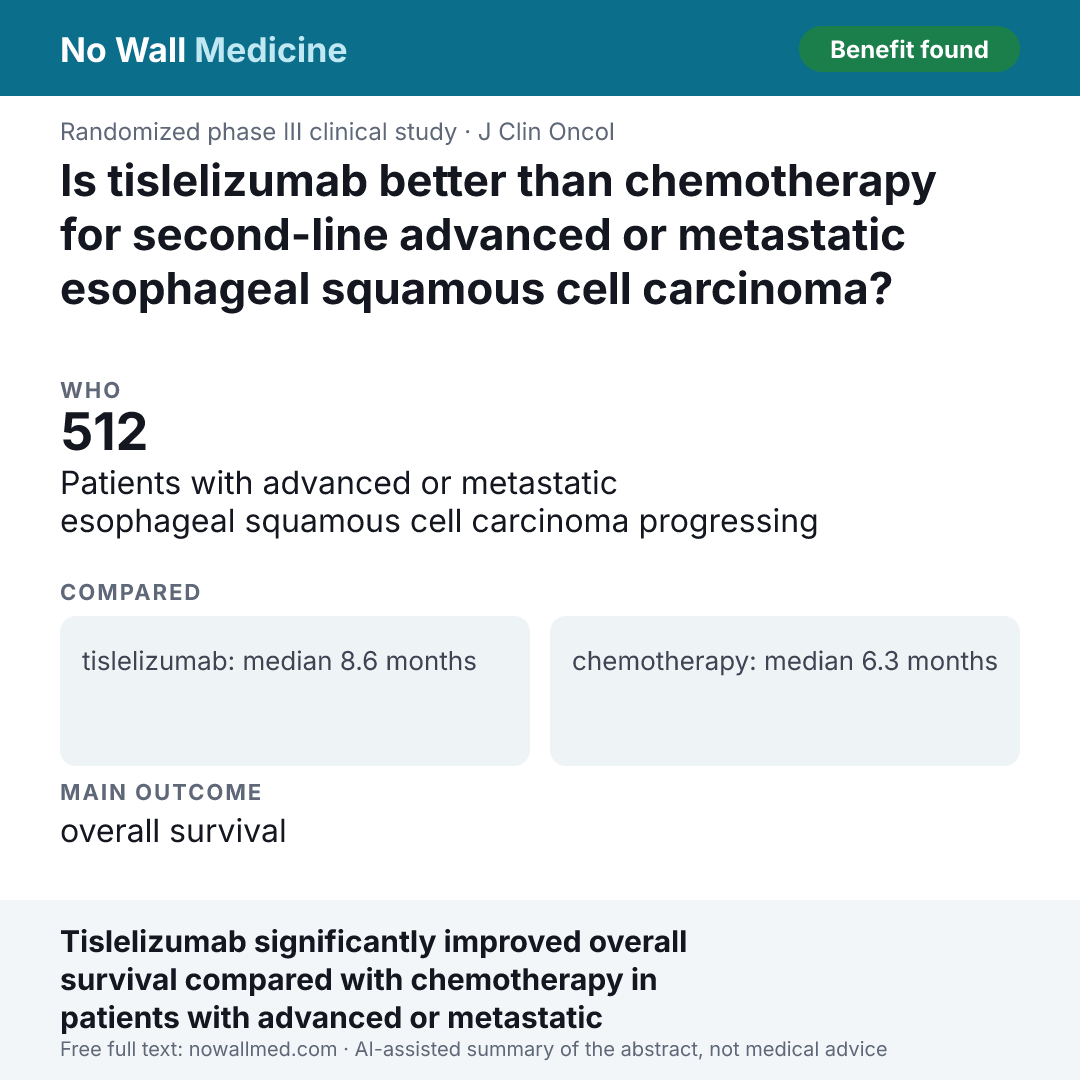
- Researchers studied 512 patients with advanced or metastatic esophageal squamous cell carcinoma who progressed after first-line treatment and were assigned to receive either tislelizumab or chemotherapy.
- In all patients, median overall survival was 8.6 months with tislelizumab compared to 6.3 months with chemotherapy, and patients with a tumor area positivity score of 10% or more lived 10.3 months versus 6.8 months.
- Tislelizumab was associated with a 20.3% objective response rate compared to 9.8% for chemotherapy and fewer grade 3 or higher treatment-related adverse events at 18.8% versus 55.8%.
Why it matters: Treatment options are limited for patients with advanced or metastatic esophageal squamous cell carcinoma after they progress on first-line systemic therapy.
Discussion prompts
- Would these patients look like yours? Who was left out?
- Is the main outcome one that matters to patients?
- Is the difference large enough to change what you do?
Cite: Shen L, Kato K, Kim SB, et al. Tislelizumab Versus Chemotherapy as Second-Line Treatment for Advanced or Metastatic Esophageal Squamous Cell Carcinoma (RATIONALE-302): A Randomized Phase III Study. J Clin Oncol. 2022. doi:10.1200/JCO.21.01926
Free full text: PubMed Central · Summary and visual abstract: nowallmed.com/a/tislelizumab-versus-chemotherapy-as-second-line-treatment-for-ouacwp/ (AI-assisted from the abstract; check the paper before relying on it).