Titanium-nitride-oxide-coated stents and everolimus-eluting stents showed similar 5-year outcomes in acute coronary syndrome
Titanium-Nitride-Oxide-Coated vs Everolimus-Eluting Stents in Acute Coronary Syndrome: 5-Year Clinical Outcomes of the TIDES-ACS Randomized Clinical Trial
Multicenter, randomized, controlled, open-label trialNo clear difference
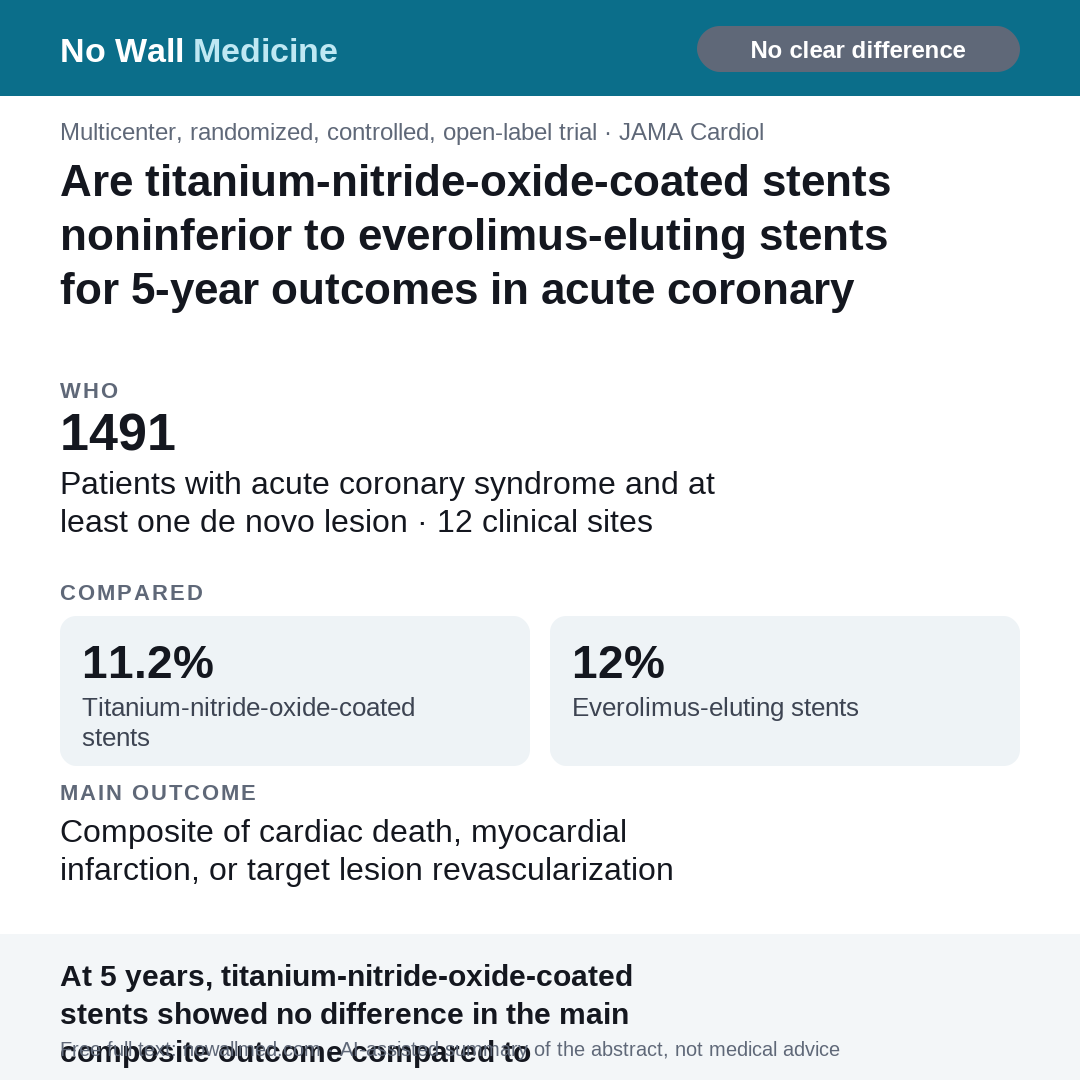
Are titanium-nitride-oxide-coated stents noninferior to everolimus-eluting stents for 5-year outcomes in acute coronary syndrome?
Who
1491
Patients with acute coronary syndrome and at least one de novo lesion · 12 clinical sites in 5 European countries
Compared
11.2%Titanium-nitride-oxide-coated stents (111/989)
12%Everolimus-eluting stents (60/502)
Main outcome
Composite of cardiac death, myocardial infarction, or target lesion revascularization
Result: hazard ratio 0.94 (95% CI, 0.69-1.28)
Bottom line: At 5 years, titanium-nitride-oxide-coated stents showed no difference in the main composite outcome compared to everolimus-eluting stents.
JAMA Cardiol · 2023-05-19Download image
Clinical question: Are titanium-nitride-oxide-coated stents noninferior to everolimus-eluting stents for 5-year outcomes in acute coronary syndrome?
Why it matters: Long-term clinical outcomes for patients with acute coronary syndrome treated with titanium-nitride-oxide-coated stents, which are neither drug-eluting nor bare metal stents, were unknown.
Key points
- The trial randomized 1491 patients with acute coronary syndrome to receive either titanium-nitride-oxide-coated stents or everolimus-eluting stents, which are drug-releasing stents.
- At 5 years, the main composite outcome of cardiac death, heart attack, or repeat procedure occurred in 11.2% of the titanium-nitride-oxide group versus 12% of the everolimus-eluting group.
- The rate of cardiac death was 0.9% in the titanium-nitride-oxide group compared to 3.0% in the everolimus-eluting group, while stent thrombosis was 1.2% versus 2.8%.
Headline and key points written with AI from the paper’s abstract, with every number checked against it. Read the paper before relying on them.
Was this summary helpful?
Subject terms
Cite this article
Bouisset F, Sia J, Mizukami T, Karjalainen PP, Tonino PAL, Pijls NHJ. Titanium-Nitride-Oxide-Coated vs Everolimus-Eluting Stents in Acute Coronary Syndrome: 5-Year Clinical Outcomes of the TIDES-ACS Randomized Clinical Trial. JAMA Cardiol. 2023. doi:10.1001/jamacardio.2023.1373
Spotted a mistake? Suggest a correction
Top studies every Monday
The week’s key trials and guidelines in your specialties, plus any topics you follow. By email, free.
Get the weekly digest