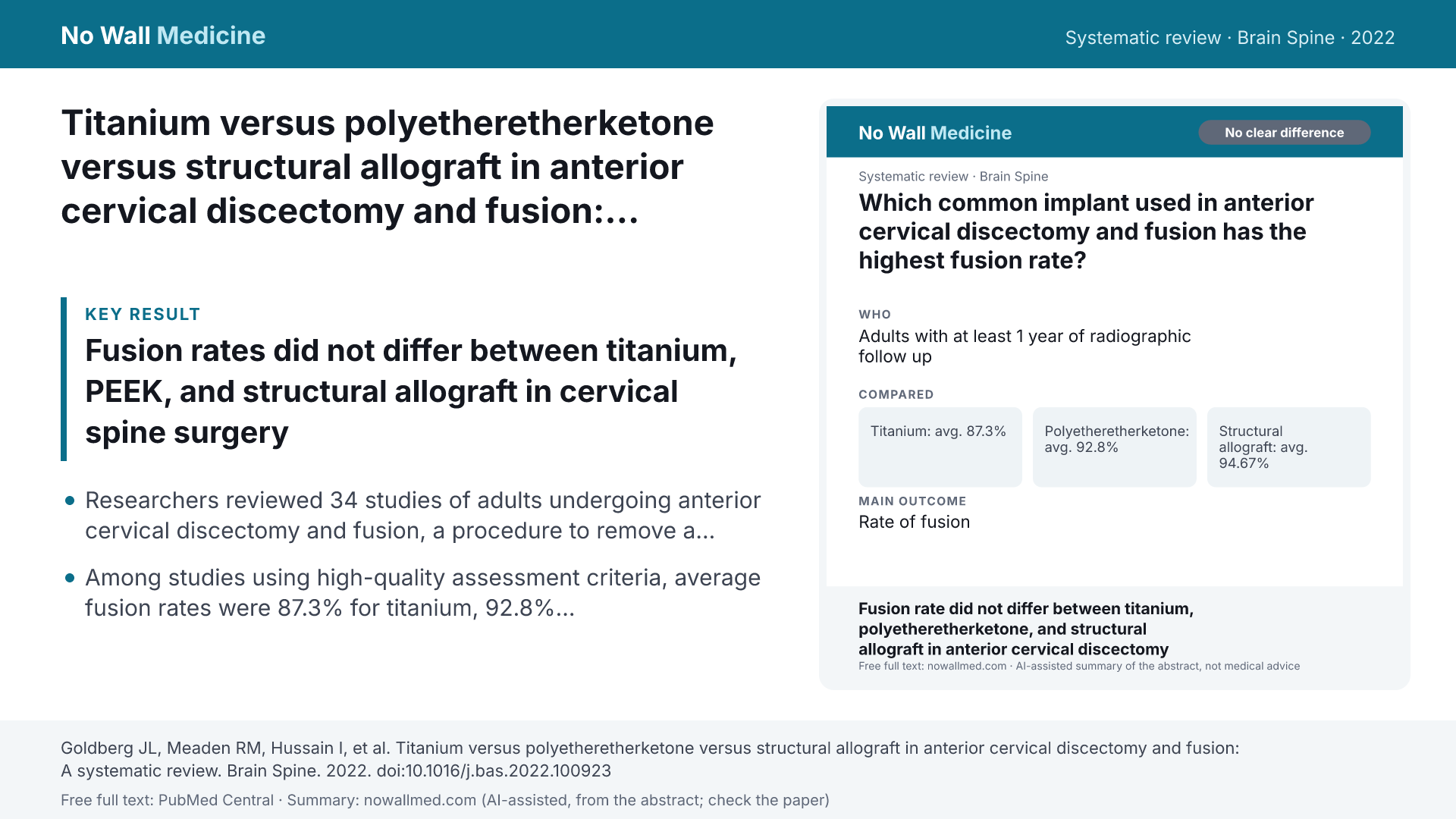
Fusion rates did not differ between titanium, PEEK, and structural allograft in cervical spine surgery
Titanium versus polyetheretherketone versus structural allograft in anterior cervical discectomy and fusion: A systematic review
Systematic reviewNo clear difference
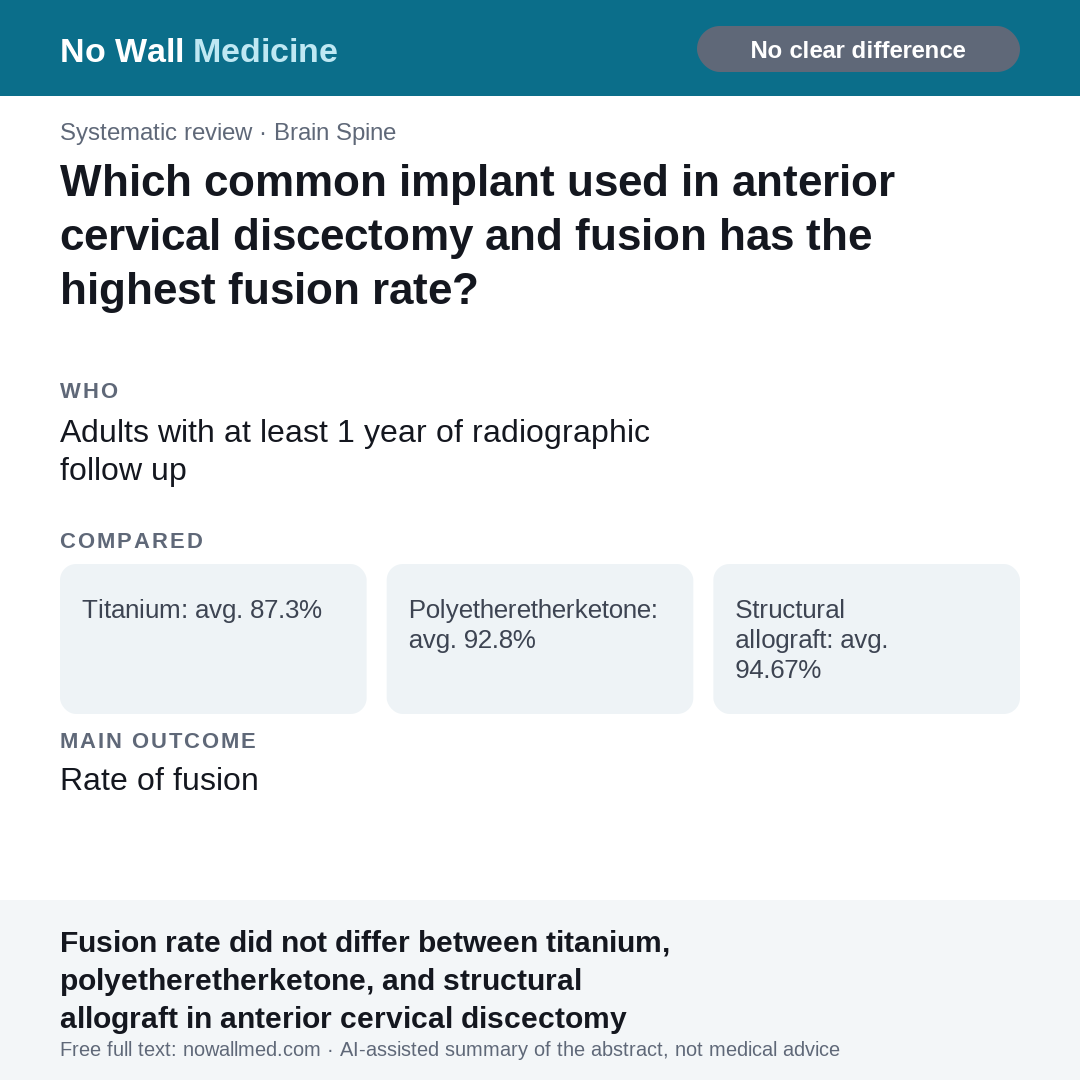
Which common implant used in anterior cervical discectomy and fusion has the highest fusion rate?
Who
Adults with at least 1 year of radiographic follow up
Compared
Titanium: avg. 87.3%
Polyetheretherketone: avg. 92.8%
Structural allograft: avg. 94.67%
Main outcome
Rate of fusion
Bottom line: Fusion rate did not differ between titanium, polyetheretherketone, and structural allograft in anterior cervical discectomy and fusion.
Brain Spine · 2022-08-22Download image
Clinical question: Which common implant used in anterior cervical discectomy and fusion has the highest fusion rate?
Why it matters: It is difficult to compare fusion rates because different studies use non-standardized methods to assess whether the bone has successfully fused.
Key points
- Researchers reviewed 34 studies of adults undergoing anterior cervical discectomy and fusion, a procedure to remove a disc and fuse the vertebrae.
- Among studies using high-quality assessment criteria, average fusion rates were 87.3% for titanium, 92.8% for polyetheretherketone, and 94.67% for structural allograft.
- The review found that the rate of bone fusion did not differ based on the type of graft used.
Headline and key points written with AI from the paper’s abstract, with every number checked against it. Read the paper before relying on them.
Was this summary helpful?
Cite this article
Goldberg JL, Meaden RM, Hussain I, et al. Titanium versus polyetheretherketone versus structural allograft in anterior cervical discectomy and fusion: A systematic review. Brain Spine. 2022. doi:10.1016/j.bas.2022.100923
Spotted a mistake? Suggest a correction