Titanium versus polyetheretherketone versus structural allograft in anterior cervical discectomy and fusion: A systematic review
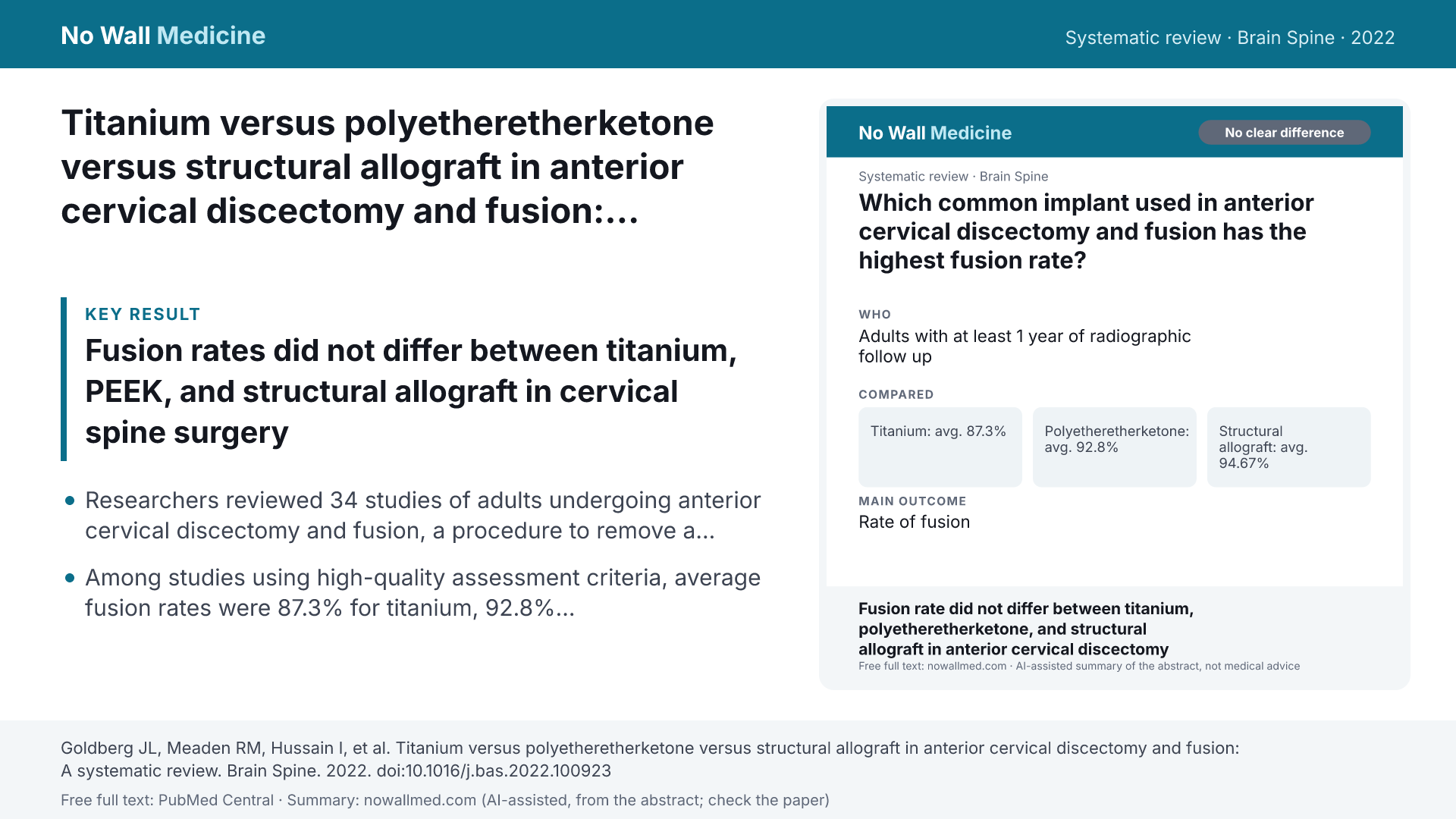
Key result: Fusion rates did not differ between titanium, PEEK, and structural allograft in cervical spine surgery
Systematic reviewNo clear difference
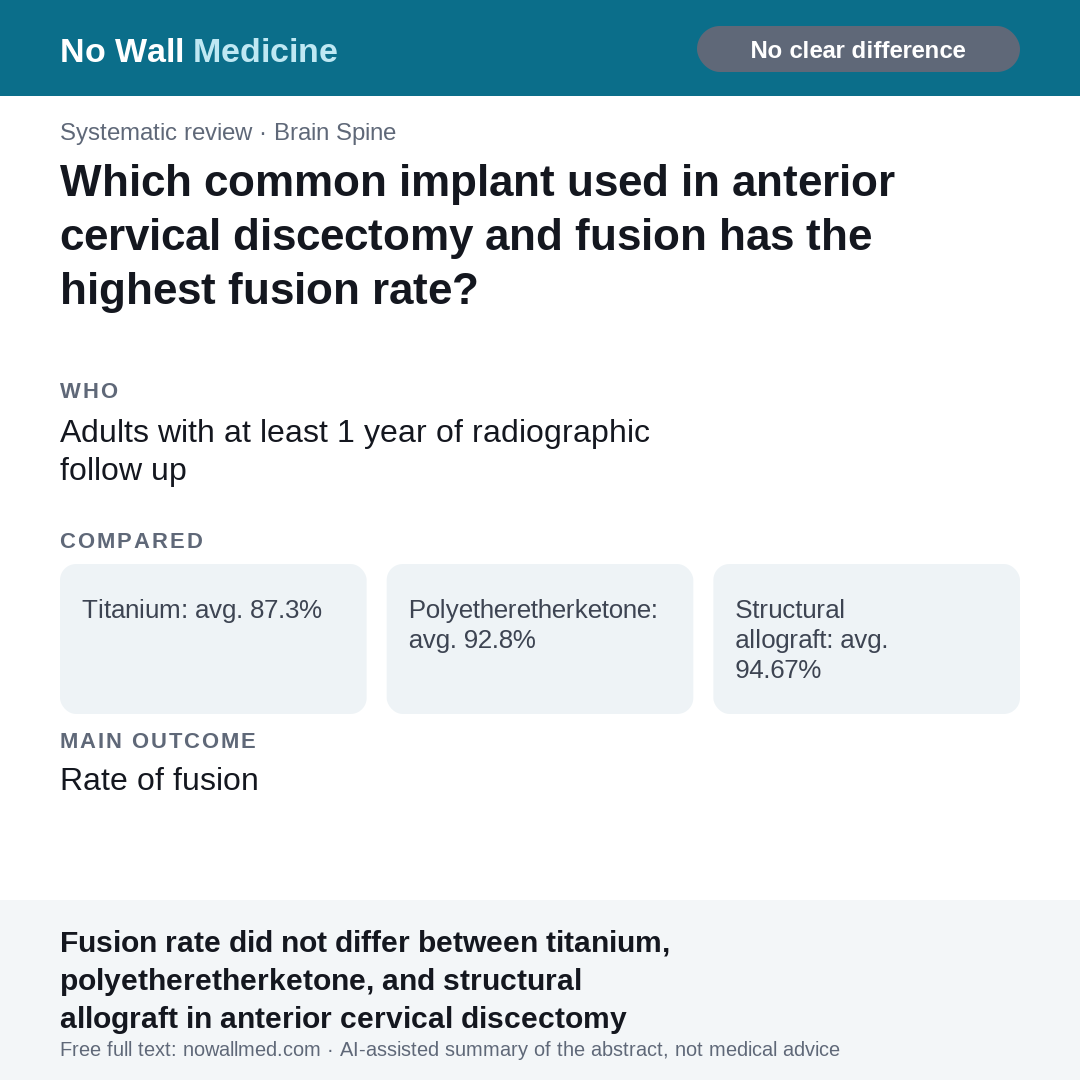
Which common implant used in anterior cervical discectomy and fusion has the highest fusion rate?
Who
Adults with at least 1 year of radiographic follow up
Compared
Titanium: avg. 87.3%
Polyetheretherketone: avg. 92.8%
Structural allograft: avg. 94.67%
Main outcome
Rate of fusion
Bottom line: Fusion rate did not differ between titanium, polyetheretherketone, and structural allograft in anterior cervical discectomy and fusion.
Brain Spine · 2022-08-22Download image
Key points
- Researchers reviewed 34 studies of adults undergoing anterior cervical discectomy and fusion, a procedure to remove a disc and fuse the vertebrae.
- Among studies using high-quality assessment criteria, average fusion rates were 87.3% for titanium, 92.8% for polyetheretherketone, and 94.67% for structural allograft.
- The review found that the rate of bone fusion did not differ based on the type of graft used.
Why it matters: It is difficult to compare fusion rates because different studies use non-standardized methods to assess whether the bone has successfully fused.
Discussion prompts
- Would these patients look like yours? Who was left out?
- Is the main outcome one that matters to patients?
- Is the difference large enough to change what you do?
Cite: Goldberg JL, Meaden RM, Hussain I, et al. Titanium versus polyetheretherketone versus structural allograft in anterior cervical discectomy and fusion: A systematic review. Brain Spine. 2022. doi:10.1016/j.bas.2022.100923
Free full text: PubMed Central · Summary and visual abstract: nowallmed.com/a/titanium-versus-polyetheretherketone-versus-structural-allograft-in-6r9d5q/ (AI-assisted from the abstract; check the paper before relying on it).