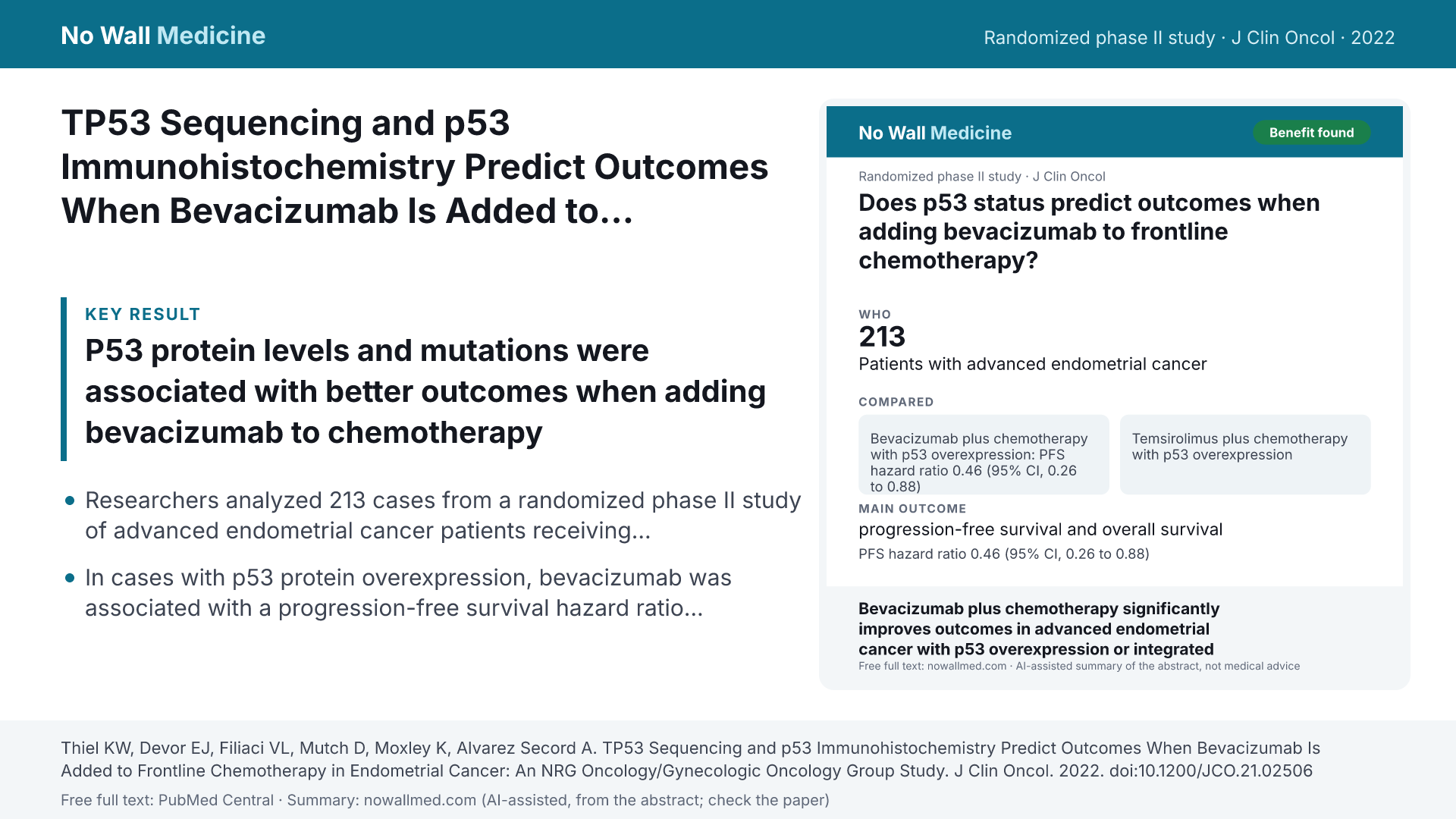
P53 protein levels and mutations were associated with better outcomes when adding bevacizumab to chemotherapy
TP53 Sequencing and p53 Immunohistochemistry Predict Outcomes When Bevacizumab Is Added to Frontline Chemotherapy in Endometrial Cancer: An NRG Oncology/Gynecologic Oncology Group Study
Randomized phase II studyBenefit found
Does p53 status predict outcomes when adding bevacizumab to frontline chemotherapy?
Who
213
Patients with advanced endometrial cancer
Compared
Bevacizumab plus chemotherapy with p53 overexpression: PFS hazard ratio 0.46 (95% CI, 0.26 to 0.88)
Temsirolimus plus chemotherapy with p53 overexpression
Main outcome
progression-free survival and overall survival
Result: PFS hazard ratio 0.46 (95% CI, 0.26 to 0.88)
Bottom line: Bevacizumab plus chemotherapy significantly improves outcomes in advanced endometrial cancer with p53 overexpression or integrated TP53 mutations.
J Clin Oncol · 2022-06-03Download image
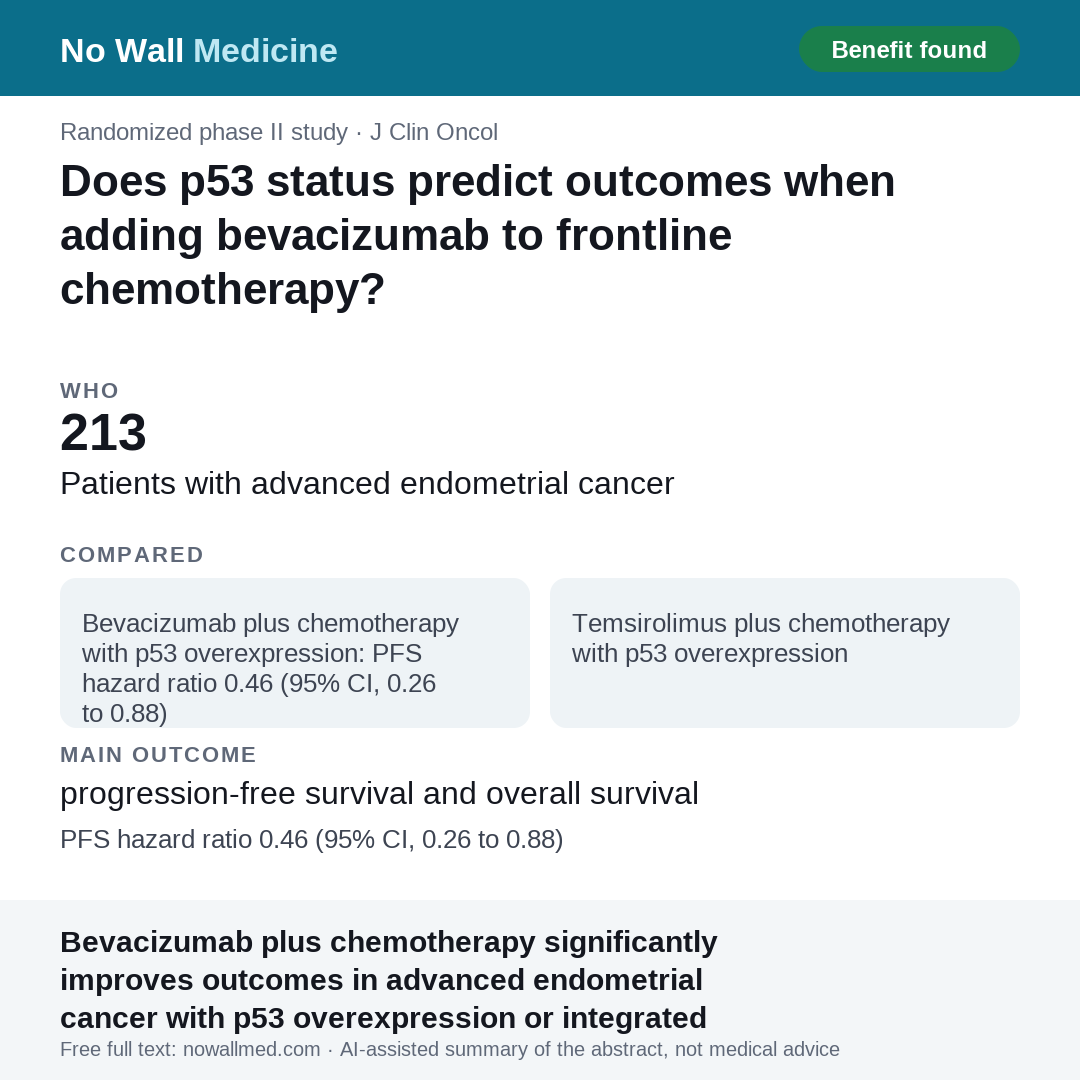
Clinical question: Does p53 status predict outcomes when adding bevacizumab to frontline chemotherapy?
Why it matters: It was unknown if p53 protein expression or TP53 gene sequencing could predict how patients with advanced endometrial cancer respond to bevacizumab added to chemotherapy.
Key points
- Researchers analyzed 213 cases from a randomized phase II study of advanced endometrial cancer patients receiving chemotherapy plus either bevacizumab or temsirolimus.
- In cases with p53 protein overexpression, bevacizumab was associated with a progression-free survival hazard ratio of 0.46 and an overall survival hazard ratio of 0.31.
- Patients with both TP53 missense mutations and p53 protein overexpression had a progression-free survival hazard ratio of 0.41 and an overall survival hazard ratio of 0.28.
Headline and key points written with AI from the paper’s abstract, with every number checked against it. Read the paper before relying on them.
Was this summary helpful?
Subject terms
Cite this article
Thiel KW, Devor EJ, Filiaci VL, Mutch D, Moxley K, Alvarez Secord A. TP53 Sequencing and p53 Immunohistochemistry Predict Outcomes When Bevacizumab Is Added to Frontline Chemotherapy in Endometrial Cancer: An NRG Oncology/Gynecologic Oncology Group Study. J Clin Oncol. 2022. doi:10.1200/JCO.21.02506
Spotted a mistake? Suggest a correction