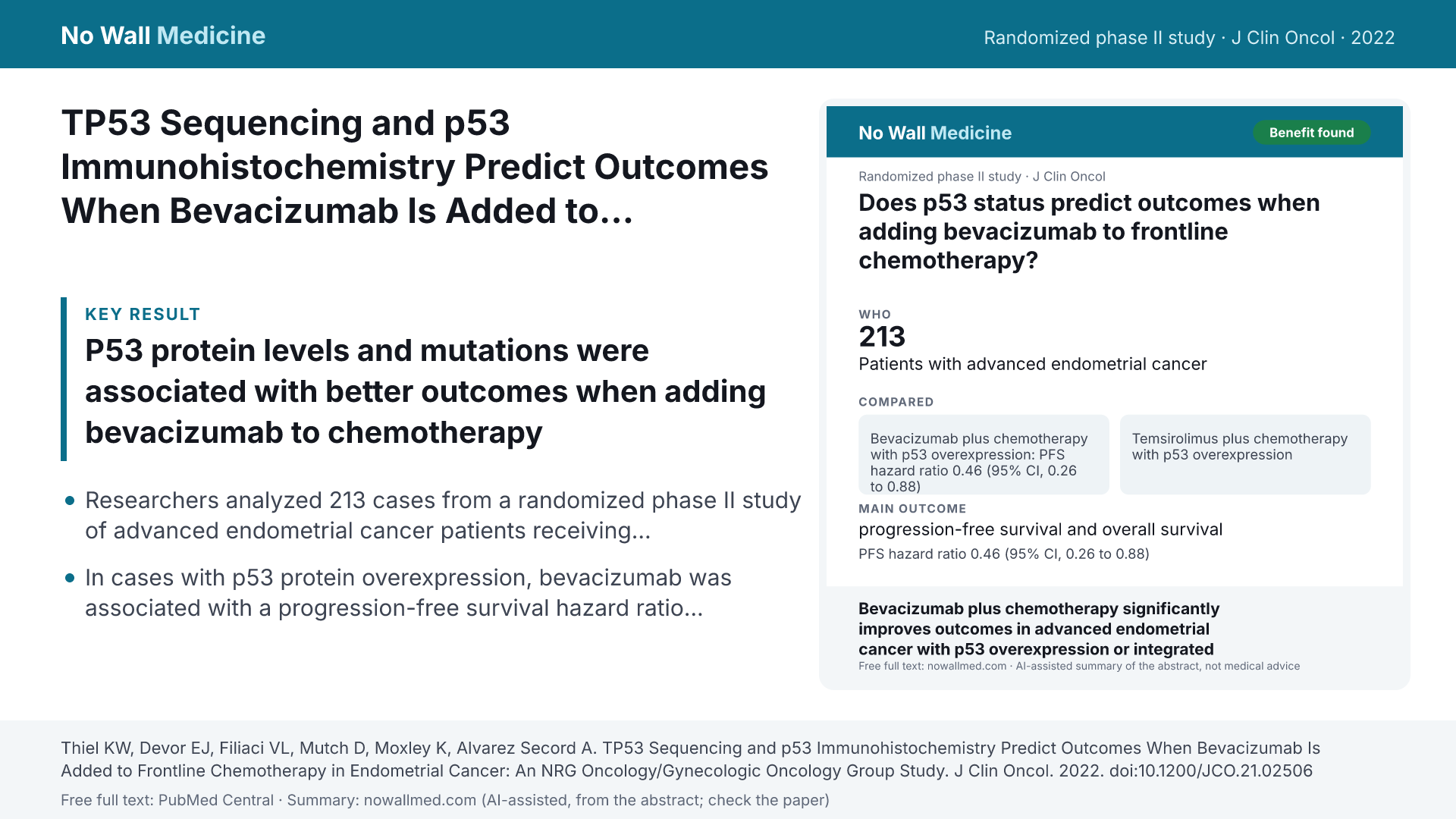
TP53 Sequencing and p53 Immunohistochemistry Predict Outcomes When Bevacizumab Is Added to Frontline Chemotherapy in Endometrial Cancer: An NRG Oncology/Gynecologic Oncology Group Study
Key result: P53 protein levels and mutations were associated with better outcomes when adding bevacizumab to chemotherapy
Key points
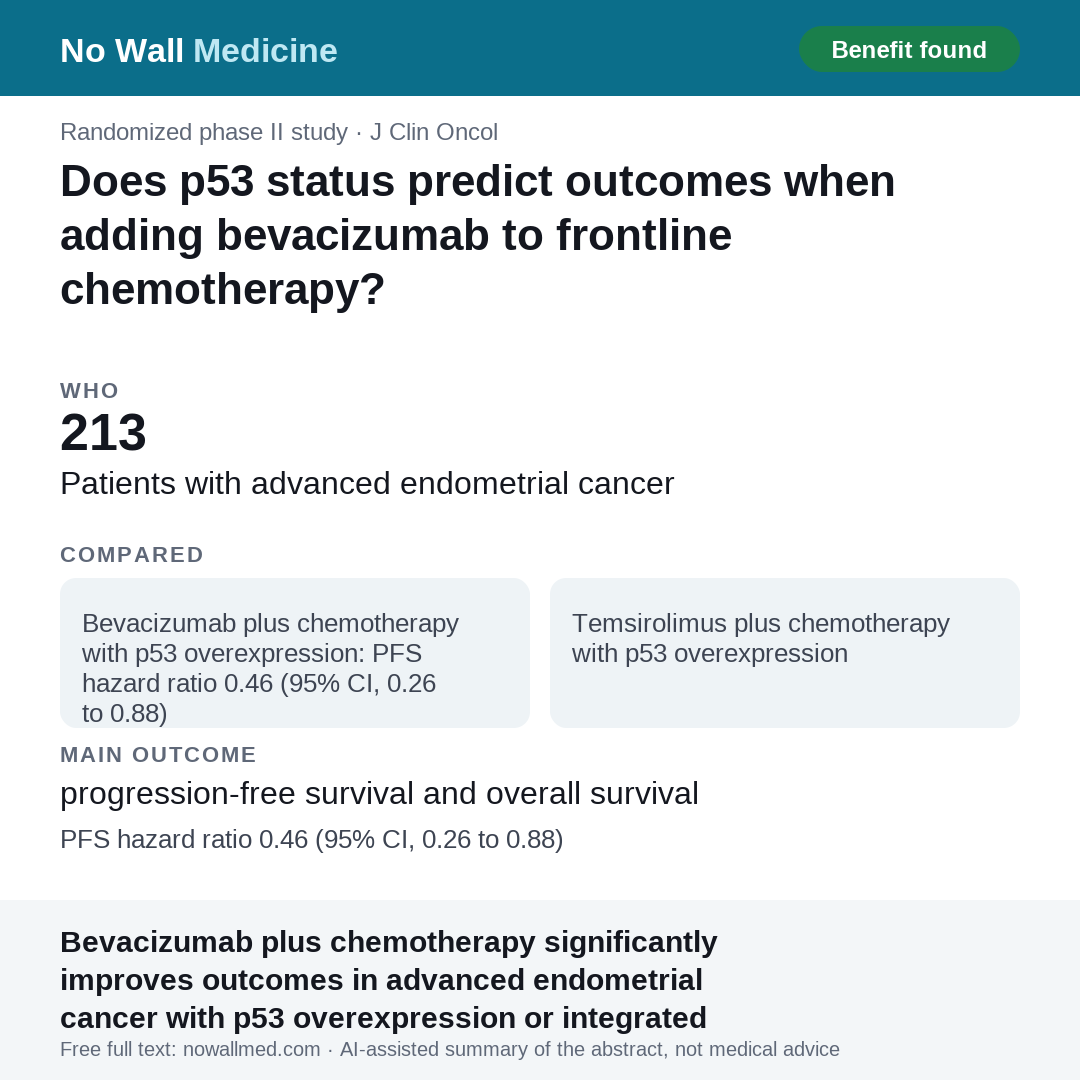
- Researchers analyzed 213 cases from a randomized phase II study of advanced endometrial cancer patients receiving chemotherapy plus either bevacizumab or temsirolimus.
- In cases with p53 protein overexpression, bevacizumab was associated with a progression-free survival hazard ratio of 0.46 and an overall survival hazard ratio of 0.31.
- Patients with both TP53 missense mutations and p53 protein overexpression had a progression-free survival hazard ratio of 0.41 and an overall survival hazard ratio of 0.28.
Why it matters: It was unknown if p53 protein expression or TP53 gene sequencing could predict how patients with advanced endometrial cancer respond to bevacizumab added to chemotherapy.
Discussion prompts
- Would these patients look like yours? Who was left out?
- Is the main outcome one that matters to patients?
- Is the difference large enough to change what you do?
Cite: Thiel KW, Devor EJ, Filiaci VL, Mutch D, Moxley K, Alvarez Secord A. TP53 Sequencing and p53 Immunohistochemistry Predict Outcomes When Bevacizumab Is Added to Frontline Chemotherapy in Endometrial Cancer: An NRG Oncology/Gynecologic Oncology Group Study. J Clin Oncol. 2022. doi:10.1200/JCO.21.02506
Free full text: PubMed Central · Summary and visual abstract: nowallmed.com/a/tp53-sequencing-and-p53-immunohistochemistry-predict-outcomes-when-12czzdk/ (AI-assisted from the abstract; check the paper before relying on it).