Surgical resection and reconnection for airway narrowing after intubation shows varying restenosis rates
Tracheal resection and anastomosis in postintubation tracheal stenosis: a systematic review
Scoping reviewBenefit found
What are the outcomes of tracheal resection and anastomosis in postintubation tracheal stenosis?
Who
110
Adult patients with postintubation tracheal stenosis
Compared
All patients: Restenosis rate ranged from 2% to 25%
All patients: No perioperative mortality
Main outcome
Surgical management and outcomes
Bottom line: Tracheal resection and primary anastomosis appear safe and effective in the short and mid-terms for postintubation stenosis.
Limitation: Very low level of evidence from case reports and case series prevents definitive conclusions.
Eur J Cardiothorac Surg · 2024-09-10 · Save PNG
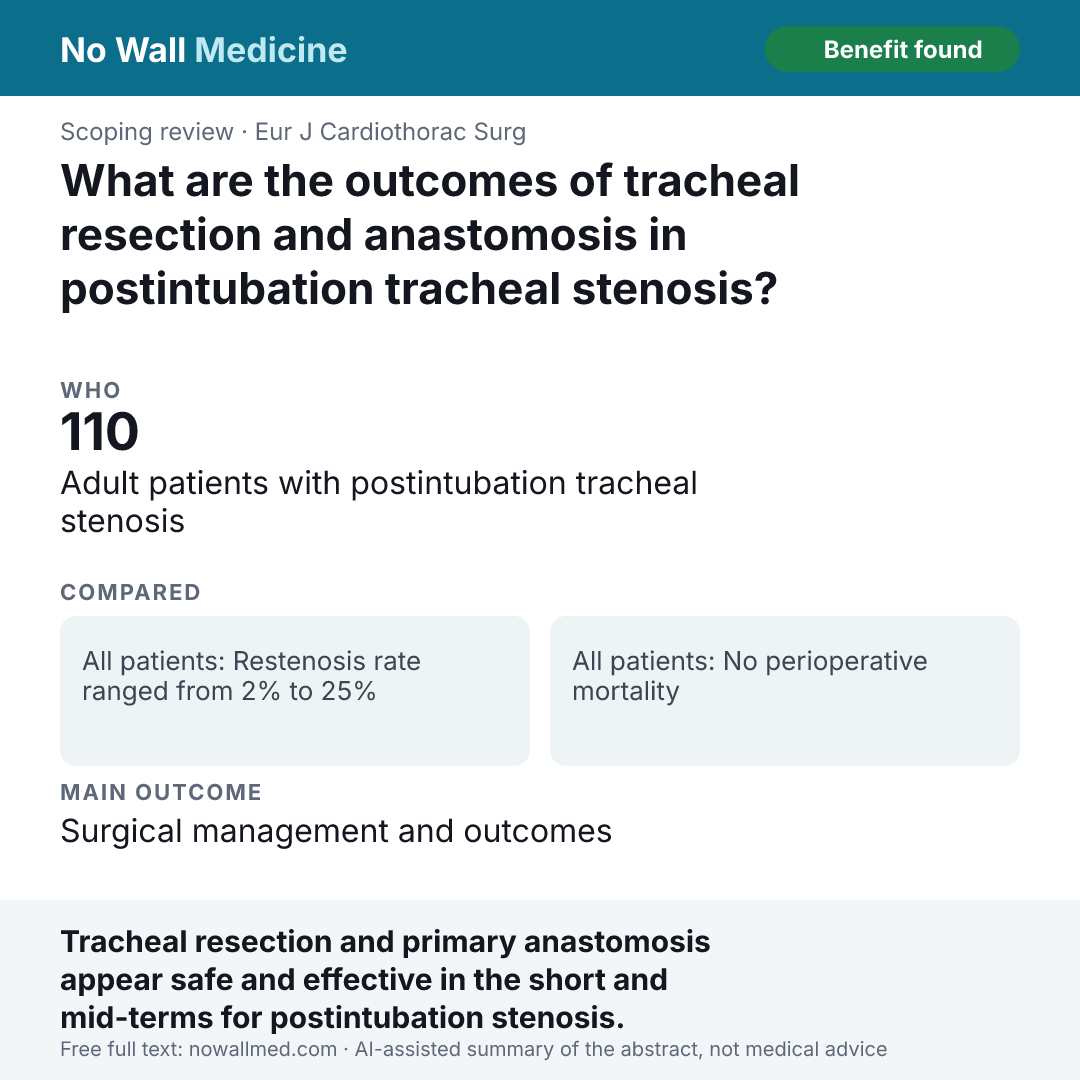
Clinical question: What are the outcomes of tracheal resection and anastomosis in postintubation tracheal stenosis?
Why it matters: The specific outcomes and characteristics of surgical resection and end-to-end anastomosis for narrowing of the windpipe caused by breathing tubes were not well described.
Key points
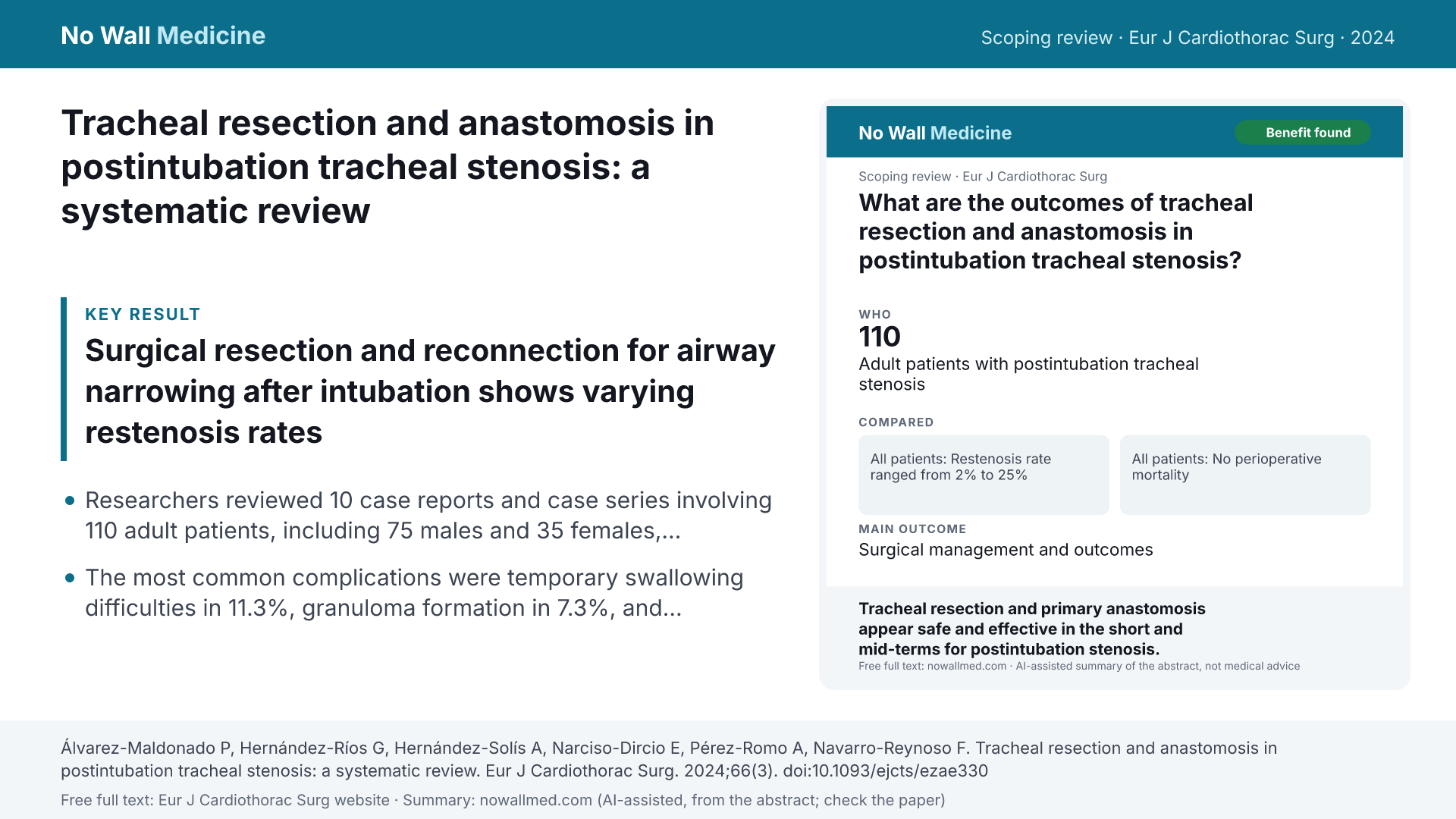
- Researchers reviewed 10 case reports and case series involving 110 adult patients, including 75 males and 35 females, with narrowing of the windpipe after breathing tube use.
- The most common complications were temporary swallowing difficulties in 11.3%, granuloma formation in 7.3%, and air leaks or wound separation in 4.5%.
- The rate of the airway narrowing returning, known as restenosis, ranged from 2% to 25% with no deaths reported during or after surgery.
Limitation the authors note: The very low level of evidence from case reports and case series prevents definitive conclusions.
Headline and key points written with AI from the paper’s abstract, with every number checked against it. Read the paper before relying on them.
Was this summary helpful?
Subject terms
Headline, design, result, key points, caveat and citation as plain text.
Cite this article
Álvarez-Maldonado P, Hernández-Ríos G, Hernández-Solís A, Narciso-Dircio E, Pérez-Romo A, Navarro-Reynoso F. Tracheal resection and anastomosis in postintubation tracheal stenosis: a systematic review. Eur J Cardiothorac Surg. 2024;66(3). doi:10.1093/ejcts/ezae330
Spotted a mistake? Suggest a correction