Tranexamic acid did not significantly change maternal death or blood transfusion rates after cesarean delivery
Tranexamic Acid to Prevent Obstetrical Hemorrhage after Cesarean Delivery
Randomized trialNo clear difference
Does tranexamic acid prevent maternal death or blood transfusion after cesarean delivery?
Who
11000
Patients undergoing cesarean delivery · 31 U.S. hospitals
Compared
3.6%Tranexamic acid (201/5525)
4.3%Placebo (233/5470)
Main outcome
Maternal death or blood transfusion by hospital discharge or 7 days postpartum
Result: adjusted relative risk 0.89 (95.26% CI 0.74 to 1.07)
Bottom line: Tranexamic acid did not significantly lower the risk of maternal death or blood transfusion compared to placebo after cesarean delivery.
Funded by: Eunice Kennedy Shriver National Institute of Child Health and Human Development
NEJM · 2023-04-12Download image
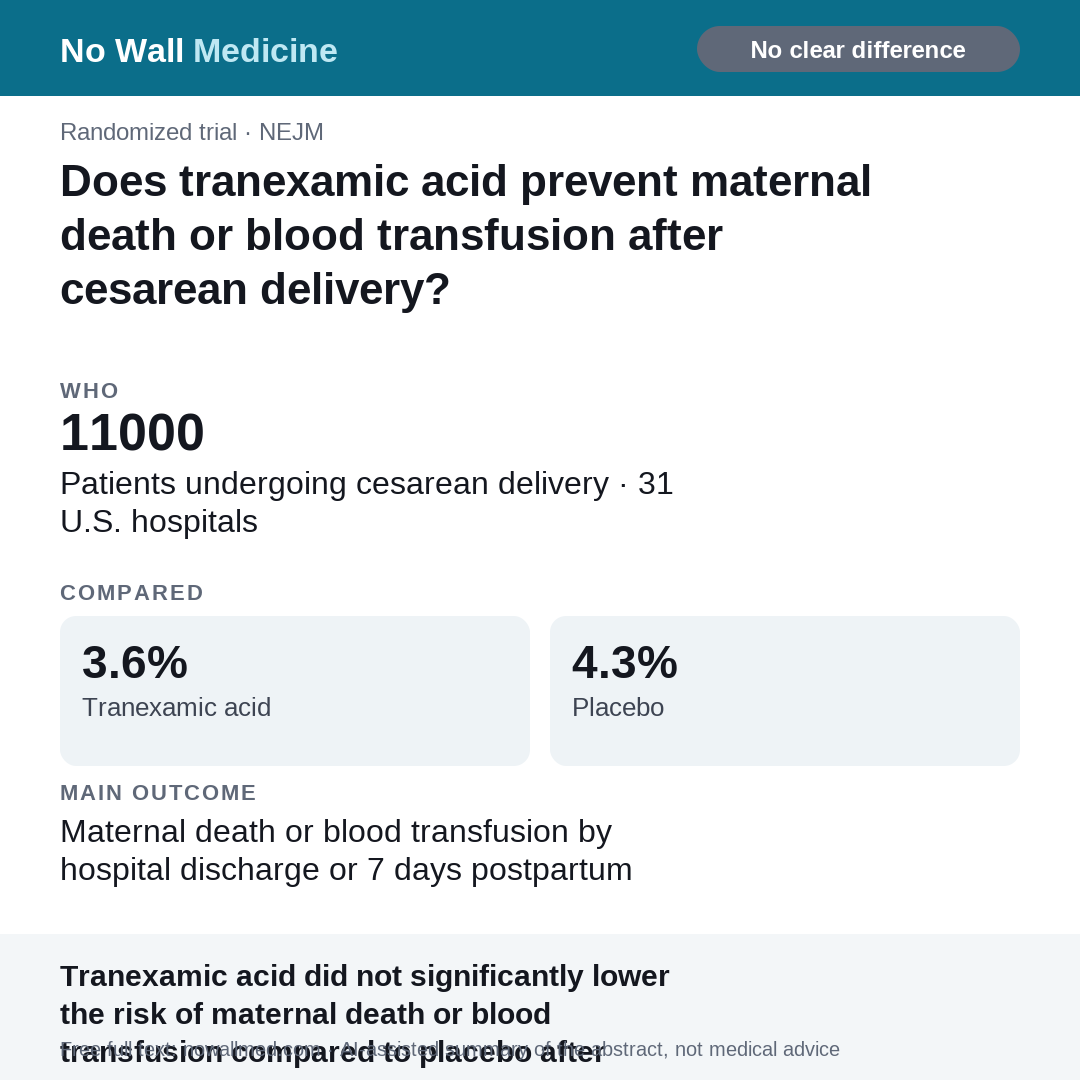
Clinical question: Does tranexamic acid prevent maternal death or blood transfusion after cesarean delivery?
Why it matters: While tranexamic acid decreases calculated blood loss, its effect on the actual need for blood transfusions during cesarean delivery is unclear.
Key points
- Researchers randomly assigned 11,000 patients undergoing cesarean delivery to receive either tranexamic acid, a medication used to stop bleeding, or a placebo.
- The primary composite outcome of maternal death or blood transfusion occurred in 3.6% of the tranexamic acid group and 4.3% of the placebo group.
- Estimated intraoperative blood loss of more than 1 liter occurred in 7.3% of the tranexamic acid group and 8.0% of the placebo group.
Headline and key points written with AI from the paper’s abstract, with every number checked against it. Read the paper before relying on them.
Topics
Cite this article
Pacheco LD, Clifton RG, Saade GR, Weiner SJ, Parry S, Thorp JM. Tranexamic Acid to Prevent Obstetrical Hemorrhage after Cesarean Delivery. NEJM. 2023. doi:10.1056/NEJMoa2207419
Spotted a mistake? Suggest a correction