Transcranial direct current stimulation combined with therapy improves swallowing function in post-stroke patients
Transcranial direct current stimulation for post-stroke dysphagia: a meta-analysis
Meta-analysis of 9 randomized controlled trialsBenefit found
Is transcranial direct current stimulation effective for post-stroke dysphagia?
Who
Patients with post-stroke dysphagia
Compared
Transcranial direct current stimulation plus conventional therapy
Control group
Main outcome
Swallowing function and risk of penetration and aspiration
Result: Hedges's g = 0.55
Bottom line: Transcranial direct current stimulation combined with conventional therapy improves swallowing function and reduces penetration and aspiration risk.
J Neuroeng Rehabil · 2023-12-11Download image
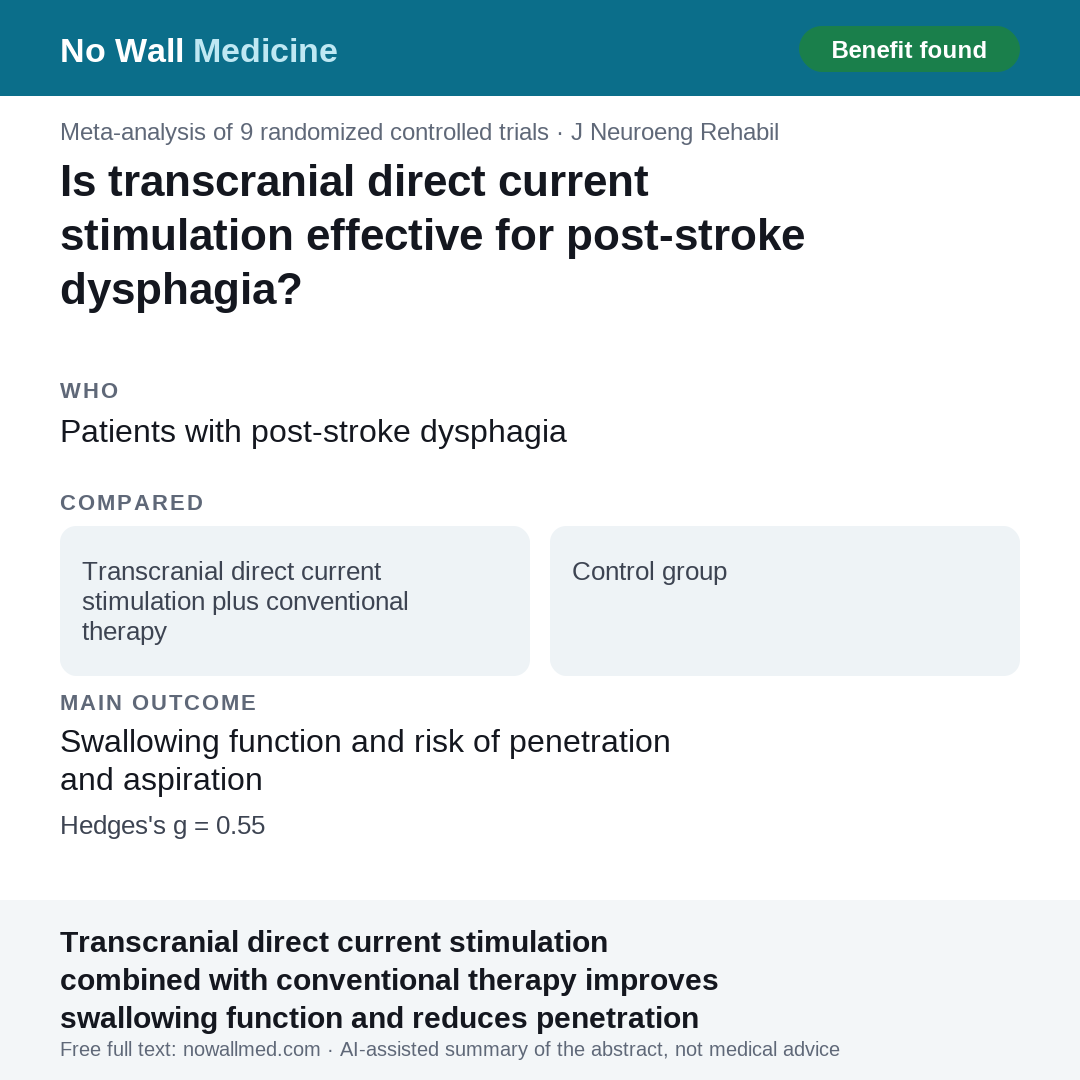
Clinical question: Is transcranial direct current stimulation effective for post-stroke dysphagia?
Why it matters: The effectiveness of transcranial direct current stimulation, a method using low electrical currents to stimulate the brain, for treating swallowing difficulties after a stroke was not clearly established.
Key points
- Researchers analyzed 9 randomized controlled trials involving patients with swallowing difficulties following a stroke.
- The meta-analysis found that adding transcranial direct current stimulation to conventional therapy improved swallowing function and oral and pharyngeal phase times.
- The intervention was associated with a reduction in the risk of penetration and aspiration with a Hedges's g of 0.55.
Headline and key points written with AI from the paper’s abstract, with every number checked against it. Read the paper before relying on them.
Was this summary helpful?
Subject terms
Cite this article
Gómez-García N, Álvarez-Barrio L, Leirós-Rodríguez R, Soto-Rodríguez A, Andrade-Gómez E, Hernández-Lucas P. Transcranial direct current stimulation for post-stroke dysphagia: a meta-analysis. J Neuroeng Rehabil. 2023. doi:10.1186/s12984-023-01290-w
Spotted a mistake? Suggest a correction
Top studies every Monday
The week’s key trials and guidelines in your specialties, plus any topics you follow. By email, free.
Get the weekly digest