Enzalutamide treatment was associated with temporary changes in gene expression in prostate cancer patients
Transcriptome profiling of prostatic tumours from ENACT trial patients with or without enzalutamide
Exploratory biomarker analysis of a randomized trialMixed results
What are the longitudinal transcriptomic changes in patients with low- or intermediate-risk prostate cancer?
Who
131
Patients with low- or intermediate-risk prostate cancer
Compared
enzalutamide plus active surveillance: downregulation of androgen-receptor signalling and immune-suppressor signatures
active surveillance alone
Main outcome
longitudinal transcriptomic changes
Bottom line: Enzalutamide causes transient transcriptomic changes, including immune modulation, which revert to baseline after treatment cessation.
BJU Int · 2025-07-31Download image
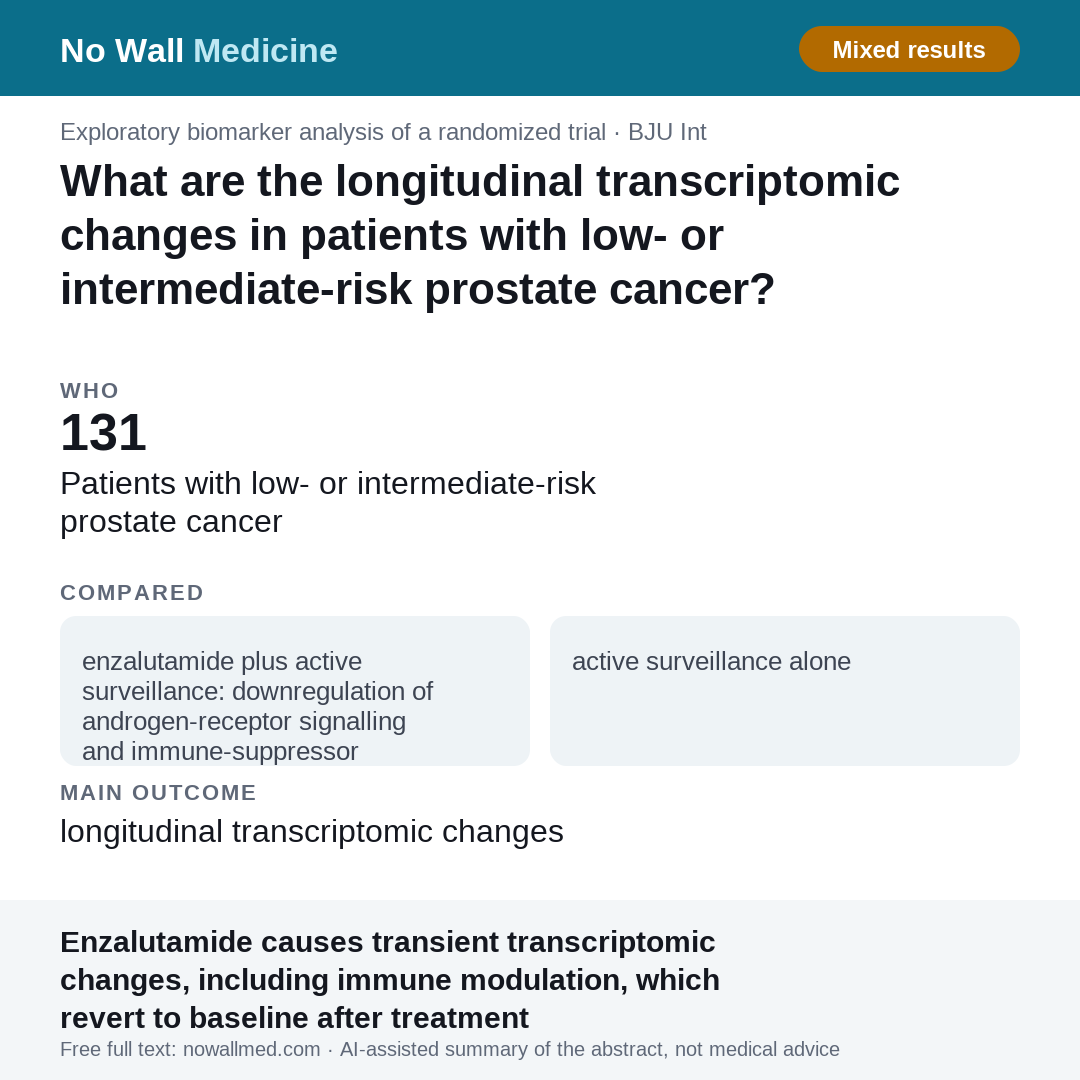
Clinical question: What are the longitudinal transcriptomic changes in patients with low- or intermediate-risk prostate cancer?
Key points
- Researchers analyzed 131 prostate cancer samples from the ENACT trial, comparing 57 patients receiving enzalutamide plus active surveillance to 74 patients receiving active surveillance alone.
- At Year 1, enzalutamide treatment was associated with downregulated androgen-receptor signaling and immune-suppressor signatures, alongside upregulated immune-activated and basal-like markers.
- Many transcriptomic changes, including those related to immune activity, were transient and returned to baseline levels at Year 2 after enzalutamide treatment was stopped.
Headline and key points written with AI from the paper’s abstract, with every number checked against it. Read the paper before relying on them.
Topics
Cite this article
Handa N, Shore ND, Cooperberg MR, Davicioni E, Zhao X, Elsouda D. Transcriptome profiling of prostatic tumours from ENACT trial patients with or without enzalutamide. BJU Int. 2025. doi:10.1111/bju.16861
Spotted a mistake? Suggest a correction