Genomic scores and cell subtypes are linked to outcomes in high-risk prostate cancer
Transcriptomic Analysis of Localized High-risk Prostate Cancer Improves Prognostication and Identifies Benefit from Adding Docetaxel to Definitive Radiotherapy with Androgen Suppression in the NRG Oncology/RTOG 0521 Phase 3 Trial
Randomized trialBenefit found
Does docetaxel improve survival in prostate cancer?
Who
283
Men with high-risk localized prostate cancer
Compared
Luminal proliferating: 13.7 mo
Non-luminal proliferating: 2.5 mo
Main outcome
Overall survival
Bottom line: Docetaxel may benefit some prostate cancer patients
Limitation: No biomarker-by-treatment interaction detected
Eur Urol Oncol · 2025-07-17Download image
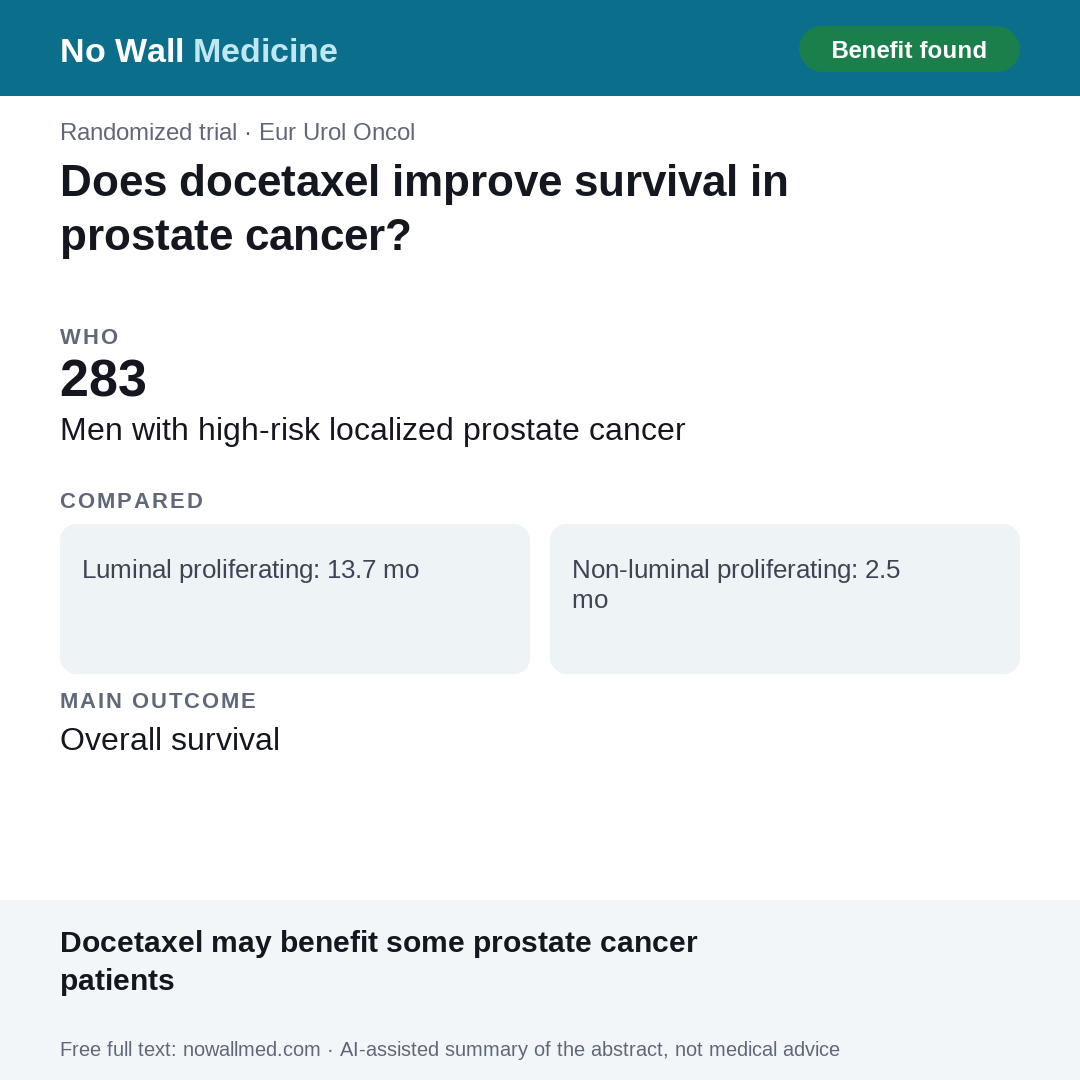
Clinical question: Does docetaxel improve survival in prostate cancer?
Why it matters: The original trial showed that the survival benefit of adding chemotherapy to radiation and hormone therapy was lost during longer follow-up.
Key points
- Researchers analyzed 283 patients from a clinical trial to see if the Decipher genomic classifier and cell subtypes could predict outcomes for prostate cancer.
- The Decipher genomic classifier was independently associated with distant metastasis (hazard ratio 1.45) and metastasis-free survival (hazard ratio 1.20).
- The 10-year survival time difference with chemotherapy was 13.7 months for luminal proliferating tumors and 2.5 months for non-luminal proliferating tumors.
Headline and key points written with AI from the paper’s abstract, with every number checked against it. Read the paper before relying on them.
Topics
Cite this article
Phillips RM, Proudfoot JA, Davicioni E, Liu Y, Spratt DE, Simko JM. Transcriptomic Analysis of Localized High-risk Prostate Cancer Improves Prognostication and Identifies Benefit from Adding Docetaxel to Definitive Radiotherapy with Androgen Suppression in the NRG Oncology/RTOG 0521 Phase 3 Trial. Eur Urol Oncol. 2025. doi:10.1016/j.euo.2025.04.009
Spotted a mistake? Suggest a correction
Top studies every Monday
The week’s key trials and guidelines in your specialties, by email. Free.
Get the weekly digest