Non-invasive ear nerve stimulation reduced pain in patients with systemic sclerosis
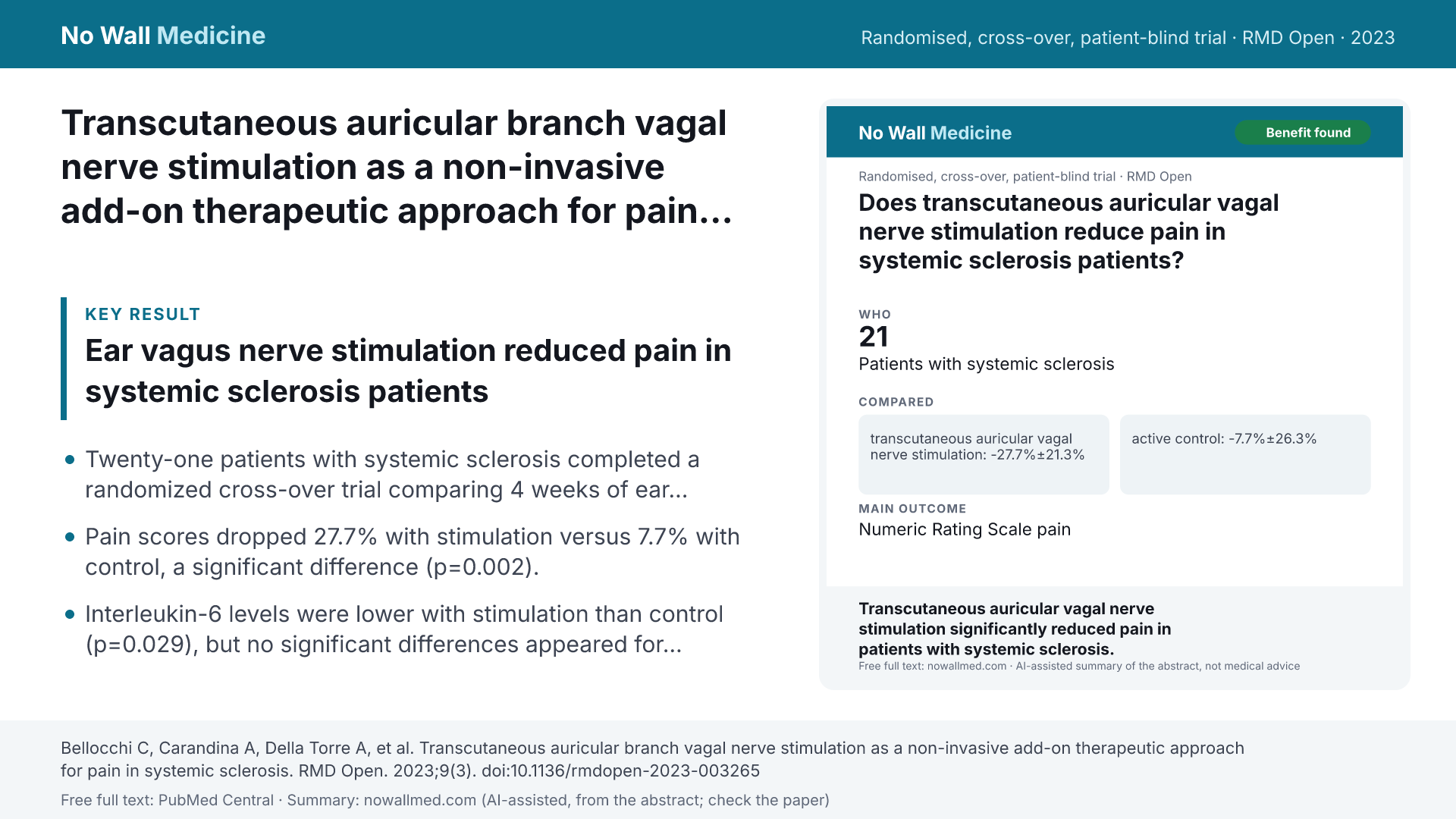
Transcutaneous auricular branch vagal nerve stimulation as a non-invasive add-on therapeutic approach for pain in systemic sclerosis
Randomised, cross-over, patient-blind trialBenefit found
Does transcutaneous auricular vagal nerve stimulation reduce pain in systemic sclerosis patients?
Who
21
Patients with systemic sclerosis
Compared
transcutaneous auricular vagal nerve stimulation: -27.7%±21.3%
active control: -7.7%±26.3%
Main outcome
Numeric Rating Scale pain
Bottom line: Transcutaneous auricular vagal nerve stimulation significantly reduced pain in patients with systemic sclerosis.
RMD Open · 2023-08-04Download image
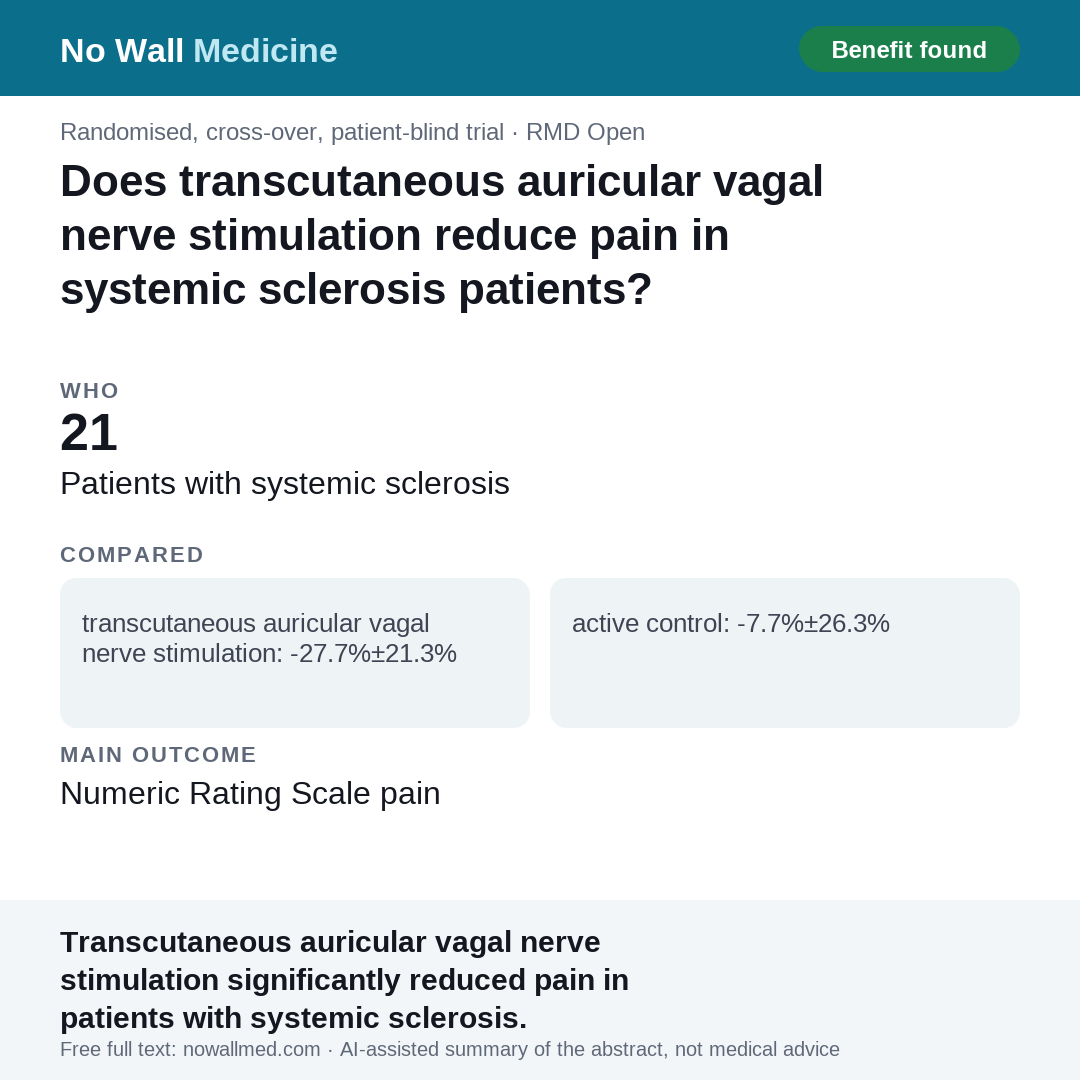
Clinical question: Does transcutaneous auricular vagal nerve stimulation reduce pain in systemic sclerosis patients?
Why it matters: Pain is a major issue for people with systemic sclerosis, but effective non-invasive therapeutic approaches to target this pain are needed.
Key points
- Researchers conducted a randomized, cross-over trial with 21 patients with systemic sclerosis to compare transcutaneous auricular vagal nerve stimulation, a non-invasive nerve stimulation through the ear, against an active control.
- Transcutaneous auricular vagal nerve stimulation was associated with a -27.7%±21.3% reduction in pain on the Numeric Rating Scale compared to -7.7%±26.3% for the active control.
- The stimulation was also associated with downregulated Interleukin-6, though no significant differences were found for heart rate variability or quality of life scales.
Headline and key points written with AI from the paper’s abstract, with every number checked against it. Read the paper before relying on them.
Was this summary helpful?
Abstract
Objective
Systemic sclerosis (SSc) is an autoimmune disease with health-related quality of life (HRQoL) high impairment. Pain is of paramount importance to be targeted by therapeutical approaches. Our study aim was to perform an add-on device-based non-invasive neuromodulatory treatment through transcutaneous auricular vagal nerve stimulation (tVNS) in patients with SSc, assessing its effects on pain as primary endpoint and on inflammation, cardiovascular autonomic control and HRQoL. Methods
Thirty-two patients with SSc were enrolled based on reported pain assessed through Numeric Rating Scale (NRS). Twenty-one (90% with limited cutaneous SSc) completed a randomised, cross-over, patient-blind trial, in which interventional and active control were used in random order for 4 weeks, interspersed with 4 weeks washout. NRS, Patient-Reported Outcomes Measurement Information System-29 (PROMIS-29) Item4 for pain interference, heart rate variability (HRV), serum cytokines and HRQoL questionnaires (Health Assessment Questionnaire, Patient Health Questionnaire-9, University of California, Los Angeles Gastrointestinal Tract, Pittsburgh Sleep Quality Index) were assessed at baseline, at T1 (after 1 month of tVNS or active control), at T2 (after washout) and at T3 (after 1 month of active control or tVNS). T-test for paired data and Wilcoxon signed-rank test for non-normally distributed parameters were performed to compare the effect of tVNS and active control. Results
NRS pain was significantly reduced by tVNS and not by active control (Mean±SD: -27.7%±21.3% vs -7.7%±26.3%, p=0.002). Interleukin-6 was downregulated in tVNS versus active control (p=0.029). No significant differences were observed in tVNS versus active control for PROMIS-29 Item4, QoL scales and HRV with both spectral and symbolic analyses. Conclusion
tVNS demonstrated to be a safe and non-invasive add-on tool to reduce pain in SSc.
Abstract reproduced under the article’s CC BY NC licence.
Subject terms
Cite this article
Bellocchi C, Carandina A, Della Torre A, et al. Transcutaneous auricular branch vagal nerve stimulation as a non-invasive add-on therapeutic approach for pain in systemic sclerosis. RMD Open. 2023. doi:10.1136/rmdopen-2023-003265
Spotted a mistake? Suggest a correction