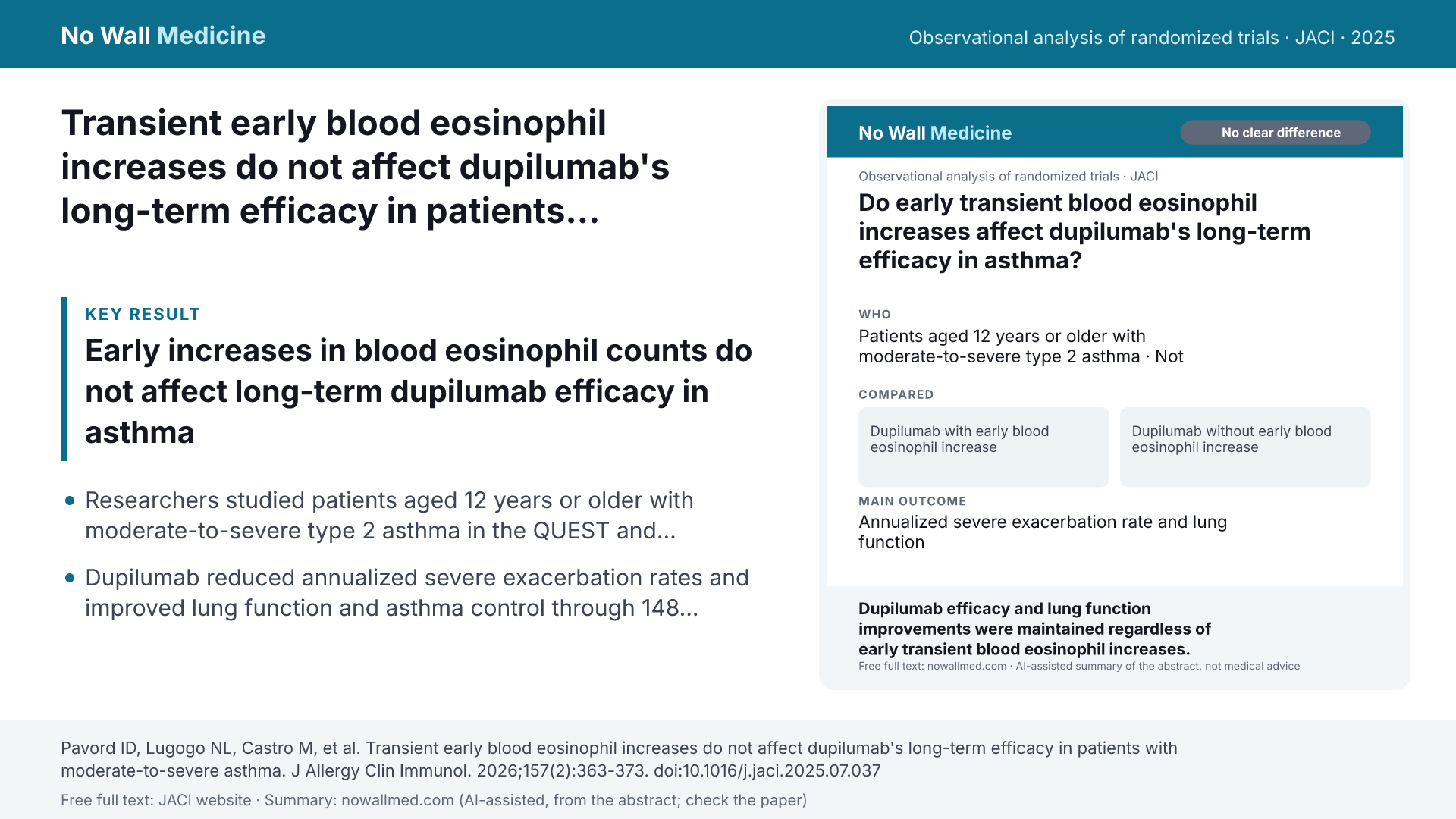
Early increases in blood eosinophil counts do not affect long-term dupilumab efficacy in asthma
Transient early blood eosinophil increases do not affect dupilumab's long-term efficacy in patients with moderate-to-severe asthma
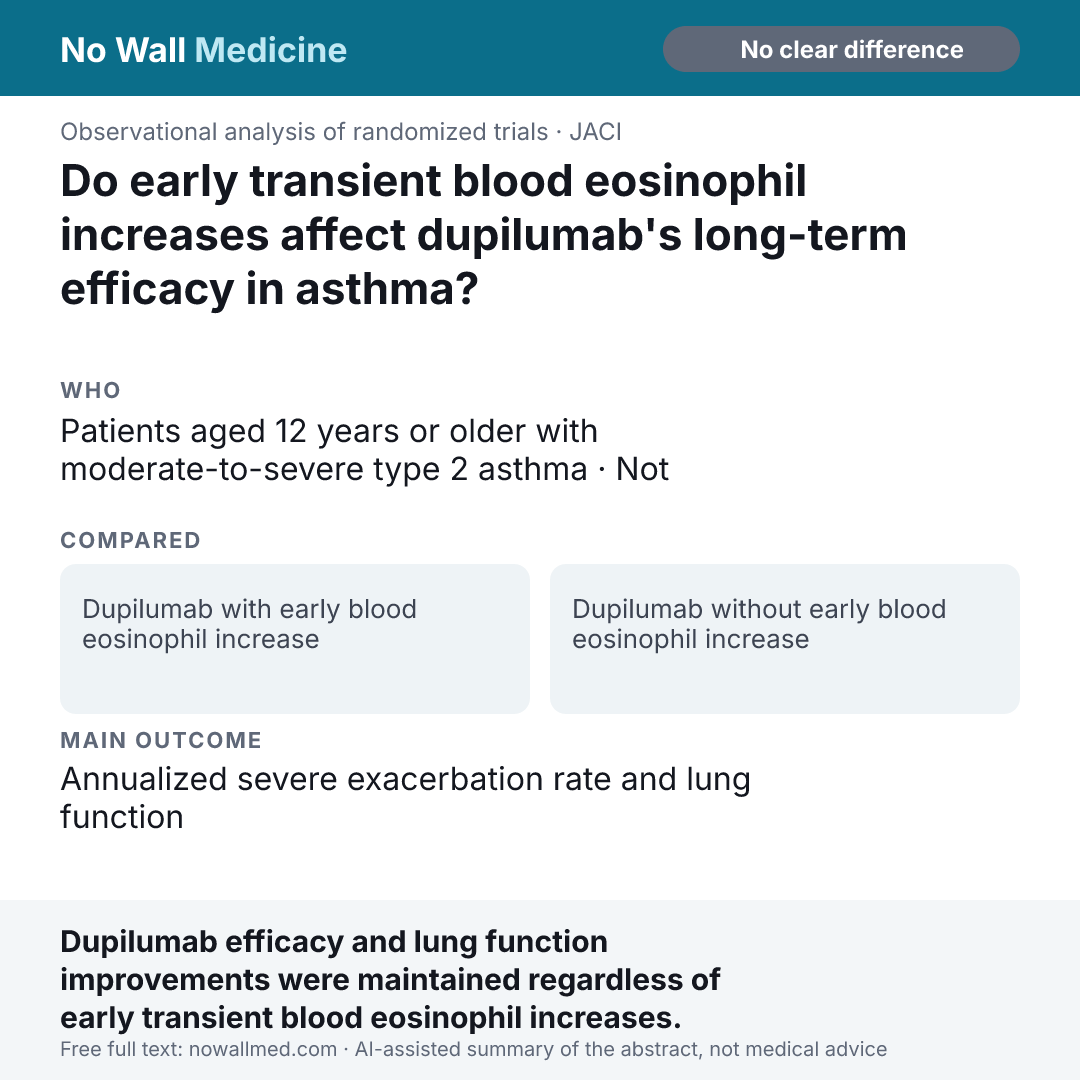
Observational analysis of randomized trialsNo clear difference
Do early transient blood eosinophil increases affect dupilumab's long-term efficacy in asthma?
Who
Patients aged 12 years or older with moderate-to-severe type 2 asthma · Not specified
Compared
Dupilumab with early blood eosinophil increase
Dupilumab without early blood eosinophil increase
Main outcome
Annualized severe exacerbation rate and lung function
Bottom line: Dupilumab efficacy and lung function improvements were maintained regardless of early transient blood eosinophil increases.
JACI · 2025-11-14 · Save PNG
Same trial (NCT02414854, NCT02134028)
Papers we list that report this registered trial, oldest first. Read a secondary analysis alongside the main results.
- Secondary analysis Benefit found
Dupilumab reduces severe asthma exacerbations and improves lung function regardless of prior exacerbation history Eur Respir J 2021-10 - Main results
Dupilumab treatment was associated with sustained reductions in oral corticosteroid use for severe asthma Chest 2022-02 - Secondary analysis Key finding
Higher baseline exhaled nitric oxide levels predicted better response to dupilumab in asthma patients J Allergy Clin Immunol Pract 2022-12 - Secondary analysis
Biomarker changes were not associated with asthma exacerbation rates in patients treated with dupilumab J Allergy Clin Immunol Pract 2024-03 - Secondary analysis No clear difference
This paper JACI 2025-11
Clinical question: Do early transient blood eosinophil increases affect dupilumab's long-term efficacy in asthma?
Key points
- Researchers studied patients aged 12 years or older with moderate-to-severe type 2 asthma in the QUEST and TRAVERSE studies.
- Dupilumab reduced annualized severe exacerbation rates and improved lung function and asthma control through 148 weeks regardless of early blood eosinophil increases.
- By week 12, 36.6% of patients treated with dupilumab versus 21.7% of those receiving placebo experienced a 2-fold or greater increase in blood eosinophil counts.
Headline and key points written with AI from the paper’s abstract, with every number checked against it. Read the paper before relying on them.
Was this summary helpful?
Subject terms
Headline, design, result, key points, caveat and citation as plain text.
Cite this article
Pavord ID, Lugogo NL, Castro M, et al. Transient early blood eosinophil increases do not affect dupilumab's long-term efficacy in patients with moderate-to-severe asthma. J Allergy Clin Immunol. 2026;157(2):363-373. doi:10.1016/j.jaci.2025.07.037
Spotted a mistake? Suggest a correction