Laparoscopic-assisted nerve block was superior to placebo for pain relief in colon surgery
Transversus abdominis plane block in minimally invasive colon surgery: a multicenter three-arm randomized controlled superiority and non-inferiority clinical trial
Multicenter three-arm randomized controlled trialMixed results
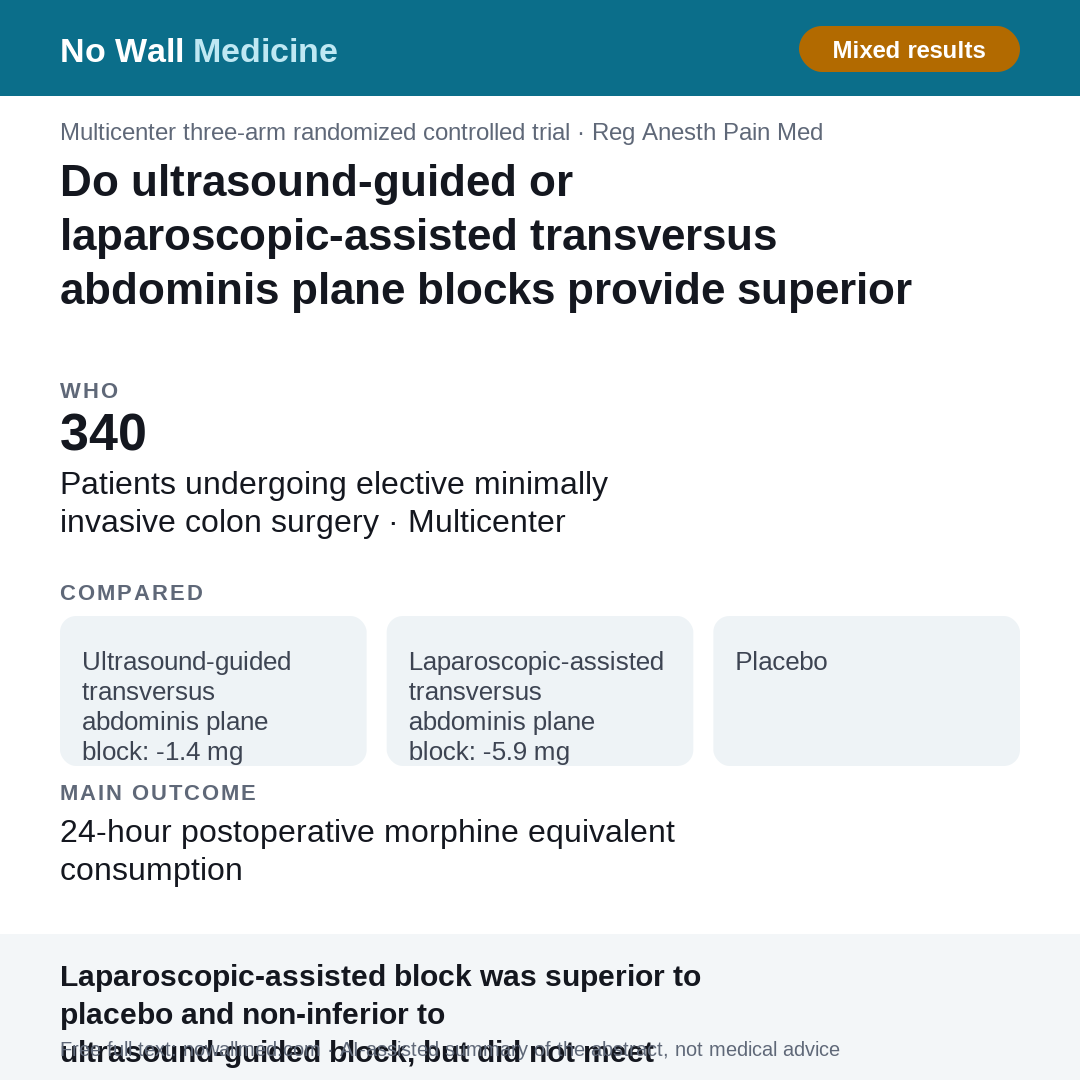
Do ultrasound-guided or laparoscopic-assisted transversus abdominis plane blocks provide superior pain relief?
Who
340
Patients undergoing elective minimally invasive colon surgery · Multicenter
Compared
Ultrasound-guided transversus abdominis plane block: -1.4 mg morphine (97.5% CI -6.8 to 4.0 mg)
Laparoscopic-assisted transversus abdominis plane block: -5.9 mg morphine (97.5% CI -11.3 to -0.5 mg)
Placebo
Main outcome
24-hour postoperative morphine equivalent consumption
Bottom line: Laparoscopic-assisted block was superior to placebo and non-inferior to ultrasound-guided block, but did not meet minimal clinically important difference.
Limitation: Neither block met the predetermined minimal clinically important difference of 10 mg morphine.
Reg Anesth Pain Med · 2026-05-05Download image
Clinical question: Do ultrasound-guided or laparoscopic-assisted transversus abdominis plane blocks provide superior pain relief?
Why it matters: It is unclear if ultrasound-guided or laparoscopic-assisted transversus abdominis plane blocks provide better pain relief compared to a placebo in minimally invasive colon surgery.
Key points
- Researchers studied 340 patients undergoing elective minimally invasive colon surgery, comparing ultrasound-guided transversus abdominis plane blocks, laparoscopic-assisted transversus abdominis plane blocks, and a placebo.
- The laparoscopic-assisted technique was superior to placebo with a difference of -5.9 mg morphine equivalents, while the ultrasound-guided technique showed no difference from placebo at -1.4 mg.
- The laparoscopic-assisted block was non-inferior to the ultrasound-guided block, though neither method met the predetermined minimal clinically important difference of 10 mg morphine.
Headline and key points written with AI from the paper’s abstract, with every number checked against it. Read the paper before relying on them.
Was this summary helpful?
Abstract
Background and objectives
The transversus abdominis plane (TAP) block is the most widely used abdominal field block in colorectal surgery with a postoperative enhanced recovery pathway. We aimed to determine whether the laparoscopic-assisted and ultrasound-guided TAP (US-TAP) blocks provide superior pain relief compared with placebo. We separately investigated whether the laparoscopic-assisted technique was non-inferior to the ultrasound-guided technique in providing pain relief, with a non-inferiority margin of 10 mg morphine dose equivalents. Methods
340 patients undergoing elective minimally invasive colon surgery were randomly allocated to one of three groups: (1) US-TAP block, (2) laparoscopic-assisted TAP (L-TAP) block, or (3) placebo. Superiority and non-inferiority were tested for the primary outcome: 24-hour postoperative morphine equivalent consumption. Secondary outcomes, including patient-reported quality of recovery, were included in the superiority analysis. Results
127 patients were included in each block group and 86 in the placebo group. The US-TAP block was no different from placebo at -1.4 mg morphine (97.5% CI -6.8 to 4.0 mg; p=0.55). The L-TAP block was superior to placebo at -5.9 mg morphine (97.5% CI -11.3 to -0.5 mg; p=0.01) and non-inferior to the US-TAP block at -4.5 mg morphine (98.75% CI -10.0 to 1.1 mg). Conclusion
The L-TAP block was superior to placebo and non-inferior to the US-TAP block. However, neither met our predetermined estimate of the minimal clinically important difference of 10 mg morphine. Trial registration number
NCT04311099.
Abstract reproduced under the article’s CC BY NC licence.
Subject terms
Cite this article
Salmonsen CB, Lange KHW, Kleif J, Krøijer R, Bruun L, Mikalonis M. Transversus abdominis plane block in minimally invasive colon surgery: a multicenter three-arm randomized controlled superiority and non-inferiority clinical trial. Reg Anesth Pain Med. 2026. doi:10.1136/rapm-2024-105712
Spotted a mistake? Suggest a correction
Top studies every Monday
The week’s key trials and guidelines in your specialties, plus any topics you follow. By email, free.
Get the weekly digest