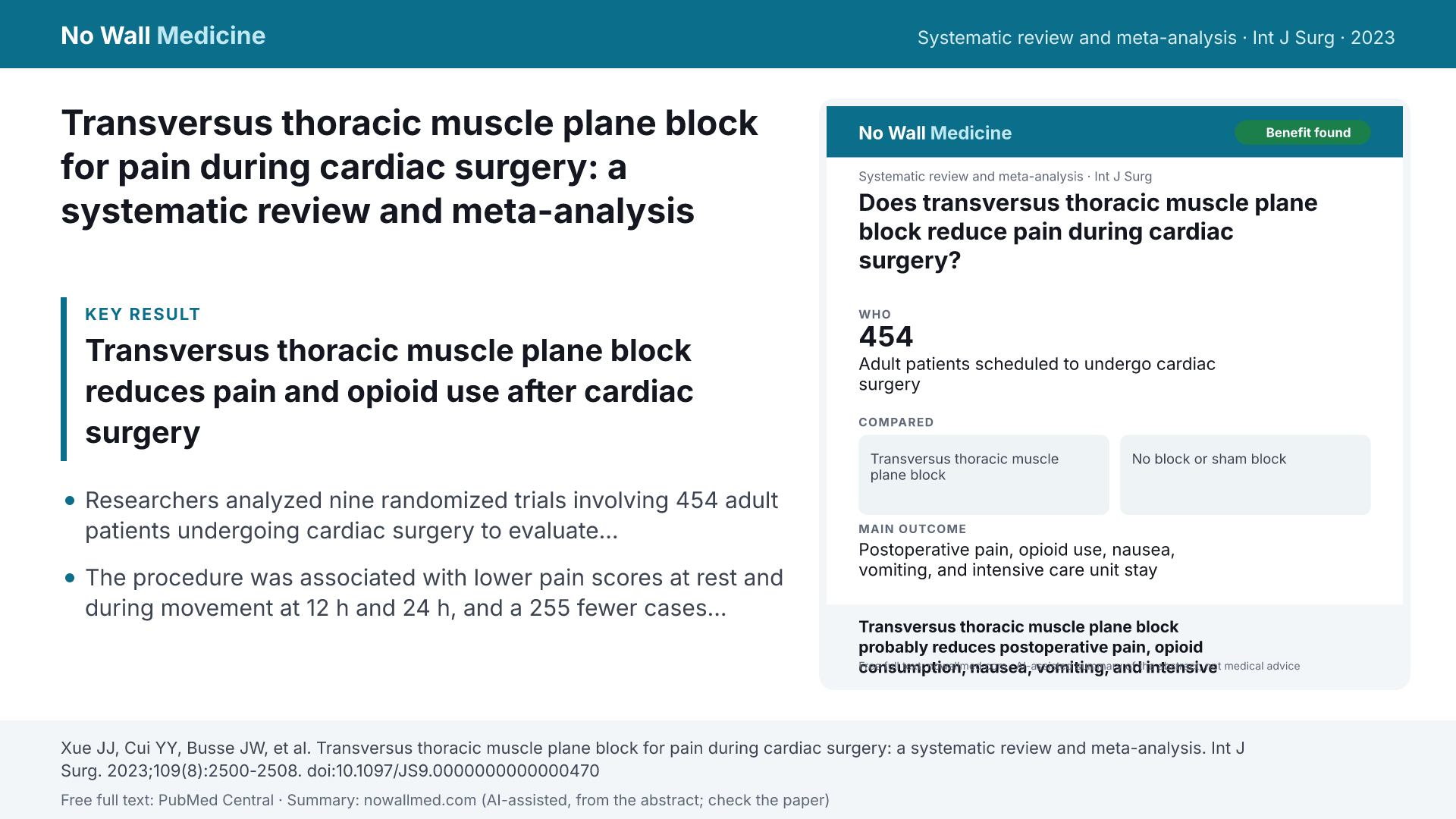
Transversus thoracic muscle plane block reduces pain and opioid use after cardiac surgery
Transversus thoracic muscle plane block for pain during cardiac surgery: a systematic review and meta-analysis
Systematic review and meta-analysisBenefit found
Does transversus thoracic muscle plane block reduce pain during cardiac surgery?
Who
454
Adult patients scheduled to undergo cardiac surgery
Compared
Transversus thoracic muscle plane block
No block or sham block
Main outcome
Postoperative pain, opioid use, nausea, vomiting, and intensive care unit stay
Result: weighted mean difference -1.51 cm on a 10 cm visual analogue scale for pain (95% CI -2.02 to -1.00)
Bottom line: Transversus thoracic muscle plane block probably reduces postoperative pain, opioid consumption, nausea, vomiting, and intensive care unit length of stay.
Int J Surg · 2023-08-01Download image
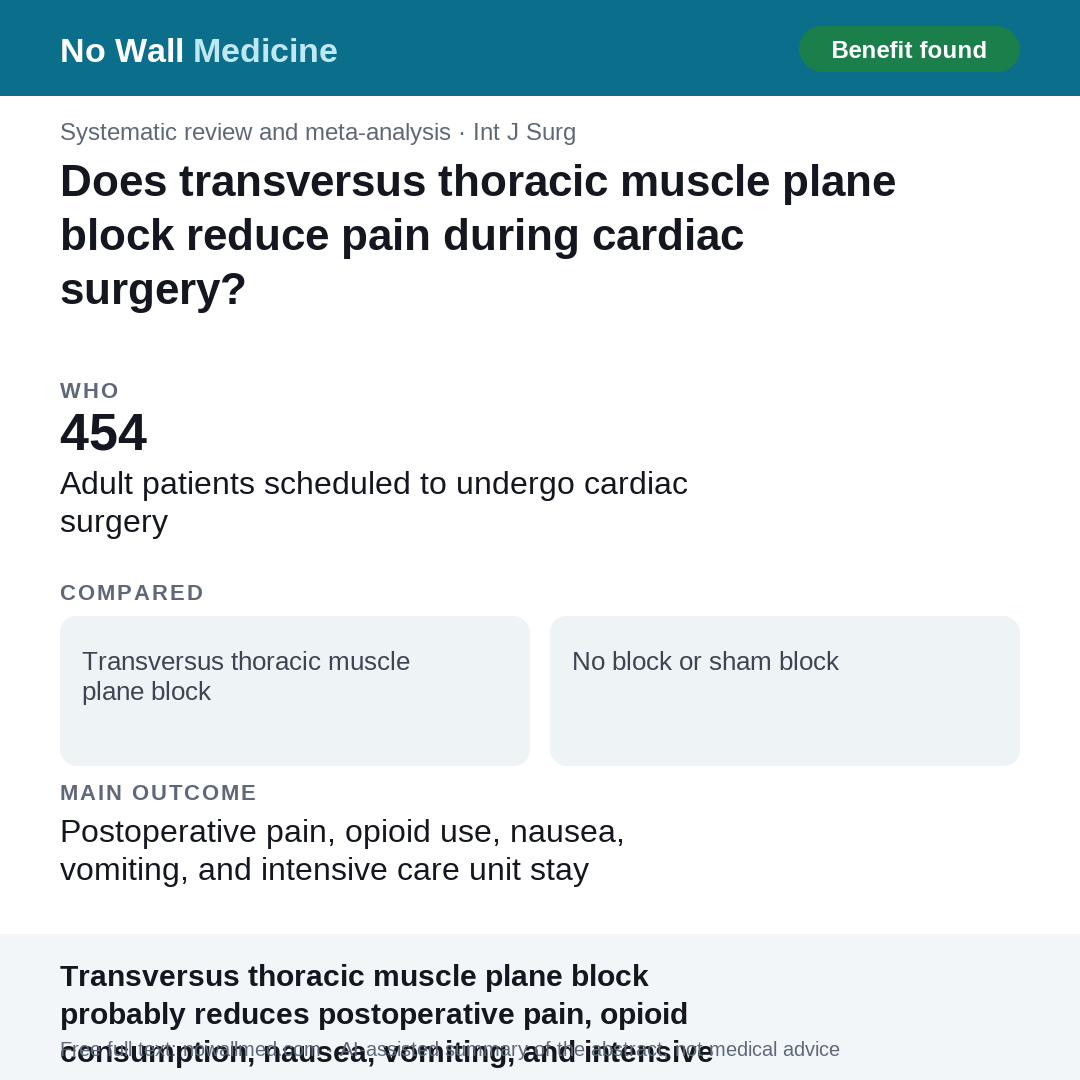
Clinical question: Does transversus thoracic muscle plane block reduce pain during cardiac surgery?
Why it matters: The effectiveness of transversus thoracic muscle plane blocks for managing pain during cardiac surgery is currently controversial.
Key points
- Researchers analyzed nine randomized trials involving 454 adult patients undergoing cardiac surgery to evaluate the effectiveness of transversus thoracic muscle plane blocks.
- The procedure was associated with lower pain scores at rest and during movement at 12 h and 24 h, and a 255 fewer cases of nausea and vomiting per 1000 persons.
- Patients receiving the block had a reduction in intraoperative opioid use by 28 milligram morphine equivalent, postoperative opioid use by 17 milligram morphine equivalent, and intensive care unit stay by 13 h.
Headline and key points written with AI from the paper’s abstract, with every number checked against it. Read the paper before relying on them.
Was this summary helpful?
Subject terms
Cite this article
Xue JJ, Cui YY, Busse JW, Ge L, Zhou T, Huang WH. Transversus thoracic muscle plane block for pain during cardiac surgery: a systematic review and meta-analysis. Int J Surg. 2023. doi:10.1097/JS9.0000000000000470
Spotted a mistake? Suggest a correction