Surgical excision was associated with lower recurrence rates in patients with Kimura's disease
Treatment algorithm for Kimura's disease: A systematic review and meta-analysis of treatment modalities and prognostic predictors
Systematic review and meta-analysisKey finding
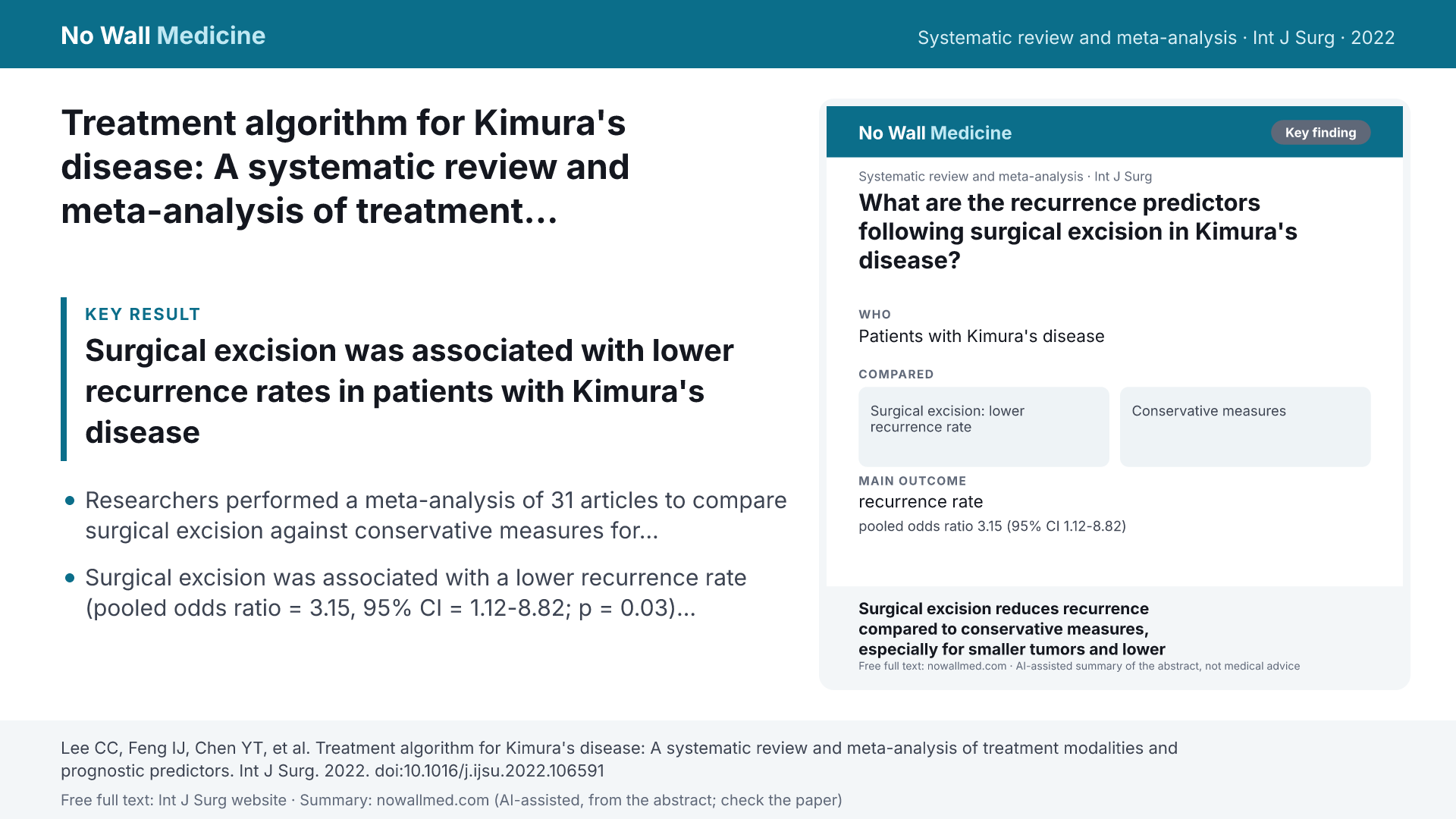
What are the recurrence predictors following surgical excision in Kimura's disease?
Who
Patients with Kimura's disease
Compared
Surgical excision: lower recurrence rate
Conservative measures
Main outcome
recurrence rate
Result: pooled odds ratio 3.15 (95% CI 1.12-8.82)
Bottom line: Surgical excision reduces recurrence compared to conservative measures, especially for smaller tumors and lower eosinophilia or IgE levels.
Int J Surg · 2022-03-05Download image

Clinical question: What are the recurrence predictors following surgical excision in Kimura's disease?
Key points
- Researchers performed a meta-analysis of 31 articles to compare surgical excision against conservative measures for Kimura's disease, a chronic inflammatory condition.
- Surgical excision was associated with a lower recurrence rate (pooled odds ratio = 3.15, 95% CI = 1.12-8.82; p = 0.03) than conservative measures.
- Surgery was associated with better outcomes for tumors smaller than 3 cm, symptom duration shorter than 5 years, eosinophilia less than 20%, or serum IgE less than 10000 IU/ml.
Headline and key points written with AI from the paper’s abstract, with every number checked against it. Read the paper before relying on them.
Was this summary helpful?
Subject terms
Headline, design, result, key points, caveat and citation as plain text.
Cite this article
Lee CC, Feng IJ, Chen YT, et al. Treatment algorithm for Kimura's disease: A systematic review and meta-analysis of treatment modalities and prognostic predictors. Int J Surg. 2022. doi:10.1016/j.ijsu.2022.106591
Spotted a mistake? Suggest a correction