Treatment algorithm for Kimura's disease: A systematic review and meta-analysis of treatment modalities and prognostic predictors
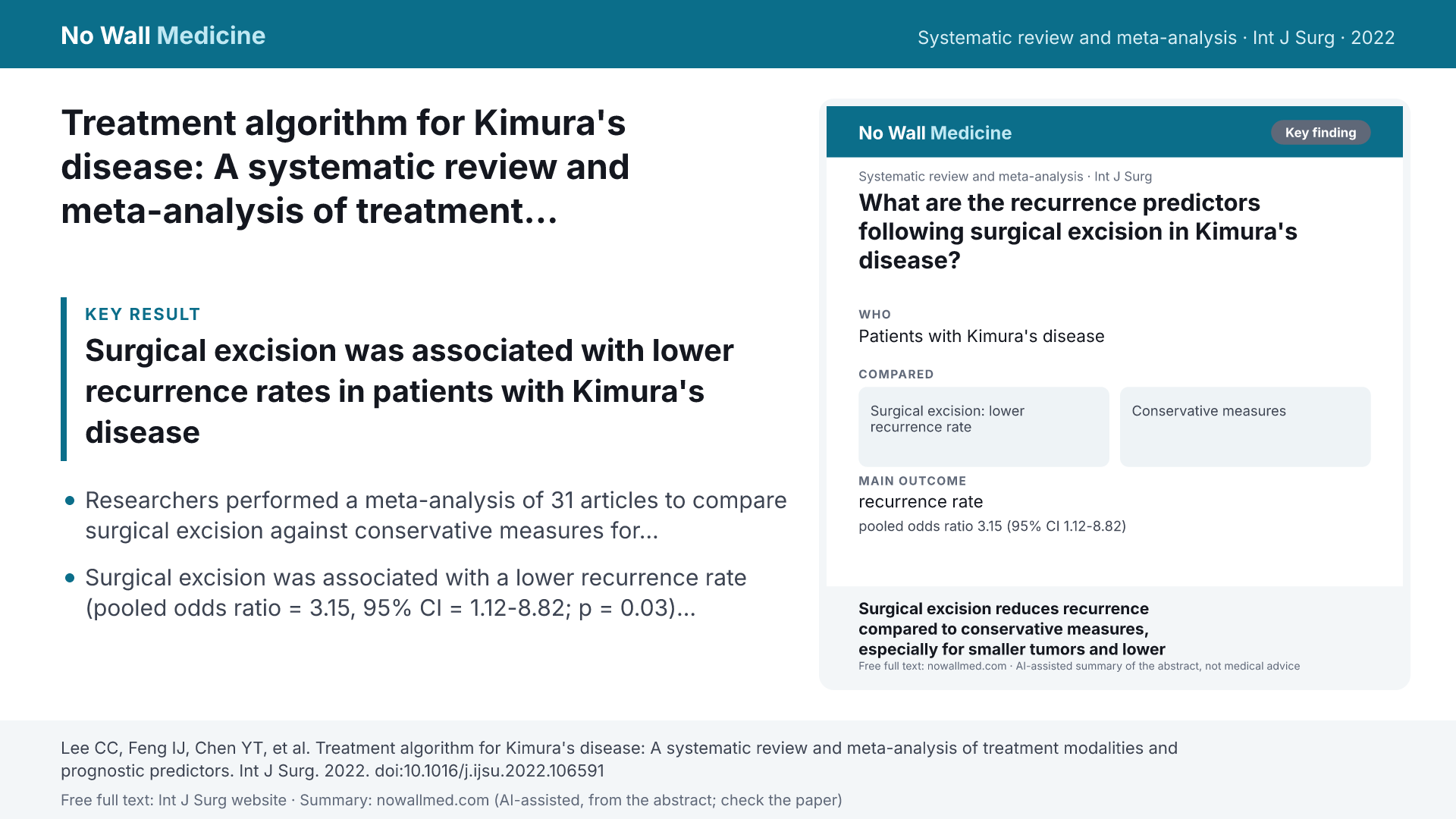
Key result: Surgical excision was associated with lower recurrence rates in patients with Kimura's disease
Systematic review and meta-analysisKey finding
What are the recurrence predictors following surgical excision in Kimura's disease?
Who
Patients with Kimura's disease
Compared
Surgical excision: lower recurrence rate
Conservative measures
Main outcome
recurrence rate
Result: pooled odds ratio 3.15 (95% CI 1.12-8.82)
Bottom line: Surgical excision reduces recurrence compared to conservative measures, especially for smaller tumors and lower eosinophilia or IgE levels.
Int J Surg · 2022-03-05Download image

Key points
- Researchers performed a meta-analysis of 31 articles to compare surgical excision against conservative measures for Kimura's disease, a chronic inflammatory condition.
- Surgical excision was associated with a lower recurrence rate (pooled odds ratio = 3.15, 95% CI = 1.12-8.82; p = 0.03) than conservative measures.
- Surgery was associated with better outcomes for tumors smaller than 3 cm, symptom duration shorter than 5 years, eosinophilia less than 20%, or serum IgE less than 10000 IU/ml.
Discussion prompts
- Would these patients look like yours? Who was left out?
- Is the main outcome one that matters to patients?
- Is the difference large enough to change what you do?
Cite: Lee CC, Feng IJ, Chen YT, et al. Treatment algorithm for Kimura's disease: A systematic review and meta-analysis of treatment modalities and prognostic predictors. Int J Surg. 2022. doi:10.1016/j.ijsu.2022.106591
Free full text: Int J Surg website · Summary and visual abstract: nowallmed.com/a/treatment-algorithm-for-kimura-s-disease-a-systematic-review-and-meta-1uuv1u2/ (AI-assisted from the abstract; check the paper before relying on it).