Randomized trials using routinely collected data show smaller treatment effects than traditional clinical trials
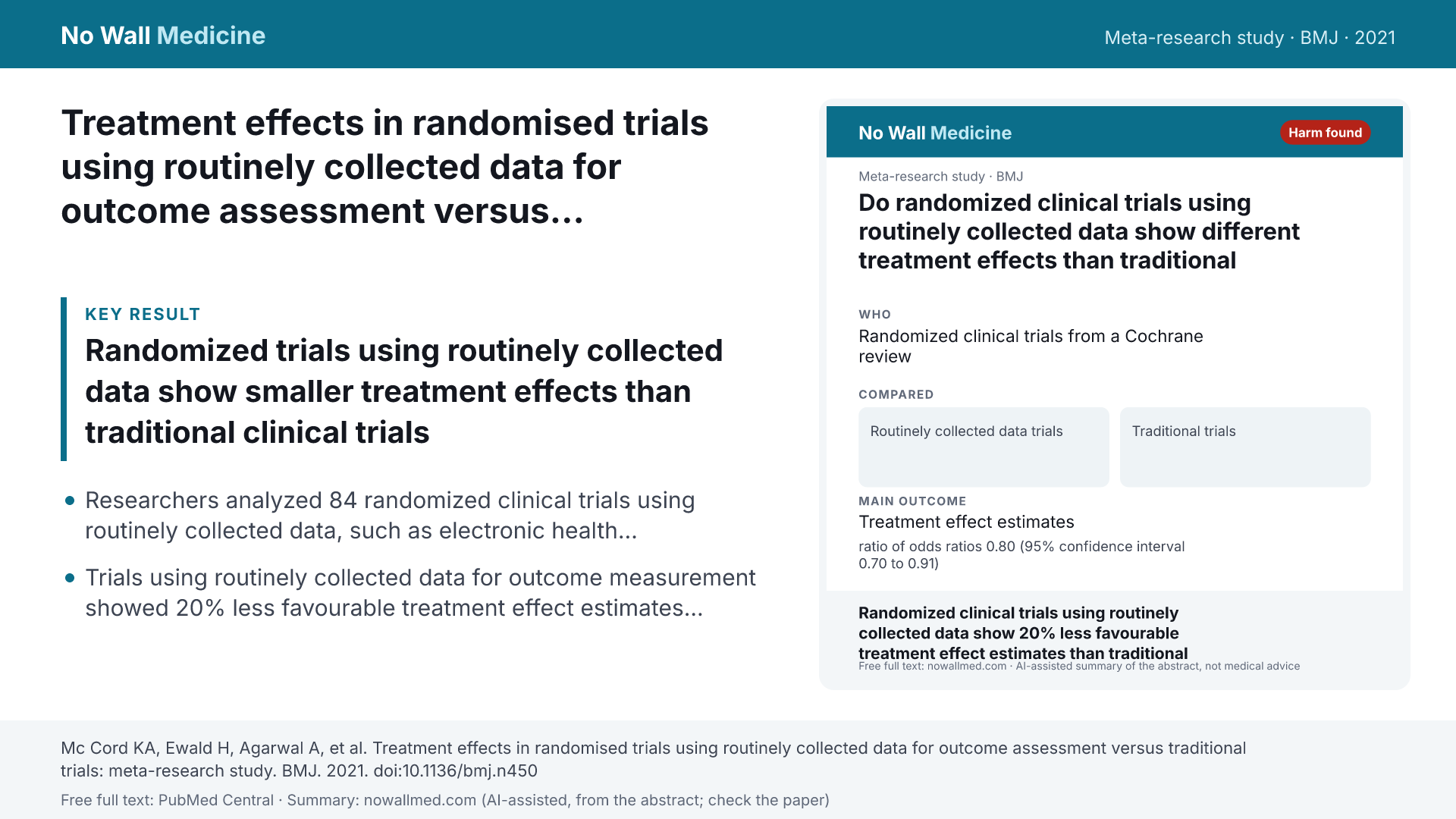
Treatment effects in randomised trials using routinely collected data for outcome assessment versus traditional trials: meta-research study
Meta-research studyHarm found
Do randomized clinical trials using routinely collected data show different treatment effects than traditional trials?
Who
Randomized clinical trials from a Cochrane review
Compared
Routinely collected data trials
Traditional trials
Main outcome
Treatment effect estimates
Result: ratio of odds ratios 0.80 (95% confidence interval 0.70 to 0.91)
Bottom line: Randomized clinical trials using routinely collected data show 20% less favourable treatment effect estimates than traditional trials.
BMJ · 2021-03-03Download image
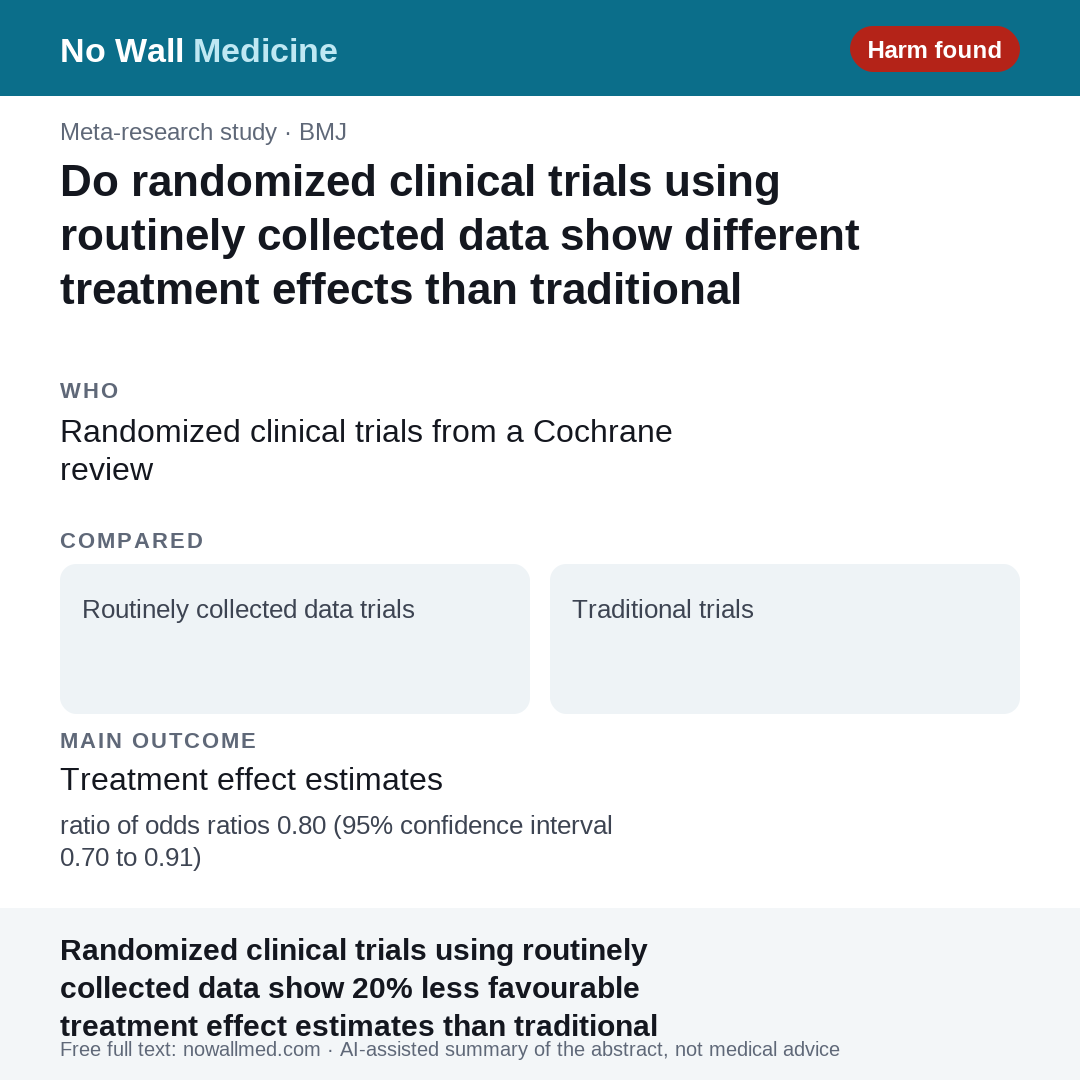
Clinical question: Do randomized clinical trials using routinely collected data show different treatment effects than traditional trials?
Key points
- Researchers analyzed 84 randomized clinical trials using routinely collected data, such as electronic health records, and 463 traditional trials across 22 clinical questions.
- Trials using routinely collected data for outcome measurement showed 20% less favourable treatment effect estimates compared to traditional trials (ratio of odds ratios 0.80, 95% confidence interval 0.70 to 0.91).
- The difference in treatment effect estimates was observed across mortality outcomes, non-mortality outcomes, registries, and electronic health records.
Headline and key points written with AI from the paper’s abstract, with every number checked against it. Read the paper before relying on them.
Was this summary helpful?
Abstract
Objective
To compare effect estimates of randomised clinical trials that use routinely collected data (RCD-RCT) for outcome ascertainment with traditional trials not using routinely collected data. Design
Meta-research study. Data source
Studies included in the same meta-analysis in a Cochrane review. Eligibility criteria for study selection
Randomised clinical trials using any type of routinely collected data for outcome ascertainment, including from registries, electronic health records, and administrative databases, that were included in a meta-analysis of a Cochrane review on any clinical question and any health outcome together with traditional trials not using routinely collected data for outcome measurement. Review methods
Effect estimates from trials using or not using routinely collected data were summarised in random effects meta-analyses. Agreement of (summary) treatment effect estimates from trials using routinely collected data and those not using such data was expressed as the ratio of odds ratios. Subgroup analyses explored effects in trials based on different types of routinely collected data. Two investigators independently assessed the quality of each data source. Results
84 RCD-RCTs and 463 traditional trials on 22 clinical questions were included. Trials using routinely collected data for outcome ascertainment showed 20% less favourable treatment effect estimates than traditional trials (ratio of odds ratios 0.80, 95% confidence interval 0.70 to 0.91, I2=14%). Results were similar across various types of outcomes (mortality outcomes: 0.92, 0.74 to 1.15, I2=12%; non-mortality outcomes: 0.71, 0.60 to 0.84, I2=8%), data sources (electronic health records: 0.81, 0.59 to 1.11, I2=28%; registries: 0.86, 0.75 to 0.99, I2=20%; administrative data: 0.84, 0.72 to 0.99, I2=0%), and data quality (high data quality: 0.82, 0.72 to 0.93, I2=0%). Conclusions
Randomised clinical trials using routinely collected data for outcome ascertainment show smaller treatment benefits than traditional trials not using routinely collected data. These differences could have implications for healthcare decision making and the application of real world evidence.
Abstract reproduced under the article’s CC BY NC licence.
Subject terms
Cite this article
Mc Cord KA, Ewald H, Agarwal A, et al. Treatment effects in randomised trials using routinely collected data for outcome assessment versus traditional trials: meta-research study. BMJ. 2021. doi:10.1136/bmj.n450
Spotted a mistake? Suggest a correction