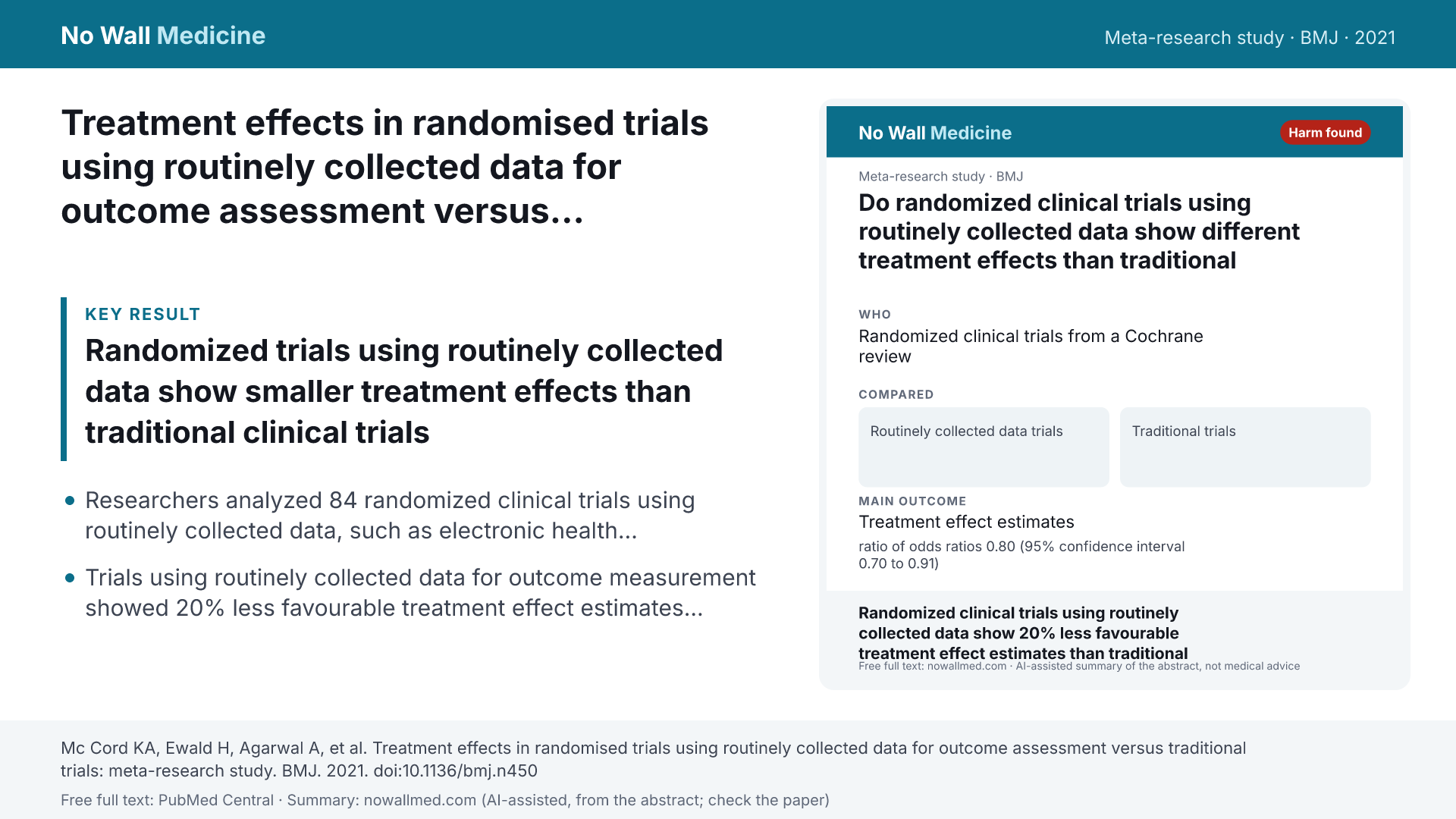
Treatment effects in randomised trials using routinely collected data for outcome assessment versus traditional trials: meta-research study
Key result: Randomized trials using routinely collected data show smaller treatment effects than traditional clinical trials
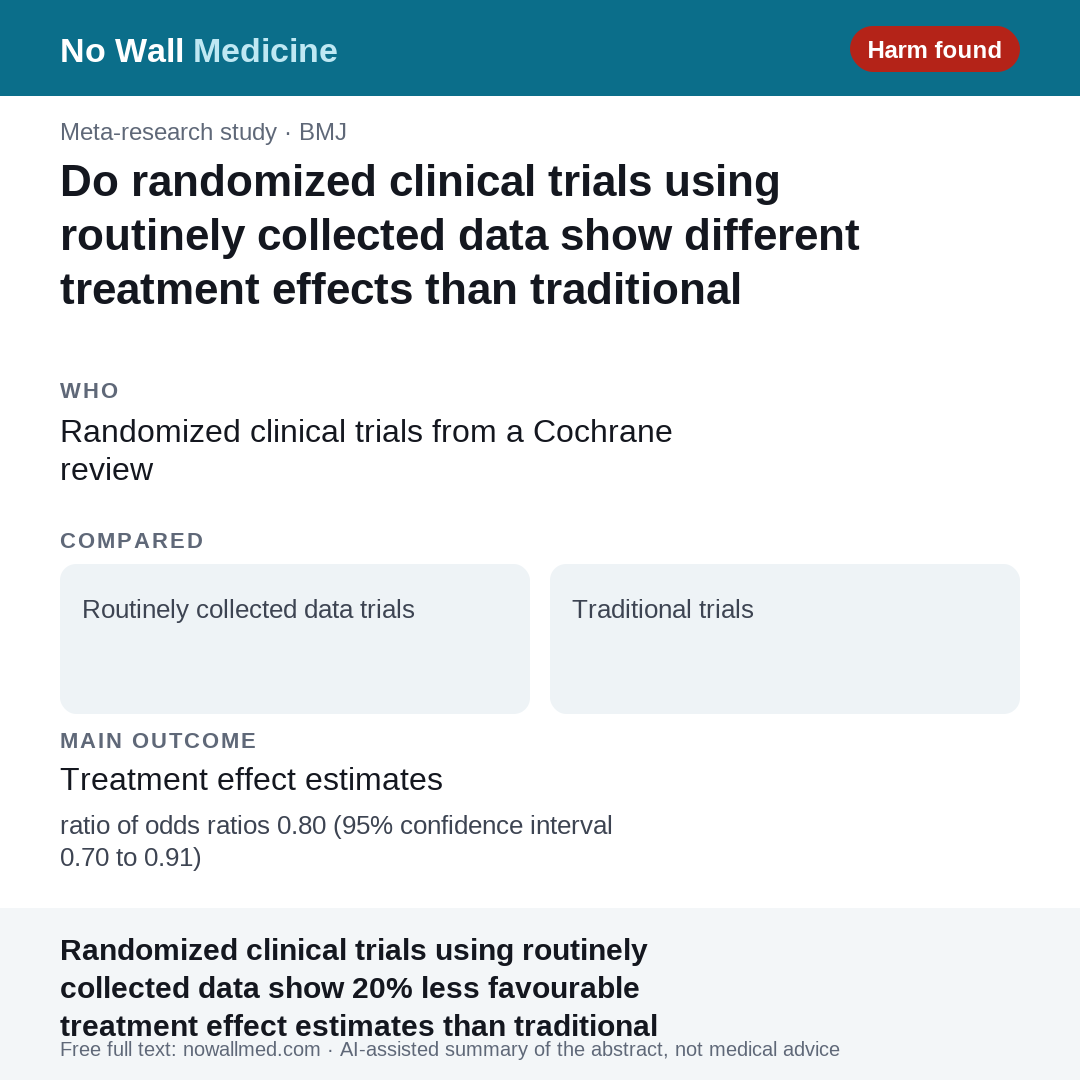
Meta-research studyHarm found
Do randomized clinical trials using routinely collected data show different treatment effects than traditional trials?
Who
Randomized clinical trials from a Cochrane review
Compared
Routinely collected data trials
Traditional trials
Main outcome
Treatment effect estimates
Result: ratio of odds ratios 0.80 (95% confidence interval 0.70 to 0.91)
Bottom line: Randomized clinical trials using routinely collected data show 20% less favourable treatment effect estimates than traditional trials.
BMJ · 2021-03-03Download image
Key points
- Researchers analyzed 84 randomized clinical trials using routinely collected data, such as electronic health records, and 463 traditional trials across 22 clinical questions.
- Trials using routinely collected data for outcome measurement showed 20% less favourable treatment effect estimates compared to traditional trials (ratio of odds ratios 0.80, 95% confidence interval 0.70 to 0.91).
- The difference in treatment effect estimates was observed across mortality outcomes, non-mortality outcomes, registries, and electronic health records.
Discussion prompts
- Would these patients look like yours? Who was left out?
- Is the main outcome one that matters to patients?
- Is the difference large enough to change what you do?
Cite: Mc Cord KA, Ewald H, Agarwal A, et al. Treatment effects in randomised trials using routinely collected data for outcome assessment versus traditional trials: meta-research study. BMJ. 2021. doi:10.1136/bmj.n450
Free full text: PubMed Central · Summary and visual abstract: nowallmed.com/a/treatment-effects-in-randomised-trials-using-routinely-collected-data-1ewvwlw/ (AI-assisted from the abstract; check the paper before relying on it).