Stereotactic radiation improved symptom severity and daily functioning compared to whole brain radiation
Treatment for Brain Metastases With Stereotactic Radiation vs Hippocampal-Avoidance Whole Brain Radiation: A Randomized Clinical Trial
Phase 3, open-label, randomized clinical trialBenefit found
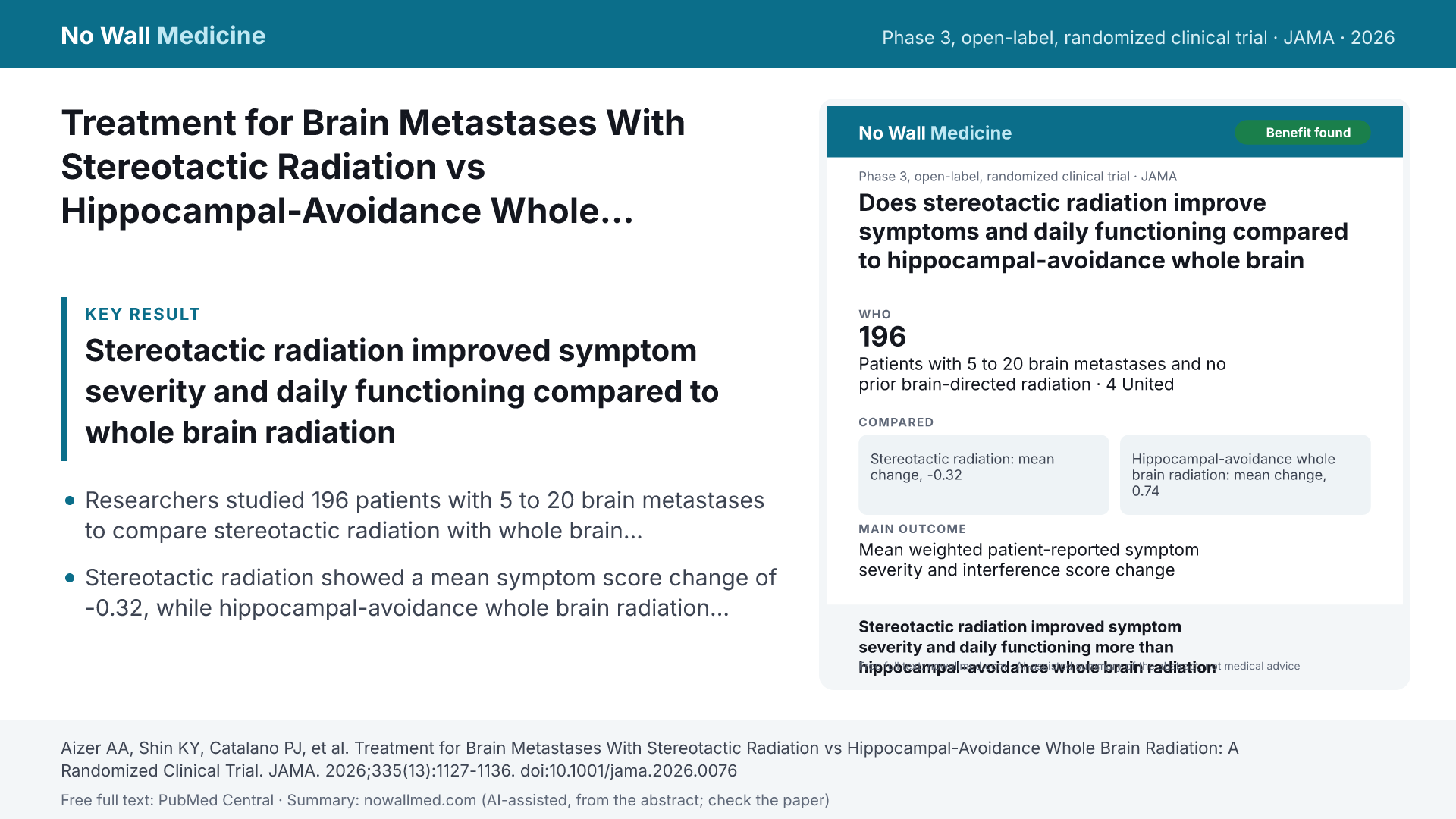
Does stereotactic radiation improve symptoms and daily functioning compared to hippocampal-avoidance whole brain radiation?
Who
196
Patients with 5 to 20 brain metastases and no prior brain-directed radiation · 4 United States-based centers
Compared
Stereotactic radiation: mean change, -0.32
Hippocampal-avoidance whole brain radiation: mean change, 0.74
Main outcome
Mean weighted patient-reported symptom severity and interference score change
Result: mean difference, -1.06 (95% CI, -1.54 to -0.58)
Bottom line: Stereotactic radiation improved symptom severity and daily functioning more than hippocampal-avoidance whole brain radiation in patients with multiple brain metastases.
JAMA · 2026-02-19Download image

Clinical question: Does stereotactic radiation improve symptoms and daily functioning compared to hippocampal-avoidance whole brain radiation?
Why it matters: The effects of stereotactic radiation targeting individual tumors versus whole brain radiation for patients with more than 4 brain metastases remain unknown.
Key points
- Researchers studied 196 patients with 5 to 20 brain metastases to compare stereotactic radiation with whole brain radiation that avoids the hippocampus.
- Stereotactic radiation showed a mean symptom score change of -0.32, while hippocampal-avoidance whole brain radiation showed a mean change of 0.74.
- Severe adverse events occurred in 12% of the stereotactic radiation group and 13% of the hippocampal-avoidance whole brain radiation group.
Headline and key points written with AI from the paper’s abstract, with every number checked against it. Read the paper before relying on them.
Was this summary helpful?
Subject terms
Cite this article
Aizer AA, Shin KY, Catalano PJ, et al. Treatment for Brain Metastases With Stereotactic Radiation vs Hippocampal-Avoidance Whole Brain Radiation: A Randomized Clinical Trial. JAMA. 2026. doi:10.1001/jama.2026.0076
Spotted a mistake? Suggest a correction