Avoiding the hippocampus during brain radiation showed similar relapse rates and lower cognitive toxicity
Hippocampal Avoidance During Prophylactic Cranial Irradiation for Patients With Small Cell Lung Cancer: Randomized Phase II/III Trial NRG-CC003
Randomized phase II/III trialBenefit found
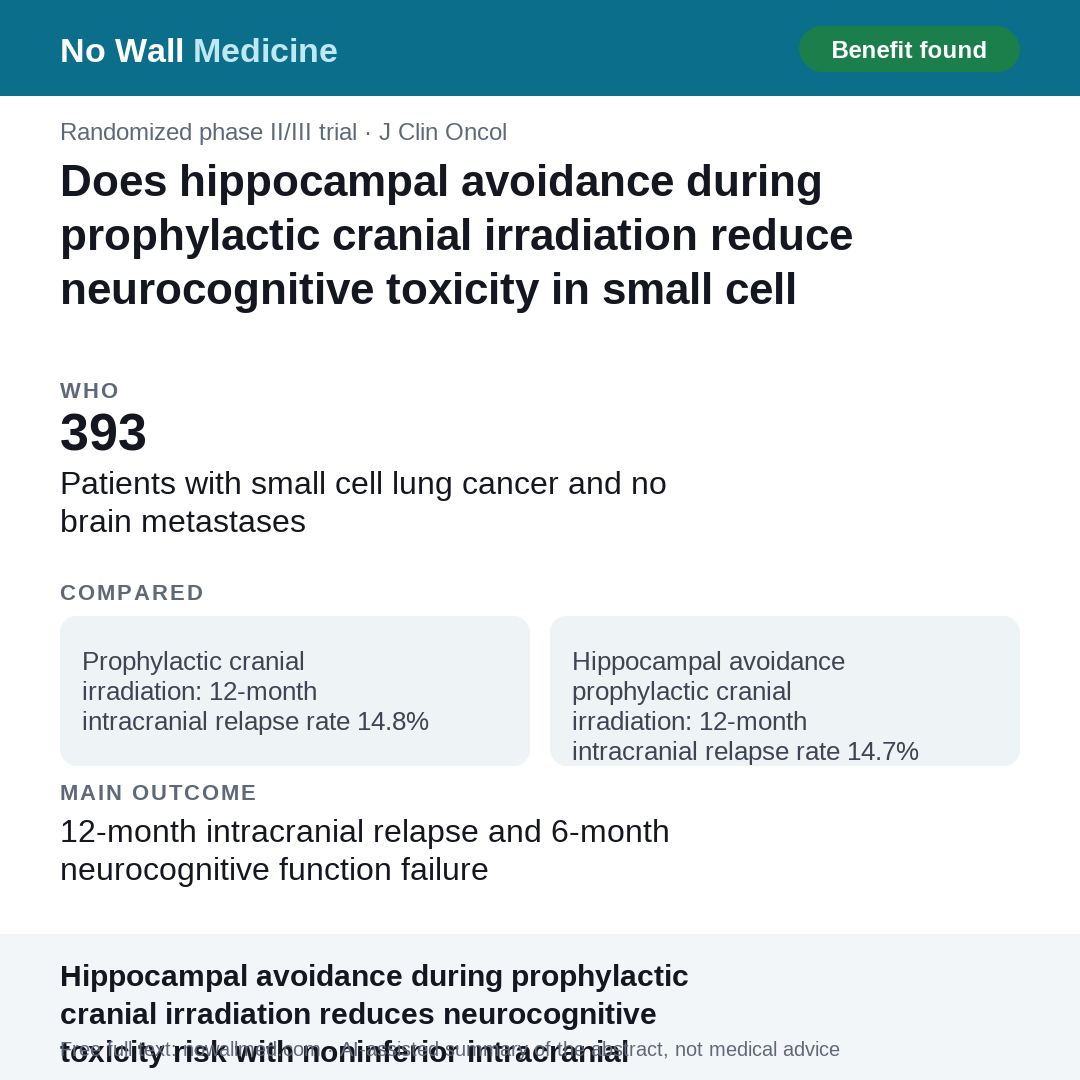
Does hippocampal avoidance during prophylactic cranial irradiation reduce neurocognitive toxicity in small cell lung cancer?
Who
393
Patients with small cell lung cancer and no brain metastases
Compared
Prophylactic cranial irradiation: 12-month intracranial relapse rate 14.8%
Hippocampal avoidance prophylactic cranial irradiation: 12-month intracranial relapse rate 14.7%
Main outcome
12-month intracranial relapse and 6-month neurocognitive function failure
Result: adjusted hazard ratio 0.78 (95% CI 0.61 to 0.99)
Bottom line: Hippocampal avoidance during prophylactic cranial irradiation reduces neurocognitive toxicity risk with noninferior intracranial relapse and similar survival.
J Clin Oncol · 2025-08-11Download image
Clinical question: Does hippocampal avoidance during prophylactic cranial irradiation reduce neurocognitive toxicity in small cell lung cancer?
Why it matters: It is unclear if avoiding the hippocampus during preventive brain radiation maintains cancer control while reducing damage to memory and thinking skills.
Key points
- Researchers studied 393 patients with small cell lung cancer who received either standard whole-brain radiation or radiation that avoids the hippocampus, the brain area responsible for memory.
- The 12-month intracranial relapse rate was noninferior at 14.8% for standard radiation compared to 14.7% for hippocampal avoidance.
- Hippocampal avoidance was associated with a reduced risk of failure in any neurocognitive function test, though it did not significantly change memory test scores.
Headline and key points written with AI from the paper’s abstract, with every number checked against it. Read the paper before relying on them.
Topics
Cite this article
Gondi V, Pugh SL, Mehta MP, Wefel JS, Tomé WA, Sun AY. Hippocampal Avoidance During Prophylactic Cranial Irradiation for Patients With Small Cell Lung Cancer: Randomized Phase II/III Trial NRG-CC003. J Clin Oncol. 2025. doi:10.1200/JCO-25-00221
Spotted a mistake? Suggest a correction