Mild hypertension treatment during pregnancy lowers complication risk
Treatment for Mild Chronic Hypertension during Pregnancy
Why it matters: Treating mild chronic hypertension in pregnancy to below 140/90 mm Hg led to better pregnancy outcomes without increasing the risk of small-for-gestational-age babies.
Context written by the No Wall Medicine team.
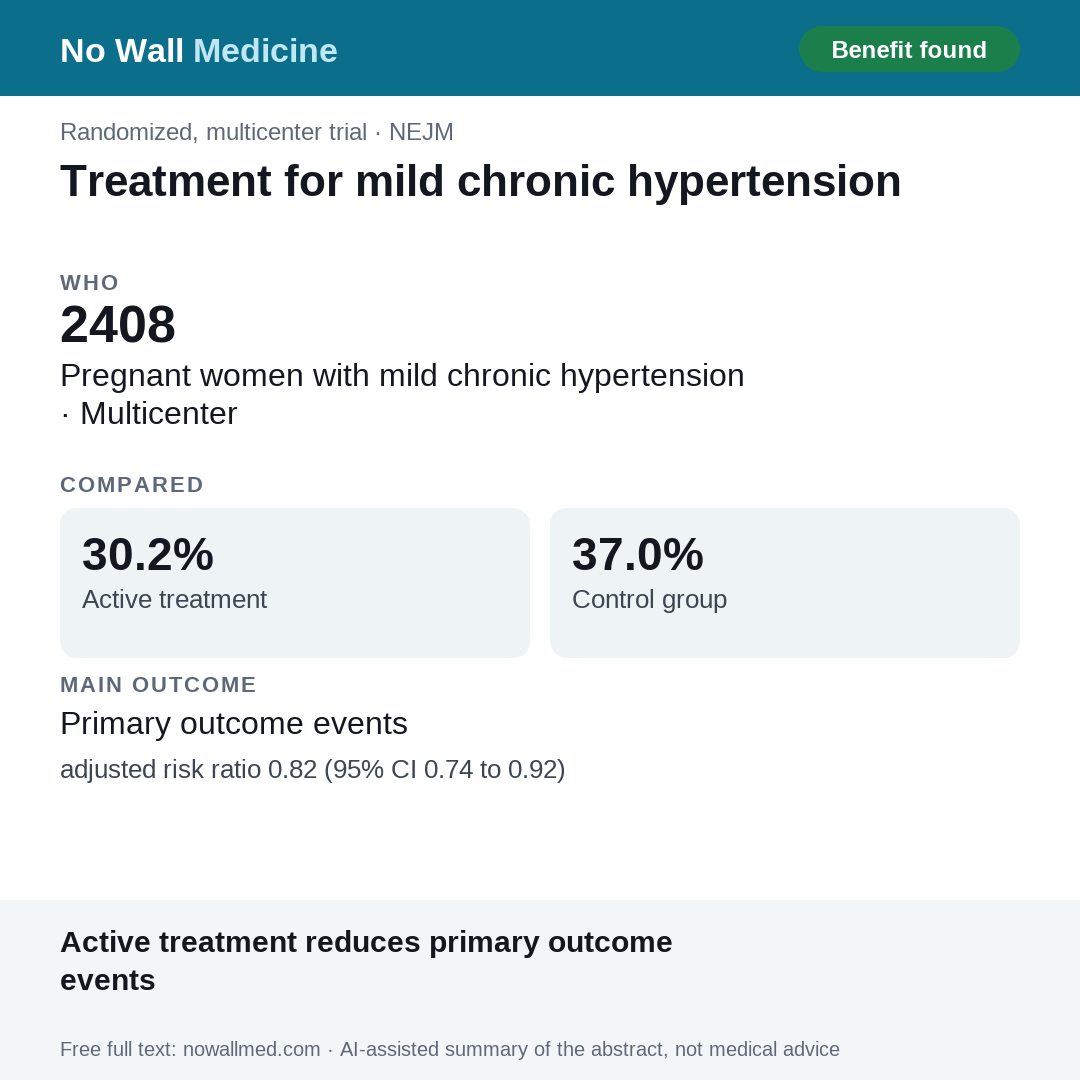
Randomized, multicenter trialBenefit found
Treatment for mild chronic hypertension
Who
2408
Pregnant women with mild chronic hypertension · Multicenter
Compared
30.2%Active treatment
37.0%Control group
Main outcome
Primary outcome events
Result: adjusted risk ratio 0.82 (95% CI 0.74 to 0.92)
Bottom line: Active treatment reduces primary outcome events
Funded by: National Heart, Lung, and Blood Institute
NEJM · 2022-04-02Download image
Trial at a glance
Bottom line: Active treatment reduced primary outcome events from 37.0% to 30.2%
Clinical question
Does treating mild chronic hypertension during pregnancy improve outcomes?
Design
Multicenter, open-label, randomized, controlled trial. United States, more than 70 sites, 2015-2021
Who was studied
2408 pregnant women with mild chronic hypertension
Key inclusion criteria
- Mild chronic hypertension
- Singleton fetuses
- Gestational age < 23 weeks
Key exclusion criteria
- Systolic blood pressure < 140 mm Hg
- Diastolic blood pressure < 90 mm Hg
- Advanced gestational age
Interventions
- Active-treatment group: Antihypertensive medications to target blood pressure < 140/90 mm Hg
- Control group: No treatment unless severe hypertension developed
Primary outcome
Composite of preeclampsia with severe features, medically indicated preterm birth, placental abruption, or fetal or neonatal death. 30.2% vs. 37.0%, adjusted risk ratio 0.82 (95% CI, 0.74 to 0.92; P<0.001)
Secondary outcomes
- Small-for-gestational-age birth weight: 11.2% vs. 10.4%, adjusted risk ratio 1.04 (95% CI, 0.82 to 1.31; P = 0.76)
- Serious maternal complications: 2.1% vs. 2.8%, risk ratio 0.75 (95% CI, 0.45 to 1.26)
- Severe neonatal complications: 2.0% vs. 2.6%, risk ratio 0.77 (95% CI, 0.45 to 1.30)
Harms
No increase in risk of small-for-gestational-age birth weight
Limitations reported by the authors
- Open-label approach
Funding
National Heart, Lung, and Blood Institute
Written with AI from the full paper; every number was checked against it. Read the paper before relying on it.
In absolute numbers
Active treatment: 30.2% · Control group: 37% → a difference of 6.8 percentage points, so about 15 people would need the treatment for 1 more to benefit (number needed to treat) over the trial’s follow-up.
Worked out by us from the two group results above, not reported by the authors. Check the paper for the exact outcome and timing.
Key points
- 2408 pregnant women with mild chronic hypertension were studied in a randomized trial.
- 30.2% of treated women had a primary outcome event, versus 37.0% of untreated women.
- Treatment had no increase in risk of small-for-gestational-age birth weight.
Limitation the authors note: The trial had an open-label design
Headline and key points written with AI from the paper’s abstract, with every number checked against it. Read the paper before relying on them.
Topics
Spotted a mistake? Suggest a correction