Treatment of patients with spinal cavernous malformations: a systematic review
Key result: Systematic review analyzes surgical and conservative treatment outcomes for spinal cavernous malformations

Key points
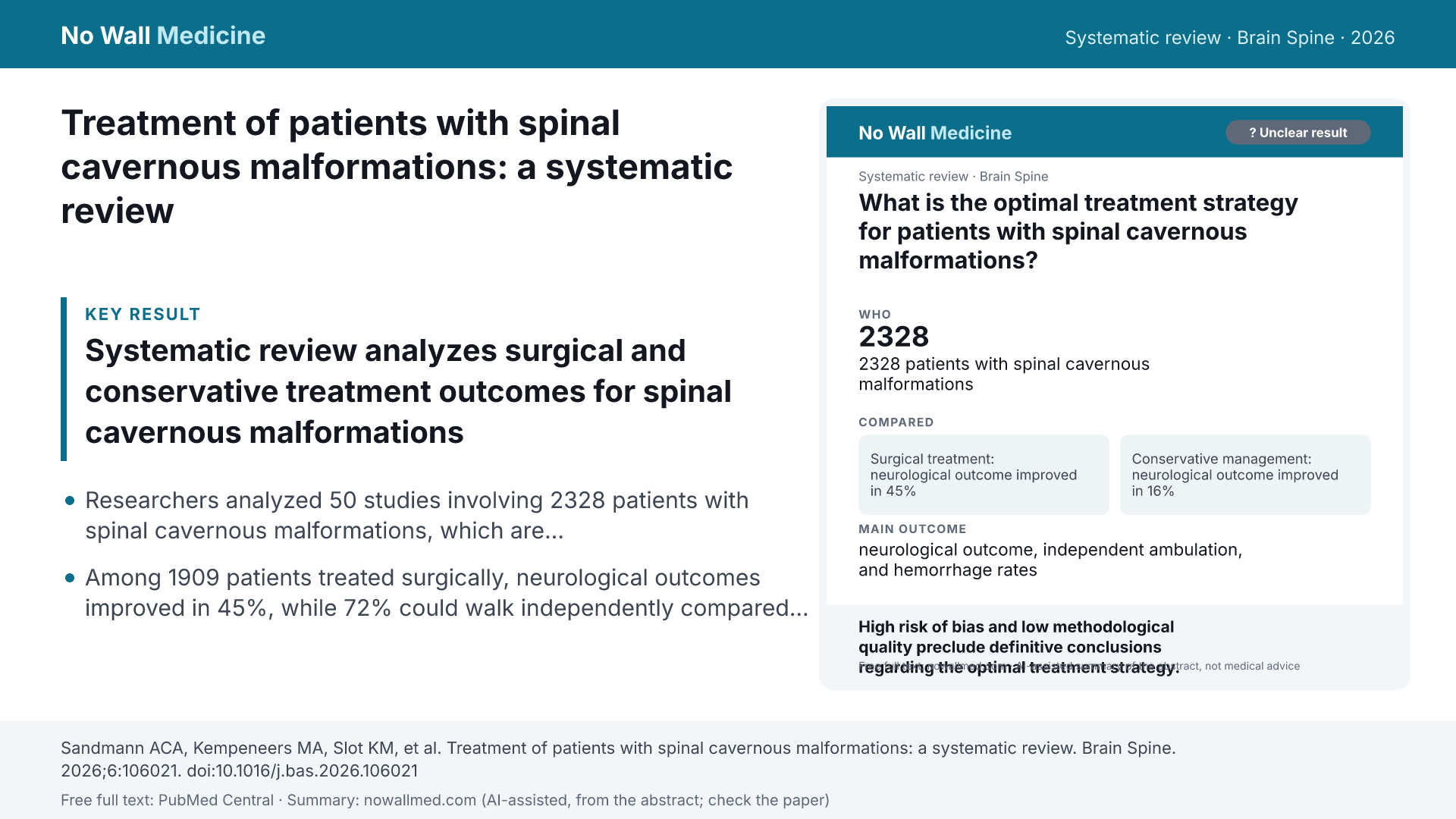
- Researchers analyzed 50 studies involving 2328 patients with spinal cavernous malformations, which are vascular malformations located within the spinal cord.
- Among 1909 patients treated surgically, neurological outcomes improved in 45%, while 72% could walk independently compared to 60% before surgery.
- Among 419 patients managed conservatively, neurological outcomes improved in 16%, and 76% could walk independently compared to 79% at baseline.
Why it matters: Clinicians lack a clear consensus on the optimal treatment strategy between surgery and conservative management for spinal cavernous malformations.
Limitation the authors note: The majority of included studies were retrospective, single-center, and had a serious risk of bias.
Discussion prompts
- Would these patients look like yours? Who was left out?
- Is the main outcome one that matters to patients?
- Is the difference large enough to change what you do?
Cite: Sandmann ACA, Kempeneers MA, Slot KM, et al. Treatment of patients with spinal cavernous malformations: a systematic review. Brain Spine. 2026;6:106021. doi:10.1016/j.bas.2026.106021
Free full text: PubMed Central · Summary and visual abstract: nowallmed.com/a/treatment-of-patients-with-spinal-cavernous-malformations-a-3rvz2x/ (AI-assisted from the abstract; check the paper before relying on it).